AI Policy After the Mythos Moment: Regulation, Open-Weight Models, and the Courts
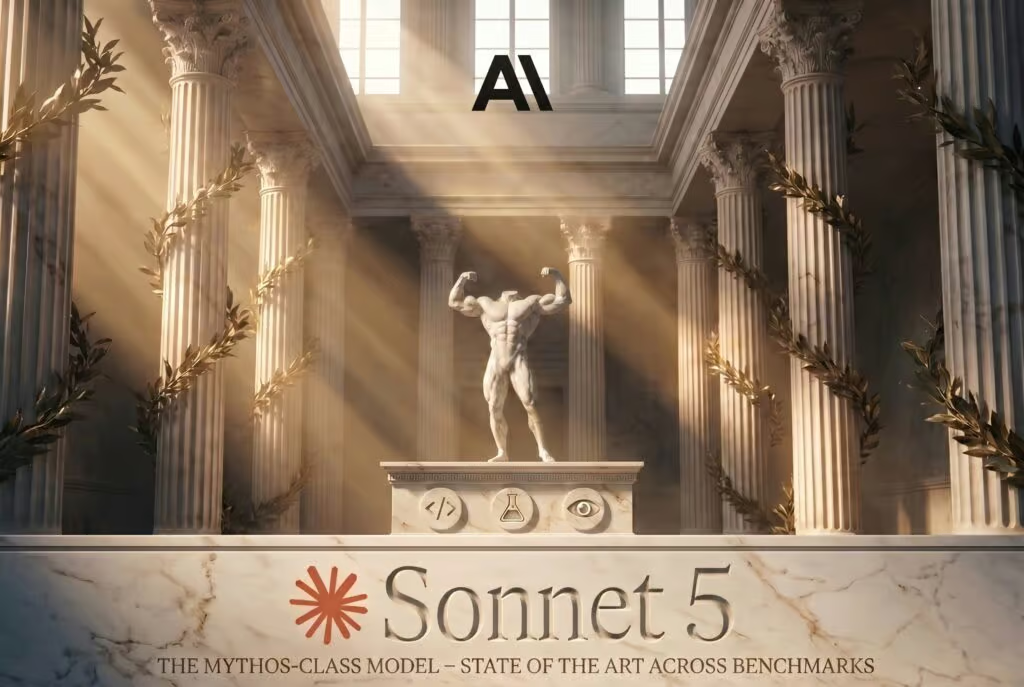
The Mythos moment is still unfolding. Anthropic released Claude Sonnet 5, positioned as a cheaper and faster counterpart to Opus 4.8 rather than a leap forward. With the AI community waiting for Claude Fable 5 and GPT-5.6-Sol, attention has shifted to the policy fights shaping what comes next: a growing US-China regulation gap, worker organizing power at DeepMind, the AI Incident Reporting Act, open-weight model safety, and a fast-moving judiciary reshaping the terrain.
How do US and China frontier AI regulations compare?
Daniel Eth pointed out that the US places more restrictions on its frontier AI than China does on Chinese frontier models. The comparison is not as flattering as it sounds. China imposes more restrictions on its models than the US did when American capabilities sat at a similar level. Regulation scales with capability. If a US lab is producing Chinese-tier results, it can largely do as it pleases. The new US restrictions are not necessarily good, but the framing matters.
What does the DeepMind-Pentagon contract reveal about worker leverage?
Andreas Kirsch argues that Google DeepMind and Demis Hassabis built their safety posture on culture and trust rather than formal governance, and that this approach failed when tested. DeepMind signed a Pentagon contract with enough wiggle room that the Pentagon holds the upper hand regardless of employee objections. Six hundred DeepMind staff signed a letter opposing the terms, but a letter is not real power. The only tools that would have mattered, collective resignation or a strike, were not deployed. This is the structural gap that Unite recognition at DeepMind is meant to close, giving workers a mechanism to act when their employer will not.
What does the AI Incident Reporting Act do?
Charlie Bullock highlighted the AI Incident Reporting Act, introduced by Representative Nate Moran (R-TX). Bullock credits the bill with handling preemption cleanly and using a capabilities-based threshold for covered models, which is technically demanding but sound in principle.
Why does the ‘good guy with an AI’ framing fall short?
The ‘good guy with a gun’ framing does not transfer cleanly to AI, despite its growing popularity. As Sophia Cai and Ben Johansen reported in Politico, the argument runs that the best way to stop a bad actor with a dangerous model is to ensure good actors have the same model. The trouble is that identical access between adversaries and defenders is not a good scenario. It is preferable to a bad actor holding a superior model, but the policy goal is defender advantage from the start. If both sides begin with equal tools, adversaries can inflict damage before defenders finish patching.
The offense has historically faced a talent deficit, since most people do not want to become attackers. AI inverts this by lowering the skill needed to launch attacks and enabling many attacks to be directed at a target at once. Open-weight models can provide parity at best. Some argue that, in the limit, offense-defense balance favors defense and that better tools will yield better security. Reaching that defensive equilibrium requires deliberate work and advantages granted to defenders, not a free outcome.
Why is the judiciary becoming a key AI regulator?
Executive action and congressional gridlock have defined AI policy so far. The judiciary is a third path, and it is fast. Dean W. Ball argues that the most consequential AI legal questions now center on the First Amendment: whether the creation, distribution, and use of frontier AI counts as protected expression, who has standing to challenge restrictions, and how courts should treat language models as expressive tools.
The position that First Amendment protections will prevent meaningful AI regulation overstates the obstacle the amendment poses. Regulation has generally focused on entities, such as frontier AI developers, more than on the models themselves. The First Amendment will impose real limits on state intervention, including limits that could take effect in specific scenarios where detailed alignment regulation would otherwise be desirable. If courts stop those controls, AI will be the only actor with meaningful sovereignty.
There is also a descriptive reality: many existing practices in non-AI contexts are plainly unconstitutional by the text of the law, from First Amendment violations to creative invocations of the interstate commerce clause. Courts have not enforced the full text, and that gap has held for decades. If the judiciary issues rulings in the AI space that are sufficiently unworkable, those rulings will be worked around, narrowed, or functionally ignored.
Does the ‘code is speech’ argument apply to AI models?
The ‘code is speech’ argument has resurfaced, with some extending it to claim that AI models themselves merit First Amendment protection. Preston Byrne argues that an LLM user is simultaneously speaker and listener, that the context window is entirely user-generated, and that regulating how people use LLMs is regulating expressive conduct. The argument has surface appeal but overreaches. Many regulated activities qualify as speech. Treating AI models as a fully protected speech category, with all the implications that follow, would reshape the regulatory landscape far beyond what most advocates intend. The likely government response to such a ruling would be to restrict training of sufficiently advanced models rather than to accept a world where deployed models are uncontrollable.
What does Slaughter v. Trump mean for AI regulation?
The 6-3 ruling in Trump v. Slaughter, which overruled Humphrey’s Executor, was not unexpected but its scope is consequential. The President can now fire, at any time, for any reason, anyone involved in executive functions except officials at the Federal Reserve, shielded by historical tradition. The practical effect for AI: creating a federal body that can independently evaluate frontier models, impose binding consequences, and remain free from political pressure has become much harder. Ben Rossen noted that any Frontier AI Commission authorized to license training runs, compel evaluations, restrict deployments, order pauses, or impose penalties would have its leaders removable at will. The Court’s reasoning treated substantive rulemaking, investigations, enforcement, civil litigation, and in-house adjudication as executive power requiring at-will removal.
There is a principled case for stripping away the fiction of nonpartisan agencies such as the FTC and SEC and acknowledging them as partisan. There is also a strong case that even the fiction matters, because open partisan use of regulatory tools inflicts more damage than covert partisan use. A spoils system for financial and speech regulation would erode the legitimacy of government institutions that already operate on thin trust margins.
Are open-weight models inherently unsafe?
Calling open-weight models inherently unsafe and saying no design or deployment practice can reduce the risk is a strong position. It is also a position that, if accepted as the basis for policy, would imply broad restrictions on who can publish model weights and under what conditions. Whether that implication is desirable depends on judgments about the offense-defense balance, the value of broad access for safety research and defensive applications, and the feasibility of controls on already-distributed weights.
FAQ
What is the Mythos moment in AI?
The Mythos moment refers to the period following Anthropic’s release of Claude Sonnet 5, a cheaper and faster counterpart to Opus 4.8 rather than a leap forward, while the AI community waits for Claude Fable 5 and GPT-5.6-Sol. Attention has shifted to the policy fights shaping what comes next.
Why is the judiciary becoming central to AI regulation?
Executive action and congressional gridlock have defined AI policy so far. With the judiciary moving quickly, the most consequential AI legal questions now center on the First Amendment, including whether frontier AI creation, distribution, and use counts as protected expression, who has standing to challenge restrictions, and how courts should treat language models as expressive tools.
How does Slaughter v. Trump affect AI oversight?
The 6-3 ruling in Trump v. Slaughter overruled Humphrey’s Executor and allows the President to fire, at any time and for any reason, anyone involved in executive functions except officials at the Federal Reserve. Any Frontier AI Commission authorized to license training runs, compel evaluations, restrict deployments, order pauses, or impose penalties would have its leaders removable at will, making independent AI oversight much harder to establish.