AI Search Liability Ruling: What It Means
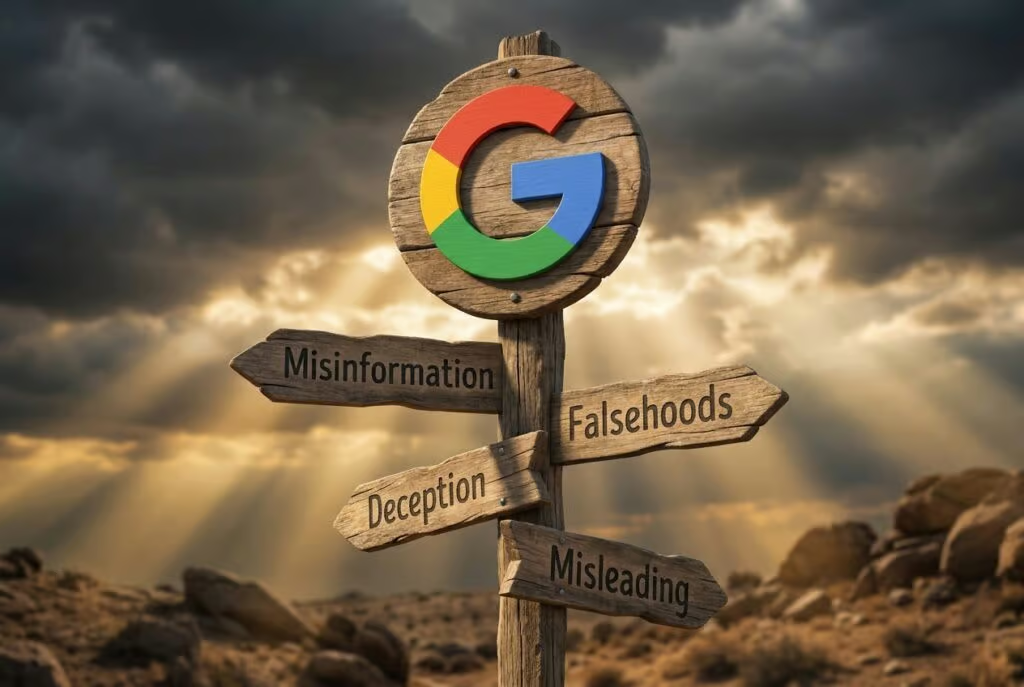
A German court has ruled that Google’s AI Overviews go beyond mirroring the web to create independent statements that can defame, and the company can be held directly liable for false claims. The preliminary injunction from the Regional Court of Hamburg is the first decision to classify an AI search summary as the platform’s own commercial speech, not a neutral container for third-party content. The ruling rewrites the risk calculus for any organization whose reputation can be described, accurately or not, by an AI system.
Why It Matters
AI-generated search summaries now appear across a huge share of Google queries, and similar AI summarization features are spreading into other products. The German court’s logic, that AI outputs are the platform’s own speech and come with full liability, does not stop at search. Any AI feature that builds a new sentence about a brand, person, or event could create the same kind of exposure. When a platform’s AI invents a claim that mischaracterizes a product or links a company to a scam, the harmed party may no longer be chasing an original source. The platform itself may be the one to hold accountable.
What Changed: The Legal Shift on AI Speech
Google argued that users understand AI Overviews can be inaccurate and should verify results themselves. The Hamburg court was not persuaded. In its order barring further publication of the false statements, the court drew a sharp line: an AI overview that produces “independent, new, and substantive statements” based on its own misinterpretation of links is fundamentally different from a traditional list of search results. The judge noted that the false claims did not appear in any of the actual web pages the AI had summarized, meaning the AI invented the smear entirely on its own.
Most importantly, the court rejected the claim that AI summaries are an essential part of search. The ruling described the feature as “an additional function, one without which the use of the search engine would still be (and is) possible, and without which users are perfectly capable of finding results amidst the ‘flood of data.'” Because the tool is a convenience layered on top of a working search engine, the platform cannot claim immunity simply because curating information is hard.
The court also dismissed the “don’t blindly trust us” defense, pointing out that the AI overview’s usefulness “would be significantly diminished if the ‘AI overview’ were generally regarded as unreliable and if every single displayed link required independent verification.” In other words, if Google sells the feature as trustworthy, it cannot simultaneously argue that nobody should trust it.
The Ruling’s Key Takeaways
- AI summaries are the platform’s own statements. The court labeled them “primarily an expression of the defendant’s commercial activity”, not protected speech.
- Liability follows the creator. Because only Google can change the algorithm that produced a false statement, only Google can be sued when that statement causes harm.
- AI search is not essential, since users navigated the web without it for decades.
- Disclaimers are not a shield. If the business model relies on users trusting the AI output, a disclaimer that says “results may be wrong” does not erase legal responsibility.
“an additional function, one without which the use of the search engine would still be (and is) possible, and without which users are perfectly capable of finding results amidst the ‘flood of data.'”
, Preliminary ruling, Regional Court of Hamburg (June 2026)
If an AI tool creates a statement that damages a brand, the platform, not the source website, may now be legally responsible.
What Comes Next
Google has said it is “carefully reviewing this decision, which is not yet final,” and an appeal is widely expected. Even if the Hamburg ruling gets overturned, the precedent will ripple across jurisdictions. Other EU courts, already operating under the strict liability framework of the AI Act, may adopt the same reasoning. The legal exposure extends to any AI feature that publishes text, auto-generated summaries, descriptions, and AI-suggested replies. A platform that auto-generates a false product description or summarizes a review incorrectly could find itself facing the same defamation claims. Expect companies to tighten their internal review loops and, in some cases, pull back on fully automated AI text features until the liability landscape clarifies.
What This Means for You
For anyone publishing with the help of AI, the ruling turns accuracy from a recommended practice into a legal requirement.
- Keep a human in the loop. Every piece of AI-generated or AI-suggested copy should get a human review before it goes live. Tools that combine AI drafting with a clear approval step give you that safety net.
- Monitor how AI describes you. Track how AI assistants and search summaries characterize your business. If a platform invents a negative claim, speed matters: document it, notify the platform, and consult legal counsel.
- Choose tools that respect your controls. Favor systems where AI assists but the final call on what gets published stays with a person, not an autonomous model.
The aim is not to abandon AI. It is to use it in a way that does not hand a brand’s reputation to an opaque model that no one can hold accountable.
The Bigger Picture
A court recently ruled against a major search engine, holding that AI-generated speech counts as real speech and can carry real consequences. When a platform’s AI writes about a brand, the platform is publishing, and platforms can be held accountable for what is published. Because trust is scarce, slowing down just enough to make sure the AI is not speaking for you before you read the script is the smartest move.
FAQ
What did the German court rule about Google AI Overviews?
The Regional Court of Hamburg issued a preliminary injunction holding Google liable for false statements its AI Overviews generated. The court found that AI Overviews create independent, new claims, not just list third-party links, and that Google cannot shield itself behind disclaimers when the tool’s value depends on user trust. Because the feature is an add-on, not essential to search, the judge ruled Google can be sued for defamation when the AI invents harmful claims.
Why did the court reject Google’s disclaimer defense?
The court reasoned that the AI overview’s usefulness would be significantly diminished if it were generally regarded as unreliable and if every displayed link required independent verification. A platform cannot market a feature as trustworthy and simultaneously argue that no one should rely on it. If the business model depends on users trusting the AI output, a disclaimer saying “results may be wrong” does not erase legal responsibility.
Can other AI-generated content face similar liability?
Potentially, yes. The Hamburg court’s reasoning, that AI-generated text is the platform’s own commercial speech, applies to any context where a platform’s AI creates substantive statements. If an AI feature auto-generates a product description that misrepresents a brand, or summarizes a review inaccurately, the same legal logic could be used to argue the platform is responsible. Google has said it is reviewing the decision and may appeal, and companies are watching closely as they tighten review of fully automated AI text features.
Related coverage
- Google’s Generative AI Search Guide Signals What Content Will Survive
- How Consumers Search for Local Businesses in 2026: Mobile, Google, and the Role of AI