AI Content vs. Human Content: Which One Actually Ranks in 2026?
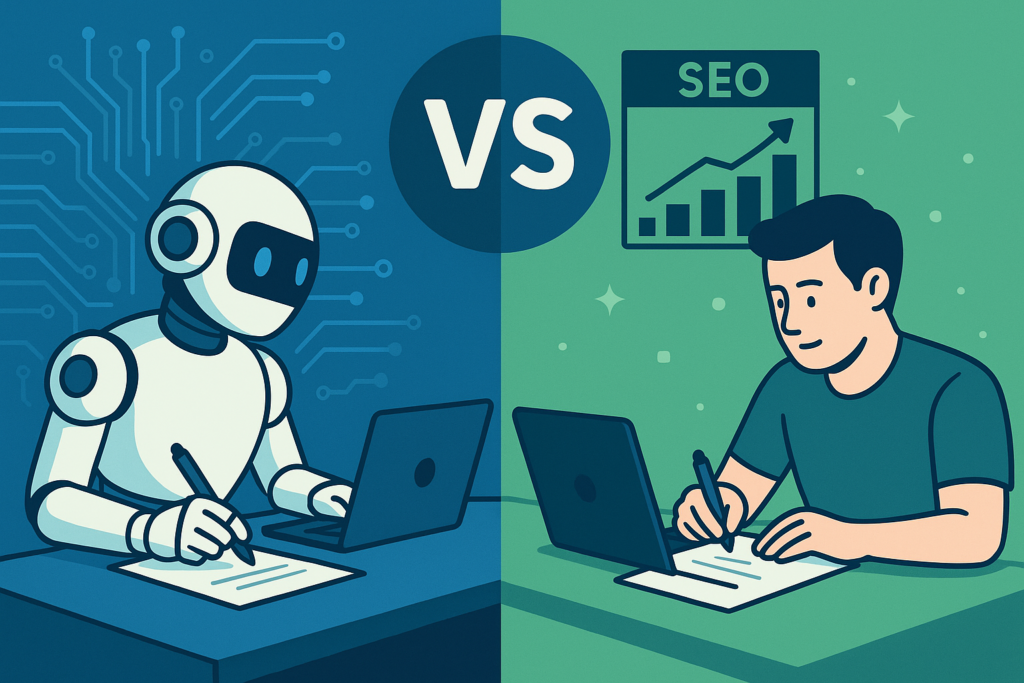
If you’ve been wondering whether the AI captions you scheduled this week will actually get reach, the 2026 data has an answer, and it’s more specific than the AI vs. human debate makes it sound. Unedited AI social content consistently underperforms. AI content layered with human editing, original data, and real perspective performs comparably to fully human-written posts. The dividing line isn’t who typed it. It’s whether anyone bothered to make it worth scrolling for.
Why It Matters
Social media managers are running brutal content math right now. Seven-plus platforms. Multiple brands. Daily cadences. Generative AI looked like the rescue line, but as more brands lean on it without editing, the platforms have responded. TikTok, Meta, and LinkedIn have all signaled, through algorithm updates, content guidelines, and quietly throttled reach, that “AI slop” is not getting the same distribution as content with a human signal on it.
The pattern mirrors what has been happening in search. Google spent the last two years refining how it identifies low-effort content, and the conclusion search marketers reached is now arriving in social: helpfulness, not authorship, is the signal that matters. The platforms are not penalizing AI. They are penalizing thin content. AI just produces a lot of it.
What’s New / How It Works
Three independent studies released in early 2026 looked at AI content performance at scale. They agree on the punchline: unedited AI content fails, edited AI content succeeds. The mechanism is the same across all three, content that lacks specific examples, original data, or real first-person experience gets flagged, throttled, or quietly demoted.
The Ahrefs analysis
Ahrefs examined thousands of AI-generated blog posts. The AI content that failed to rank shared one trait, it was generic, surface-level, with no specific details, examples, or data. The AI content that ranked had been heavily edited by humans and enriched with original insights and cited statistics. For social media managers, the translation is direct: a generic AI caption about “5 tips for productivity” performs the same way it reads, like nothing.
The Semrush finding
Semrush’s content research found that articles incorporating original data, expert quotes, and first-person experience outperformed purely AI-generated drafts by approximately 30% in click-through rate and 22% in average ranking position. On social, that gap shows up as the difference between a post that gets shared into DMs and one that scrolls past unnoticed.
The Search Engine Journal audit
Search Engine Journal audited 200 AI-generated posts. The ones that had been factually reviewed and edited for natural language performed comparably to well-written human content in the same topic categories. The ones published raw saw higher rates of algorithmic demotion after Google’s helpful content updates. Same pattern shows up across social feeds, generic AI captions die in the algorithm; specific, edited captions get a fair shot at reach.
The Numbers
Headline numbers from the 2026 research:
- 30% higher CTR for AI content layered with original data and expert insight, versus pure AI drafts (Semrush)
- 22% better average ranking position for hybrid human+AI content versus pure AI (Semrush)
- 200 posts audited by Search Engine Journal, edited AI content performed on par with human content; raw AI content got demoted
- Majority of failing AI content shared one trait: no specific details, examples, or data (Ahrefs)
- Zero platform penalties applied to AI content as a category, the throttle is on thin content, not on AI
Google’s own framing on this hasn’t changed in two years. From the company’s helpful content guidance:
“Our focus on the quality of content, rather than how content is produced, is a more reliable signal of what our systems should reward.”, Google Search Central
The social platforms are downstream of that same logic. TikTok, Meta, and LinkedIn are not looking for an AI fingerprint. They are looking for engagement that signals real human interest. AI content that earns it works. AI content that doesn’t, gets buried.
What Comes Next
The brands and agencies winning in 2026 are not picking sides. They are building hybrid workflows where AI handles volume and humans handle authority. The pattern that consistently wins:
Human-led strategy, AI-assisted production. A human decides what to say, who it’s for, and what makes it specific. AI handles the first draft, the platform variations, or the research summary. The human then rewrites, adds real examples or data, and ships.
AI for scale, human for hero content. Use AI to generate platform variations of a single idea across TikTok, Instagram, LinkedIn, and Pinterest. Reserve a real human voice for the cornerstone post that earns the share.
Always add the human layer. Every piece of AI content that ships should have at least one original example, one specific data point, or one real perspective. Without that, it is pattern-matched filler.
Audit AI content quarterly. AI captions and posts go stale faster than human-written ones because they often lack specific current citations and may reference outdated trends. A 90-day sweep, refreshing stats, removing what underperformed, updating dated references, significantly extends the shelf life of evergreen content. Independent research from Ahrefs and Semrush both point to the same conclusion: hybrid content beats pure-AI by a wide margin and rivals pure-human content on engagement metrics.
The platforms don’t care whether a human or an AI wrote your post. They care whether anyone stopped scrolling for it.
What This Means for You
If you’re a social media manager juggling multiple brands or platforms, the practical implication is clear, stop publishing raw AI captions, and start treating AI as the first 60% of a workflow, not the last 100%.
This is exactly what Feedsta is built around. Use AI inside the platform to generate the first draft, repurpose a single idea into native variations for TikTok, Instagram, LinkedIn, and Pinterest, and schedule everything across brands from one calendar inside the Feedsta app. Then layer your specific knowledge on top, the example only your brand has, the customer story only you have heard, the angle only you would take. That is the version of AI content that actually performs.
A few workflow changes that pay off immediately:
- Use AI to generate three caption variations, then pick the closest to your brand voice and edit it harder than you’d expect to.
- Use AI to draft the platform variations of a hero post, but rewrite the hero post itself by hand.
- Audit your last 90 days of AI-assisted posts and identify the ones that flat-lined. They almost always lack one specific thing, a real example, a real number, or a real opinion.
If you’re building out the AI skill set this year, our breakdown of the 13 AI skills every social media manager needs in 2026 walks through the workflow shifts separating the operators pulling ahead from the ones falling behind. And if you’re also chasing visibility inside AI search engines themselves, the five plays for AI search visibility directly complement everything in this article.
The Bigger Picture
The AI versus human debate has always been a bad framing. The real question, the only one that has ever mattered to a platform algorithm or to a human scrolling at midnight, is whether a piece of content is worth the second it took to consume. AI can produce content at a scale no human team can match. Only humans can decide whether any of it is worth saying. The teams that figure out where that line sits, and build their workflow around it, are the ones who will own social feeds in 2026.