Update or Create? A Social Media Content Refresh Framework for Answer Engines in 2026
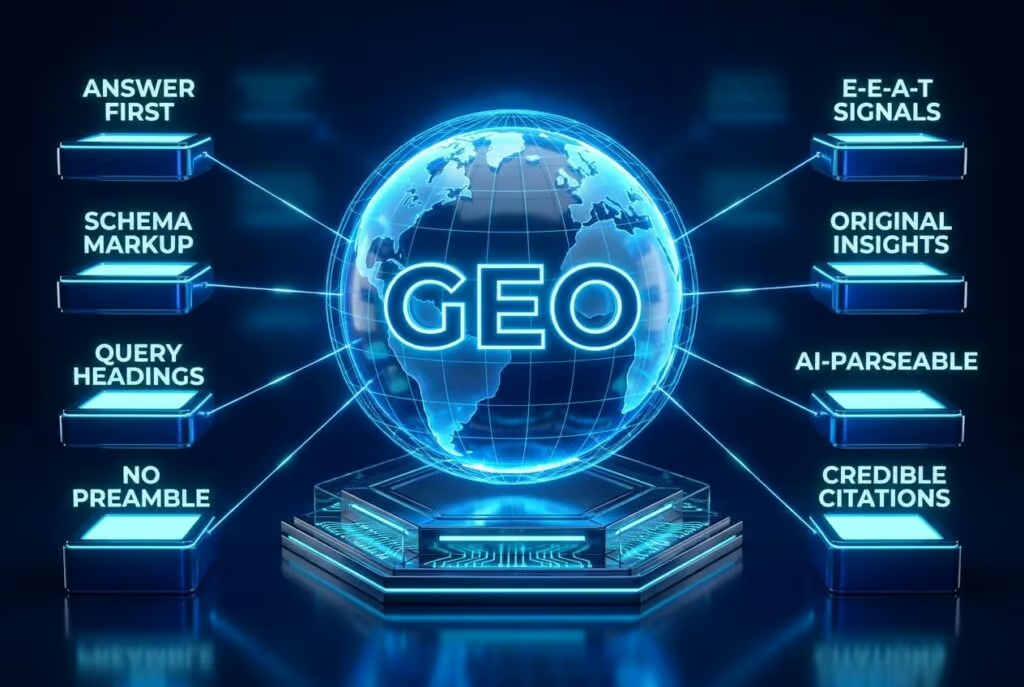
Your audience is asking AI for answers today, if your social content isn’t structured to be the answer, you’ve already lost visibility.
When a potential customer asks ChatGPT “best social media scheduling tool for a small team,” the AI doesn’t care whether your brand’s blog post is two years old. It cares whether the answer is current, clearly structured, and trustworthy. That reality has rewritten the rules for social media managers and agencies: the content you publish across blogs, link-in-bio pages, YouTube descriptions, and even pinned posts now competes in answer engines, not just feeds. A 2024 BrightEdge analysis found that Google’s AI Overviews already surface on 15% of search queries, and Gartner forecasts that traditional search engine volume will drop 25% by 2026 as AI chatbots and virtual agents take over discovery. For social teams, the question is no longer “how do we rank?” but “how do we get cited?”
Why It Matters
Answer Engine Optimization (AEO) and Generative Engine Optimization (GEO) aren’t just SEO sub-disciplines, they’re the new front door to your brand. When Instagram caption snippets, LinkedIn thought-leadership posts, and YouTube Shorts summaries are pulled into AI-generated answers, the quality of your content determines whether you appear. Social media managers who ignore this mutation risk losing traffic that once came from Google to competitors who structure their content to be AI-friendly. According to the Gartner prediction, by 2026 nearly a quarter of all search traffic that brands relied on for discovery will flow through answer-first experiences rather than conventional search engine result pages. That shift makes the decision of when to refresh existing posts and when to create something new a strategic lever, one that can cost you audience attention or compound it.
How AI Answer Engines Evaluate Your Social-Linked Content
Understanding the mechanics helps you decide between an update and a fresh post. Modern AI search tools use Retrieval-Augmented Generation (RAG). They pull real-time data from multiple sources, then synthesize an answer. When they look at your blog article, YouTube video description, or link-in-bio landing page, they assess:
- Entity trustworthiness. An established URL with a history of engagement and backlinks has prebuilt authority. A brand-new URL starts from zero trust.
- Answer speed. Pages that deliver a direct answer within the first 100 words get parsed and cited faster than those that bury the answer in fluff.
- Structural clarity. FAQ schema, HowTo markup, and well-organized H2 and H3 tags help AI models extract and reference your content reliably.
- Freshness signals. Updating a page signals active maintenance and gets the page re-crawled and re-indexed quickly, retaining its existing authority.
The upshot: updating a high-trust asset almost always integrates into AI outputs faster than publishing a new page with no history. But that doesn’t mean you should never create; it means you need a decision framework.
The Update-or-Create Decision Framework
Apply these three paths before you touch your content calendar.
Update existing content when…
- The post already ranks or gets AI citations but is slipping. If a blog post, YouTube description, or campaign landing page appears in the top 20 but has been losing impressions, a structural refresh, new stats, added FAQ schema, clearer subheadings, often reverses the decline without sacrificing accumulated trust.
- Search intent has shifted. A Q&A-style Instagram-how-to guide from 2023 might now attract users who want a curated comparison because AI-generated answers expect that format. Refreshing the content to match current intent prevents cannibalization and lets you keep the URL.
- The page has substantial backlinks. A piece that earned dozens of links from industry publications or newsletters is too valuable to abandon. Update the content in place so you pass authority forward; a new page would take months to build similar link equity.
Create new content when…
- The topic is brand-new to your brand. If you’ve never discussed a new platform feature (say, Instagram’s AI-curation model) or a fresh trend, there is nothing to update. Build from scratch with E-E-A-T signals: original data, expert quotes, and structured markup.
- The existing asset is fundamentally off-target. A thin post written for a keyword that no longer reflects your audience’s query is better redirected to a new, comprehensive page than patched with bandaids.
- You need to target a different semantic cluster. When social listening or keyword research uncovers a new cluster of questions your existing content can’t stretch to cover, a new dedicated piece is the right call.
Consolidate posts when…
If you have three separate blog posts all targeting slight variations of “how to schedule Instagram Reels,” AI engines struggle to pick a canonical source. Merge them into one authoritative pillar page. You’ll create a denser, more citable node, and you can redirect the old URLs to preserve link equity.
The Numbers
- 15% of Google queries now surface an AI Overview, according to BrightEdge’s analysis of billions of search sessions (BrightEdge AI Overviews Research, 2024).
- 25% drop in traditional search volume is predicted by 2026 as AI chatbots and virtual agents take over, per Gartner’s February 2024 forecast.
- Content on established URLs is acknowledged by the search community to integrate into generative responses substantially faster than brand-new pages, because existing trust signals and vector embeddings carry forward.
“Generative AI is reshaping the information discovery landscape, giving rise to answer-first experiences.”
, Alan Antin, Vice President Analyst at Gartner
What Comes Next
AI search is still evolving. Google is already testing AI Mode with deeper personalization, ChatGPT is incorporating real-time browsing more aggressively, and platforms like Perplexity and Arc are pushing citation-heavy interfaces. As these answer engines mature, the bar for what gets cited will rise, content that quietly serves factual, well-structured answers will separate itself from promotional fluff. Social media teams that bake this mindset into their editorial process now will be ahead when the majority of discovery shifts away from traditional feeds. Expect more analytics tools to differentiate “AI citation” metrics from conventional search rankings, giving you direct feedback on whether your refreshes are landing in generative responses.
What This Means for You
Your social content strategy now doubles as your AI visibility strategy. Start by auditing your top-performing blog posts, YouTube descriptions, and linked landing pages: which ones already carry backlinks and engagement but haven’t been touched in six months? Refresh those first with current stats, FAQ schema, and a clear answer in the opening paragraph. Build a rhythm: high-impact pages every 30 days, core service pages every 90 days, and a full content audit annually. When you schedule these refreshes, use a tool that can manage multi-brand, multi-platform content from one place. Feedsta, the AI-powered social media manager, lets you schedule, create, and track updates across TikTok, Meta, LinkedIn, and more, so your refactored content goes live on time. And before you invest hours in a rewrite, run a free AI visibility scan with BizScoreAI to see how answer engines currently perceive your business. Then dig into our tactical guides: the top 10 things that help AI find your business on social, and how agentic AI will reshape your workflow. The posts you refresh today are the answers your audience will see tomorrow.
The Bigger Picture
The death of traditional search is overstated, but its monopoly is eroding. Social media managers who get comfortable updating for answer engines, instead of always chasing new posts, will command the high ground when the majority of brand discoveries are generated, not retrieved. Your content library is a living asset; treat it that way.