ALL CAPS Titles: What a 17.5% Lift Means for Your Headlines
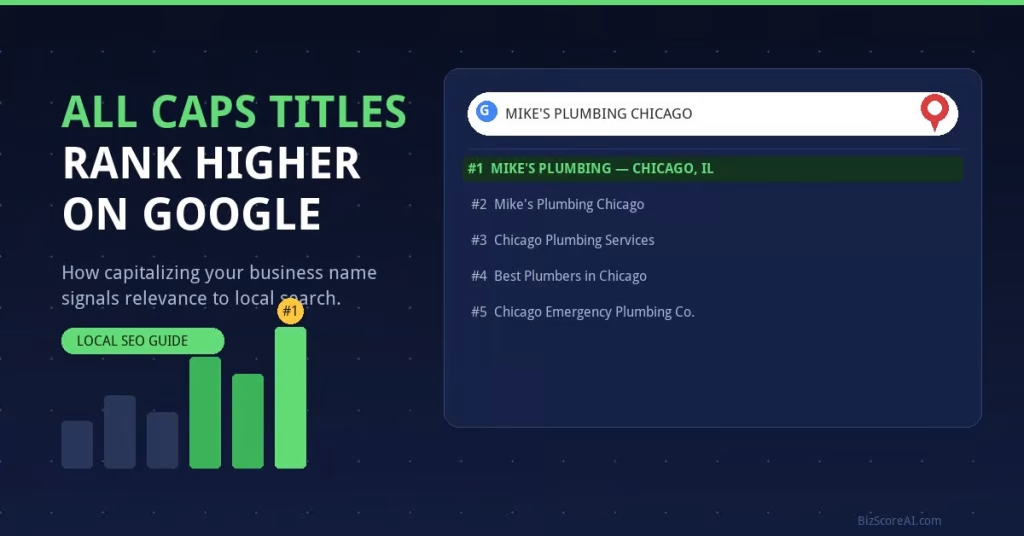
A controlled split test reportedly clocked a mobile traffic lift on pages whose titles used ALL CAPS for key terms, even though Google normalizes capitalization before showing results. The caps were never displayed to readers, but were read during indexing and weighted as semantically important by the same machine-learning logic now ranking captions, bios, and link-in-bio pages.
Why It Matters
Every major social platform now uses transformer-based language models to decide what to surface. TikTok’s recommendation engine, Instagram’s search ranking, YouTube’s suggested videos, LinkedIn’s feed, and Pinterest’s discovery all parse the words you write before they decide who sees them. Captions are no longer decoration. They’re training inputs.
The same logic runs through AI search. When ChatGPT, Perplexity, and Google AI Overviews pull citations, they draw from the corpus indexed across the open web, including landing pages, link-in-bio hubs, and captions scraped into third-party search indexes. A 17.5% mobile lift on the search side may indicate that capitalization is one of the lightweight ranking factors most teams are leaving on the table.
The reach math is brutal. Organic Instagram reach hovers around 4% of followers according to 2026 benchmarks, and TikTok’s For You algorithm may send 95%+ of views to non-followers. Every percentage point you can claw back with a caption tweak compounds across thousands of posts a year.
What’s New / How It Works
One controlled split test ran on live traffic. Half of the test group received page titles with ALL CAPS treatment on the core service plus location keywords. The other half kept standard title-case capitalization. After the test window, the ALL CAPS group pulled in 17.5% more organic mobile traffic, a result described as well outside the noise floor for a properly powered SEO experiment.
Google never rendered the caps in the SERP. It normalizes capitalization before display, so the visual experience for users was identical. The caps were never shown to users, but they were read during indexing. The win happened inside the ranking pipeline, where the NLP layer weights tokens differently based on how they appear in the raw HTML.
A breakdown of the experiment spelled out the mechanism:
The same AI models that power Google Search, Google Maps, and Google Business Profile were trained on billions of documents where ALL CAPS signals importance. Product labels. News headlines. Legal notices. When your business listing or website title uses capitalization strategically, those models assign higher semantic weight to those terms.
That training corpus isn’t unique to Google. Every foundation model from Google’s BERT to OpenAI’s GPT series to Anthropic’s Claude family learned on the same kinds of documents. The capitalization signal is portable across any system that uses transformer attention to weight words, which now includes every social platform’s ranking stack.
Capitals aren’t shouting at users; instead, they’re whispering to algorithms about which specific words carry weight.
The Numbers
- Up to 17.5% lift in mobile organic traffic on ALL CAPS title pages, as observed in an internal split test (April 2026)
- Billions of documents in transformer training corpora where ALL CAPS marks emphasis
- Zero visible change for users, Google normalizes capitalization in the SERP before display
- ~4% organic reach on Instagram for the average creator, per 2026 industry benchmarks
- 95%+ of TikTok views arrive through the For You recommendation engine, not follower feeds
The asymmetry is the point. Your audience sees a normal caption. The ranking model sees a weighted signal. Teams spend hours optimizing thumbnails and hooks, this is a one-keystroke change with comparable upside.
What Comes Next
New split tests in this area are published roughly monthly, and the next wave of tests is expected to drill into how capitalization interacts with structured data, schema markup, and entity recognition. Expect follow-on experiments on bullet formatting, punctuation density, and heading hierarchy, all signals NLP models read but human eyes don’t consciously weight.
The broader programmatic context matters too. Google’s own documentation already warns against keyword-stuffing titles, but it has never penalized ALL CAPS used judiciously on core terms. The line between emphasis and spam is enforced by quality models trained to recognize natural-language patterns. Two or three capitalized phrases per caption sits on the safe side. Twenty does not.
On the social side, watch for platform-level disclosures. LinkedIn has started releasing more detail about how its feed model parses headlines. TikTok’s creative center documentation now mentions caption semantic weight. Pinterest’s SEO docs explicitly call out keyword placement in pin titles. The signal is going mainstream, early movers get the lift before competitors catch on.
What This Means for You
Translate the finding into a caption workflow this week:
- Pick one or two anchor terms per caption, the service, the product, the location, or the outcome, and write them in ALL CAPS. Not the whole caption. Not three out of five sentences. One or two anchor terms per post.
- Audit your bios. Instagram, TikTok, LinkedIn, and Pinterest bios are all NLP inputs. Capitalize your category and your specialty. “CUSTOM WEDDING CAKES | [Your City], ST” reads cleanly and weights the entity terms harder than “custom wedding cakes in [your city].”
- Apply it to your landing pages. If you publish landing pages or a link-in-bio hub through Feedsta, an AI-powered social media platform, your page titles, H1s, and CTA buttons all flow into search and AI-search indexes. The same capitalization logic applies there.
- Watch YouTube and LinkedIn headlines. Both platforms expose title fields that get indexed in Google. ALL CAPS treatment in those titles compounds the lift, you win the platform search and the open-web search at once.
- Track CTR for 30 days. Pull mobile click-through-rate from your native platform analytics and your scheduling tool’s reports. The lift should show up in mobile first, where character density makes capitalized anchors more visually distinct on small screens.
If your content is already aimed at AI-search visibility, this slots in cleanly. According to Feedsta, the broader playbook is covered in Get Chosen by AI Search and the corpus-level data in the 289,105-URL AI brand-visibility study. ALL CAPS treatment is one more weight you can push without rewriting your content calendar.
The Bigger Picture
Capitalization is no longer a stylistic choice, it’s metadata. Every platform that ranks your content is reading your captions through a transformer that learned the same emphasis conventions on the same training data. The teams that internalize that signal first may spend the next twelve months getting cited more often, ranked higher, and surfaced ahead of competitors who are still writing captions like it’s 2018.
FAQ
How many words per caption should I actually capitalize?
One to three anchor terms per caption is the sweet spot. The 17.5% lift came from capitalizing core service plus location keywords in titles, not entire sentences. The NLP models you’re trying to influence look for emphasis patterns that match natural-language documents like product labels and news headlines, where a few words are emphasized against a lowercase background. If you capitalize twenty words, the signal flattens and you risk tripping spam-quality classifiers. Pick the two or three words that matter most for discoverability and leave the rest in standard case.
Does the 17.5% lift apply to Instagram and TikTok captions too?
The study tested Google web search, not Instagram or TikTok specifically. But the mechanism, transformer models weighting capitalized tokens as semantically important, is shared across every platform that uses NLP for ranking. Instagram, TikTok, LinkedIn, YouTube, and Pinterest all use language models in their ranking stacks. The exact lift on social platforms hasn’t been measured publicly, but the underlying signal logic is portable. Treat ALL CAPS treatment as a directional optimization across platforms and measure your own CTR and reach over 30 days to confirm the lift in your niche.
Will ALL CAPS in my captions hurt accessibility for screen readers?
It can if you overdo it. Screen readers often spell out ALL CAPS words letter by letter, which is disruptive when applied to long phrases or full sentences. The safe pattern from the data is one or two anchor terms per caption, the service, product, location, or outcome you most want weighted. That density gives you the NLP lift without breaking the audio experience for users on VoiceOver or TalkBack. If you must capitalize a longer phrase, test it through a screen reader first and consider using proper case for the rest of the caption to preserve readability.