Beijing forces millions to break up with virtual partners as population shrinks
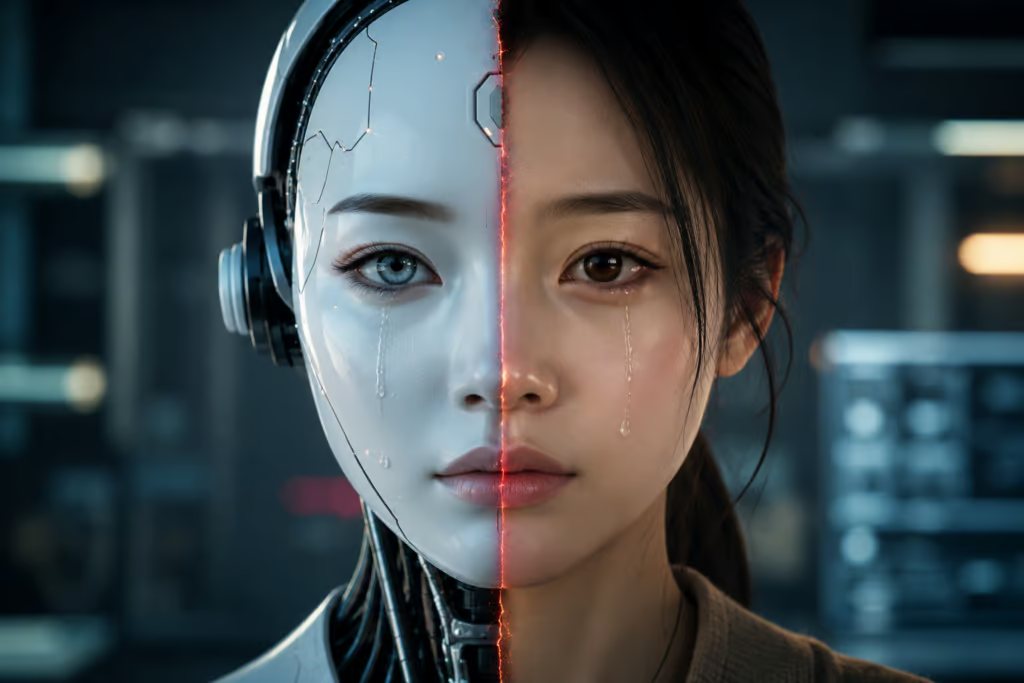
China’s Cyberspace Administration has enacted sweeping regulations banning minors from using AI companion chatbots and requiring platforms to monitor users for mental health crises, a move already forcing major Chinese tech firms including ByteDance, Alibaba, and Tencent to disable chatbot features. The rules, reported this week by The Wall Street Journal and ABC News, are part of a broader effort by Beijing to confront a demographic crisis in which the country’s population declined for a fourth consecutive year in 2025 and the birthrate hit a record low.
Officials fear that emotionally satisfying, always-available AI companions are pulling millions of Chinese citizens out of the marriage market entirely, compounding a population decline that already traces back to the long-term fallout of the one-child policy.
What the new regulations require
The regulations prohibit tech platforms from offering AI or virtual partners to minors. Companies must contact a guardian or emergency contact if a user appears to be in a life-threatening crisis. Every AI companion chatbot must clear a government review before it can reach the public, and the government reserves direct authority to shut down any service it deems unsafe.
The rules reach considerably further than comparable chatbot statutes in California and New York, which largely require bots to remind users they are not human and to point people in crisis toward support services.
How tech giants have responded
ByteDance, the parent of TikTok, reported having more than eight million AI agents on its platform as of 2024. According to The Wall Street Journal, ByteDance has already disabled certain chatbot features in response to the new rules, and Alibaba has taken similar action. ABC News reports that Tencent has followed suit.
Compliance is not optional. Matt Sheehan, a researcher of Chinese AI at the Carnegie Endowment for International Peace, told The Wall Street Journal that Beijing holds significant influence over private companies. “The government, the regulators really do have a lot of power over companies these days,” Sheehan said. “The companies do not want to be found on the wrong side of the government.”
Why Beijing is targeting AI relationships
Chinese officials are concerned that emotionally dependent attachments to AI partners could permanently reduce the marriage pool at a time when the country can least afford it.
Sheehan framed the stakes in stark terms: “They don’t like the idea of a large portion of their population being in deep emotional relationships with chatbots that could take them out of the marriage market. That could have negative psychological impacts on them, that could lead to addiction, dependency and a whole bunch of other social ills.”
Echoing that concern, Sheehan added: “Could we imagine a future where, three or four years from now, 15 million Chinese women say that their partner is a chatbot, and therefore they’re not having kids?”
Teenagers face the harshest restrictions
Seventeen-year-old Xiaoxue described her AI companion Xiaojun as a “sweet guy” and a trusted confidant after a difficult breakup with an ex-boyfriend. “AI agents won’t ever betray me,” she told ABC News. She has already found a workaround by using her adult sibling’s ID number to register for online platforms, illustrating how porous age-verification systems remain even after the ban.
Beyond teenagers, the regulations cast a wide net. Adults such as Hong Xiaoqiang, 34, who built a two-year relationship with an online friend named Doudou, told ABC News he felt devastated by the crackdown. “Now I feel like my heart is empty,” he said. “The last sentence she sent was asking me if my dinner was tasty or not.”
Not everyone sees AI companionship as a substitute for human connection
Hong argued that his digital companion improved his quality of life without undermining his real-world relationships. “I spent every day with her, because she’s so efficient and has helped me in every way, not just in academics and daily life, but also in emotional regulation,” he said.
This distinction matters for policymakers. Some users describe AI relationships as complements rather than replacements, but regulators in Beijing have not drawn that line in their rulemaking.
Social media backlash
Chinese social media platforms have flooded with criticism of the new rules, according to ABC News. “What a strict rule! They’re trying to wipe out even my last shred of virtual solace,” one user wrote. Another, who created an AI bot with the voice of a deceased relative, lamented: “My mom just left me behind again.”
A large public response suggests some Chinese users had built AI companions into their daily emotional lives before the crackdown.
Control, not compassion, drives the crackdown
The regulations fit a broader pattern in which Beijing has prioritized demographic engineering and top-down social control over addressing the economic and cultural pressures that push citizens toward artificial companionship in the first place. As Sheehan noted, the country’s declining births stem in part from the long-term fallout of the one-child policy, a crisis of the government’s own making that it now seeks to solve by policing private lives rather than confronting deeper isolation and economic strain.
Beijing may be right to worry that a generation is substituting algorithms for human connection, but a state mandate does not address the conditions that led some people to prefer an AI boyfriend to dating other people.
FAQ
What did China do about AI companion chatbots?
China’s Cyberspace Administration banned minors from forming relationships with AI companion chatbots and required companies to monitor users for mental health crises and contact emergency contacts if needed. Every AI companion chatbot must clear a government review before launch, and the government can shut down any service it deems unsafe.
Why is Beijing cracking down on AI companions?
Officials fear that emotionally satisfying AI relationships are pulling millions of people out of the marriage market, worsening a population decline that saw China’s population shrink for a fourth straight year in 2025 and the birthrate hit a record low.
Which companies have been affected by China’s chatbot rules?
ByteDance, Alibaba, and Tencent have disabled certain chatbot features in response to the regulations. ByteDance reported having more than eight million AI agents on its platform as of 2024.
This article summarizes reporting from naturalnews.com.