Claude’s $500M Mistake: Why Your AI Strategy Needs Guardrails Right Now
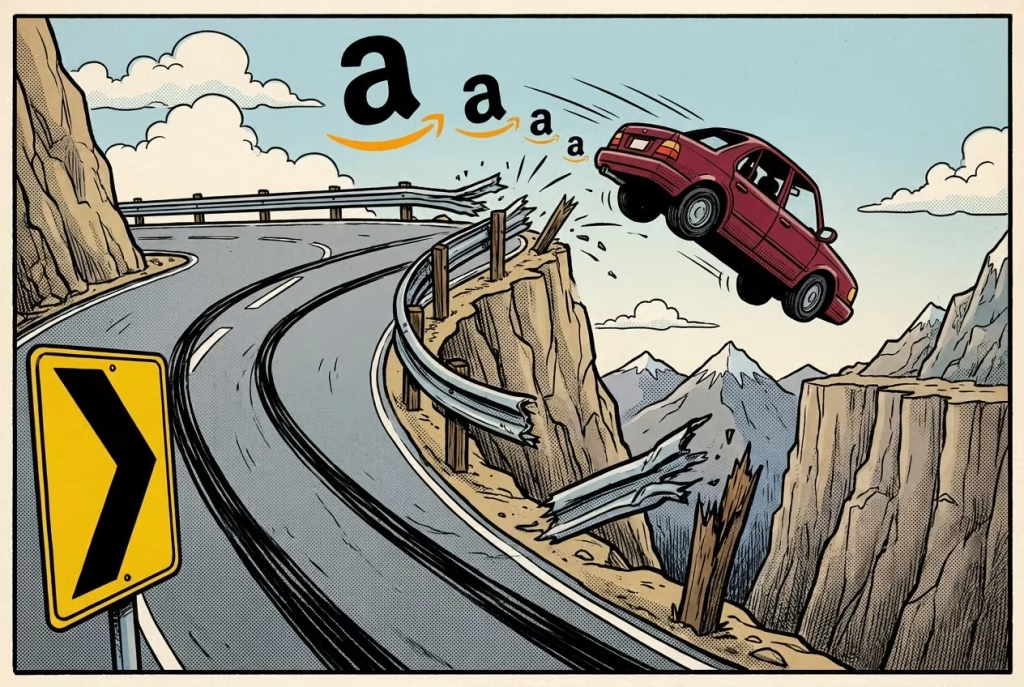
An unnamed Anthropic enterprise client, widely suspected to be Amazon, ran up $500 million in Claude charges in a single month after failing to set usage limits on employee licenses. The bill exposed a deeper problem: aggressive internal AI adoption programs built around gamified token consumption rather than real outcomes. For any company rolling out AI in 2026, the incident is a warning to install spending guardrails before employees start optimizing for the wrong metric.
How Did a Single Bill Reach $500 Million?
The Setup
Amazon has one of the deepest financial relationships with Anthropic of any company on earth:
- $8 billion already invested in Anthropic
- Another $5 billion announced in April 2026 (with potential for $20B more tied to milestones)
- Anthropic committed to spend $100+ billion over ten years on AWS
Amazon was simultaneously pushing aggressive AI adoption internally, more than 80% of developers were expected to use AI tools weekly, with internal leaderboards tracking usage.
The Exploit
Amazon employees reportedly used MeshClaw, an internal AI agent tool, to route non-essential tasks through AI, purely to boost their token counts. A leaderboard called KiroRank issued “nerd points” to top token users.
The Result
Employees optimized for the metric instead of the work. Management had to tell everyone to stop. The $500M bill report landed at the same time.
Why Is the AI Industry Built on Circular Money Flows?
The AI industry is increasingly built on circular money flows:
Hyperscalers (AWS, MS, Google)
    → invest billions in AI model companies (Anthropic, OpenAI)
    → model companies spend billions back on cloud infra
    → enterprises push employees to use AI tools
    → rising usage supports higher revenue projections
    → higher projections justify more infra spending
    → repeat
Inflated token counts can seem beneficial on paper, until someone receives the bill.
Some analysts say Anthropic’s reported growth understates parts of its business, pointing to early signs of corporate AI fatigue as revenue projections rise.
What Damage Have Other Companies Reported?
| Company | Issue | Outcome |
|---|---|---|
| Amazon | Tokenmaxxing via MeshClaw, KiroRank leaderboard | Internal ban, exec told staff “don’t use AI for AI’s sake” |
| Meta | Claudeonomics dashboard, employee competition | Dashboard killed |
| Microsoft | Canceled Claude Code licenses | Shifted developers to Copilot CLI |
| Uber | Burned 2026 AI budget by April | COO admitted cost-value line is “very hard to draw” |
What Guardrails Should Your AI Rollout Include?
1. Per-User Spending Limits
Every enterprise AI platform supports this. Set them before rollout:
- Default limit: $200/user/month for Claude/Max/Advanced tiers
- Elevated access: Manager-approval workflow for higher limits
- Organization cap: Hard ceiling on total monthly spend
2. Usage Monitoring, Not Gamification
- Track token usage as an operational metric, not a performance score
- Never build leaderboards around raw consumption
- Review anomalous usage patterns monthly
3. Define “Good AI Use” Explicitly
Your AI usage policy should cover:
- What constitutes legitimate use (code generation, content drafting, analysis)
- What constitutes wasteful use (busywork routing, unnecessary summarization, task multiplication)
- Consequences for gaming the system
4. Audit Before You Scale
Before rolling AI tools out to 5,000 employees, pilot with 50. Measure:
- Actual productivity gains (features shipped, tickets resolved)
- Token cost per unit of real output
- Whether adoption translates to business outcomes
5. The 10x Rule
If your adoption plan doesn’t account for at least 10x cost variance between best-case and worst-case scenarios, your budget isn’t realistic.
Don’t Be the $500M Headline
The companies that use AI well in 2026 won’t be the ones spending the most on tokens.
- Implement guardrails before unlimited access
- Track outcomes, not consumption
- Treat AI as a tool, not a metric
The $500M mystery bill isn’t a failure of AI, it’s a failure of management. Don’t let it happen to you.
FAQ
Who is believed to be behind the $500 million Claude bill?
The bill was run up by an unnamed Anthropic enterprise client, widely suspected to be Amazon, which has $8 billion already invested in Anthropic and announced another $5 billion in April 2026.
How did employees drive the bill so high?
Amazon employees reportedly used an internal AI agent tool called MeshClaw to route non-essential tasks through AI to boost token counts, with a leaderboard called KiroRank awarding “nerd points” to top users.
What guardrails should companies put in place before rolling out AI?
Recommended guardrails include per-user spending limits with a $200/user/month default, monitoring token usage as an operational metric rather than a performance score, defining legitimate versus wasteful AI use in policy, piloting tools with a small group before scaling, and budgeting for at least 10x cost variance between best- and worst-case scenarios.