Google Business Profile vs Paid Citation Services: The 2026 Local Search Playbook
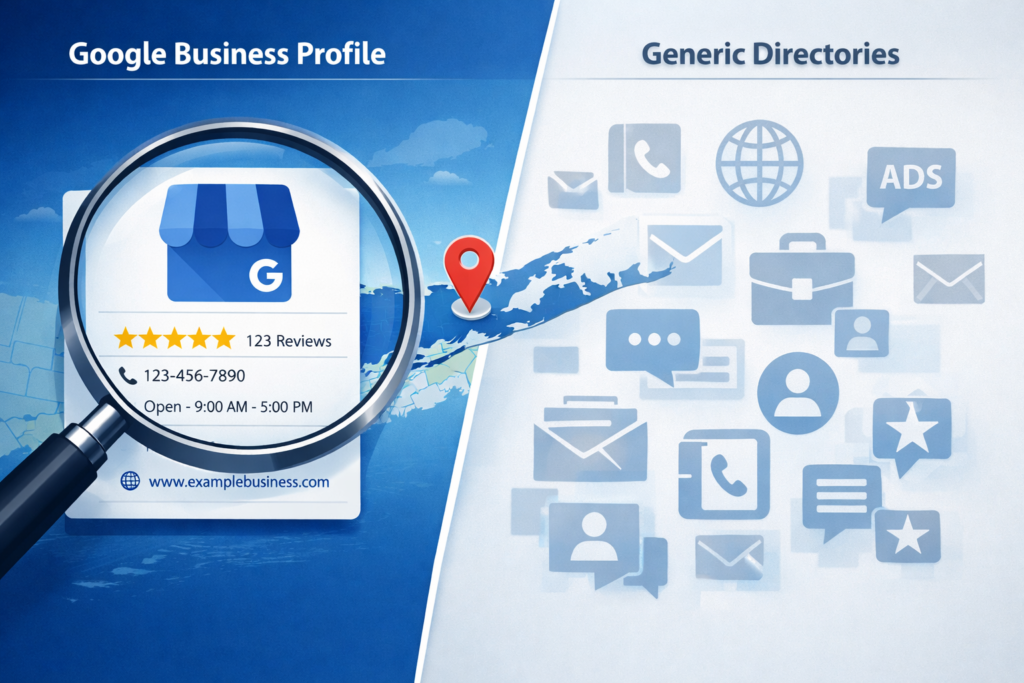
Google Business Profile engagement, review velocity, and on-site relevance now outweigh raw citation count in Google’s 2026 local algorithm. The old pitch, blast your NAP across 300 directories and watch rankings climb, is dead on arrival. The lift has moved to publishing: weekly posts, photo refreshes, owner responses, and active profile maintenance that send the signals Google actually rewards.
Why It Matters
Local search is no longer a static directory game. A citation (your business name, address, and phone number on a third-party site) still verifies you exist where you claim, feeding Google Maps, Apple Maps, voice assistants, and AI-driven search results. But the lift has migrated. Citations are not the ranking powerhouse they were a decade ago.
The new powerhouses are signals your content workflow already produces: fresh posts, photo uploads, review responses, Q&A activity, service updates. Those are publishing operations. They run on a calendar. They scale across locations and brands. And they are the daily inputs Google’s local algorithm rewards in 2026, in both the classic local pack and the new generative answer layer.
How the 2026 Local Stack Works
The 2026 local stack has a clear hierarchy. Google Business Profile sits at the top: fully completed, weekly posting, photos uploaded regularly, primary and secondary categories dialed in, services and products listed with descriptions and pricing. Below that, consistent NAP data on the top 40-50 directories and aggregators. Below that, review velocity and owner responses. Below that, location-specific on-site content. Mass citation building falls well beneath all of these in impact per dollar spent.
Two things changed. First, GBP became an active publishing surface. Google’s 2025 updates added enhanced AI-generated summaries that pull directly from profile content, an expanded products and services editor, and engagement metrics that measurably influence ranking. Posting weekly, responding to reviews within 24 hours, and answering Q&A items now send activity signals Google can score. Second, AI Overviews and conversational search read structured data, reviews, and GBP content to generate answers, meaning a profile untouched for three months also loses visibility in the generative layer.
Paid citation services still have a narrow role. Bulk submission to the major data aggregators, Data Axle, Foursquare, Neustar Localeze, creates baseline consistency that feeds downstream directories. Beyond that baseline, the incremental value of directory 150 versus directory 50 is negligible. Worse, subscription tools like Yext can revert your listings the moment you cancel, turning citation building into a recurring expense with marginal return.
The Numbers to Anchor On
Operators in the area should track these figures for the second half of 2026:
- Top 40-50 directories deliver the meaningful citation value. Past that is volume for volume’s sake.
- 24-hour response time on Google reviews is the engagement signal most directly tied to local pack performance.
- Weekly GBP posts, photos, and updates separate businesses in the three-pack from those buried on page two.
- 200 thin directory listings with a neglected GBP lose to 40 solid citations with an actively maintained profile.
- Three core data aggregators, Data Axle, Foursquare, Neustar Localeze, feed the downstream ecosystem. Get these right, then stop.
"The businesses winning local search in 2026 aren’t the ones with the most directory listings, they’re the ones doing the fundamentals exceptionally well, consistently, month after month."
What Comes Next
AI-powered search is the next frontier, already arriving. Google’s AI Overviews, ChatGPT search, Perplexity, and Gemini all blend structured profile data, reviews, and surrounding social content to generate answers. That is a new distribution channel that does not read directory listings the way the old algorithms did. It reads context.
Expect the gap to widen. Brands that operate a publishing rhythm, posts, photos, review responses, service updates, link-in-bio refreshes, will increasingly own the generative layer. Brands that bought a citation package and walked away will quietly vanish from AI answers, even when their listings are technically consistent. The win condition is no longer “be findable." It is “be the recently active, well-reviewed, content-rich answer."
That makes local search a publishing operation. And publishing operations live in the same tools you already use for content: calendars, multi-brand workflows, asset libraries, review monitoring, link-in-bio systems, QR code redirects to landing pages. The job has moved.
Local search in 2026 is not a directory checklist, it is a publishing rhythm, and whoever owns your content calendar now owns local search too.
What This Means for You
If you manage a brand’s presence, you also now manage its local search outcomes. The same calendar that schedules a TikTok and an Instagram Reel should be scheduling weekly GBP posts, photo refreshes, and review-prompt campaigns. The same dashboard that monitors comments should be flagging new Google reviews for owner response. The same link-in-bio stack that drives traffic to product pages should host a review collection flow.
A cross-platform calendar that treats GBP as another publishing surface alongside Meta, TikTok, LinkedIn, Pinterest, X, and YouTube keeps scheduling, asset library, and brand voice in one place. A URL shortener and QR codes let you run review-acquisition campaigns from in-store signage, receipts, and email signatures without burning your link-in-bio slot. A shared inbox keeps review responses in the same queue as comment replies, so the 24-hour response window stops slipping through the cracks. For operators running multiple brands or locations, a multi-brand workflow lets one person publish to a dozen GBPs, monitor reviews across all of them, and report on engagement signals without juggling logins. If you are still stitching that together with spreadsheets and browser tabs, you are paying for citation services to compensate for a workflow problem.
Not sure whether your citations, GBP, and reviews are actually pulling their weight, or whether that citation subscription is buying you anything? A free BizScoreAI visibility scan shows where your business stands across listings, reviews, and AI answers, so you can redirect budget with evidence instead of guesses.
For deeper plays on each piece of this stack, see our GBP optimization playbook, the online reviews playbook, and the 2026 local content strategy for what to actually post to feed the AI Overview layer.
The Bigger Picture
The era of buying your way into local visibility through directory blasts is over. The ranking signals that matter in 2026, fresh GBP activity, review velocity, owner responses, photos, service updates, location-specific content, are publishing outputs. They live on a calendar, they scale through tooling, and they reward consistency over volume. If you own a brand’s content, local search is your beat now. If you are an owner still wiring $500 a year into directory blasts, redirect that budget into a real publishing rhythm and watch what your local pack does over the next two quarters.
FAQ
Are paid citation services still worth it for local SEO in 2026?
Only at the baseline level. Bulk submission to the three core data aggregators, Data Axle, Foursquare, and Neustar Localeze, creates consistency that feeds downstream directories and mapping services. Beyond roughly 40 to 50 well-chosen directories, the incremental ranking value of additional listings is negligible, and subscription services like Yext can revert your listings the moment you cancel, turning citations into a recurring cost with marginal return.
What matters more for local rankings: citation volume or GBP engagement?
GBP engagement, by a wide margin. Google’s 2026 local algorithm rewards depth and consistency over breadth. A business with 200 thin directory citations but a neglected profile loses to a competitor with 40 solid citations and an actively maintained GBP. The activities with the most impact are weekly posts, regular photo uploads, owner responses within 24 hours, accurate categories and services, and Q&A activity, and those signals also feed AI Overviews.
How often should you post to a Google Business Profile?
At minimum, once per week. GBP is now an active publishing surface: offers, events, updates, and product posts all send engagement signals Google scores. A practical cadence is one update post per week, two to four new photos per month, an immediate Q&A response when one appears, and a review response within 24 hours of any new review, treated as just another channel in the cross-platform calendar.