GPT-5.6 Launches Tomorrow: OpenAI’s Sol, Terra, and Luna Arrive July 9
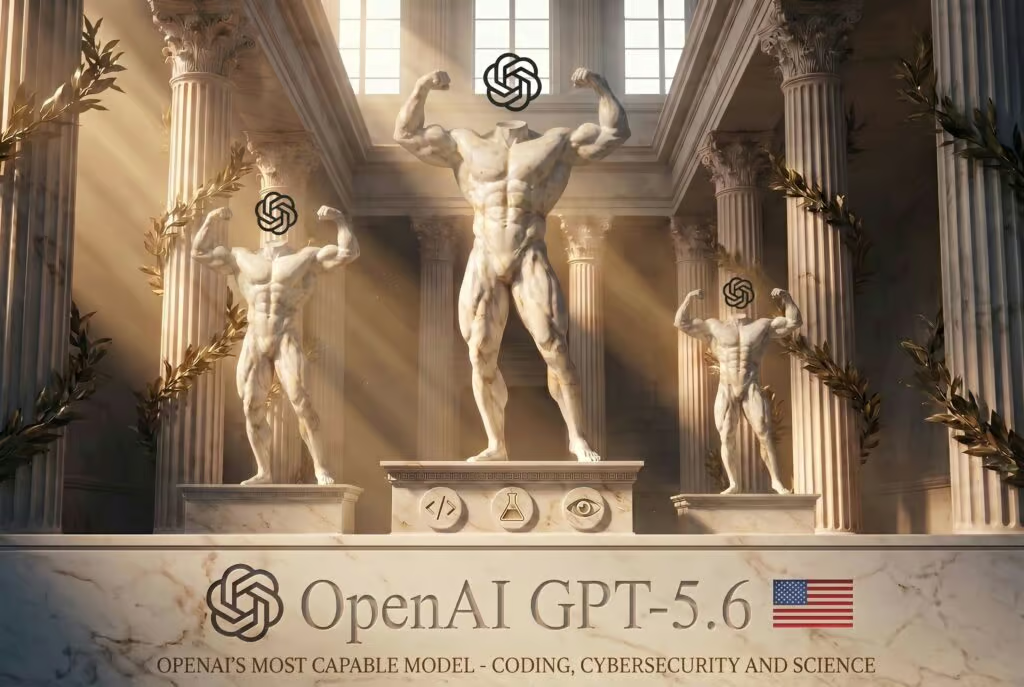
OpenAI is releasing GPT-5.6 tomorrow, Thursday, July 9, 2026, making its most ambitious model family yet available to developers, enterprises, and ChatGPT users worldwide. The launch follows a limited preview that began in late June with a small group of trusted partners, coordinated with the U.S. government.
What are the three GPT-5.6 models?
GPT-5.6 introduces a refreshed lineup built around three capability tiers rather than a single model:
- Sol is the flagship, designed for the deepest reasoning and the toughest agentic workloads.
- Terra is the balanced everyday model, offering competitive performance with GPT-5.5 at roughly half the cost.
- Luna is the fast and most affordable option, aimed at high-volume use cases.
The naming itself signals a shift. The number now marks a model’s generation, while Sol, Terra, and Luna act as durable capability tiers that can advance on their own cadence. Expect to see future updates that move one tier without forcing a full generational jump.
What new reasoning modes does Sol include?
Sol ships with two new ways to push the model harder. A new max reasoning effort setting gives Sol the most time to think deeply through a problem. A separate ultra mode goes beyond a single agent, deploying subagents in parallel to accelerate complex multi-step work. Together, these modes target the kind of long-running tasks, such as large code refactors, multi-day research projects, and intricate debugging sessions, that have historically strained single-agent systems.
Where does GPT-5.6 Sol set new benchmarks?
Three areas where GPT-5.6 Sol sets new internal benchmarks:
- Coding: Sol sets a new highest score on Terminal-Bench 2.1, a benchmark that tests command-line workflows requiring planning, iteration, and tool coordination.
- Biology: On GeneBench v1, which evaluates long-horizon genomics and quantitative-biology analyses, Sol delivers stronger results than GPT-5.5 while using fewer tokens.
- Cybersecurity: Sol is competitive with Mythos Preview on ExploitBench while using only about one third of the output tokens, and shows strong gains on ExploitGym, a benchmark created by UC Berkeley researchers in collaboration with OpenAI and other frontier labs.
How does the GPT-5.6 safety stack work?
OpenAI describes GPT-5.6’s safeguards as its most thorough to date, with configurations tailored to each model’s capabilities.
- Refusal training for prohibited cyber assistance, including attempts to disguise intent or jailbreak the model.
- Real-time cyber and biology misuse classifiers that evaluate output as it is generated. For higher-risk cases, generation can pause while a larger reasoning model reviews the conversation.
- Account-level review triggered by flagged activity.
- Differentiated access based on risk.
To harden the system, OpenAI dedicated over 700,000 A100-equivalent GPU hours to automated red-teaming aimed at universal jailbreaks, attacks designed to work across many prompts or contexts. Third-party human expert red-teaming continues through the preview period, and a rapid-response process reproduces, assesses, prioritizes, and remediates newly discovered jailbreaks.
On the cyber threshold question, OpenAI states that GPT-5.6 Sol does not cross the Cyber Critical threshold under its Preparedness Framework. In Chromium and Firefox evaluations, the model identified bugs and exploitation primitives but did not autonomously produce a functional full-chain exploit under the conditions tested. OpenAI also notes that Sol is better at helping people find and fix vulnerabilities than at reliably carrying out end-to-end attacks.
Why did the preview start with trusted partners?
OpenAI previewed its plans and the models’ capabilities to the U.S. government ahead of the limited preview launch, and began with a small group of trusted partners whose participation was shared with the government. The company has been clear that it does not want this process to become the long-term default, framing the arrangement as a short-term step on the way to broader availability while it works with the Administration to develop a cyber Executive Order framework and a repeatable process for future releases.
How much does GPT-5.6 cost per 1M tokens?
GPT-5.6 pricing follows the new tier structure:
- Sol: $5 input / $30 output
- Terra: $2.50 input / $15 output
- Luna: $1 input / $6 output
Predictability also gets an upgrade. GPT-5.6 introduces explicit cache breakpoints and a 30-minute minimum cache life. Cache writes are billed at 1.25x the model’s uncached input rate, while cache reads continue to receive the 90% cached-input discount.
How fast will Sol run on Cerebras?
OpenAI is also launching GPT-5.6 Sol on Cerebras in July, delivering up to 750 tokens per second for select customers. The partnership brings frontier-class intelligence to latency-sensitive workloads, with initial access limited while capacity ramps.
What should teams expect on day one?
When GPT-5.6 goes live tomorrow, developers can expect API and Codex access through the standard channels, with the three tiers available side by side. ChatGPT users will see broader availability roll out through the general release window. Expect a few rough edges during the first 48 hours, since OpenAI has flagged that safeguard tuning may occasionally block legitimate requests, and feedback gathered now will shape the experience before wider rollout.
For teams planning their migration, the practical shortlist looks like this. Sol for the hardest reasoning and agentic tasks where quality matters more than cost. Terra as the new default for everyday production traffic, given the 2x cost advantage over GPT-5.5 at comparable performance. Luna for high-volume or latency-sensitive workloads where price-per-token is the deciding factor.
Tomorrow’s release is the headline. The deeper story is the structural shift behind it: a tiered family that decouples capability from generation, a serious safety investment measured in hundreds of thousands of GPU hours, and pricing that finally rewards teams willing to route traffic intelligently across multiple models.
FAQ
When is GPT-5.6 launching?
GPT-5.6 launches on Thursday, July 9, 2026, following a limited preview that began in late June with a small group of trusted partners coordinated with the U.S. government.
What are the differences between Sol, Terra, and Luna?
Sol is the flagship tier for the deepest reasoning and toughest agentic workloads. Terra is the balanced everyday model offering competitive performance with GPT-5.5 at roughly half the cost. Luna is the fast, most affordable tier aimed at high-volume use cases.
How is GPT-5.6 priced per 1M tokens?
Sol is priced at $5 input and $30 output per 1M tokens, Terra at $2.50 input and $15 output, and Luna at $1 input and $6 output. GPT-5.6 also introduces explicit cache breakpoints, a 30-minute minimum cache life, cache writes billed at 1.25x the uncached input rate, and a 90% cached-input discount on cache reads.
Related coverage