OpenAI Previews GPT-5.6 Sol with Ultra Mode and Hardened Safeguards
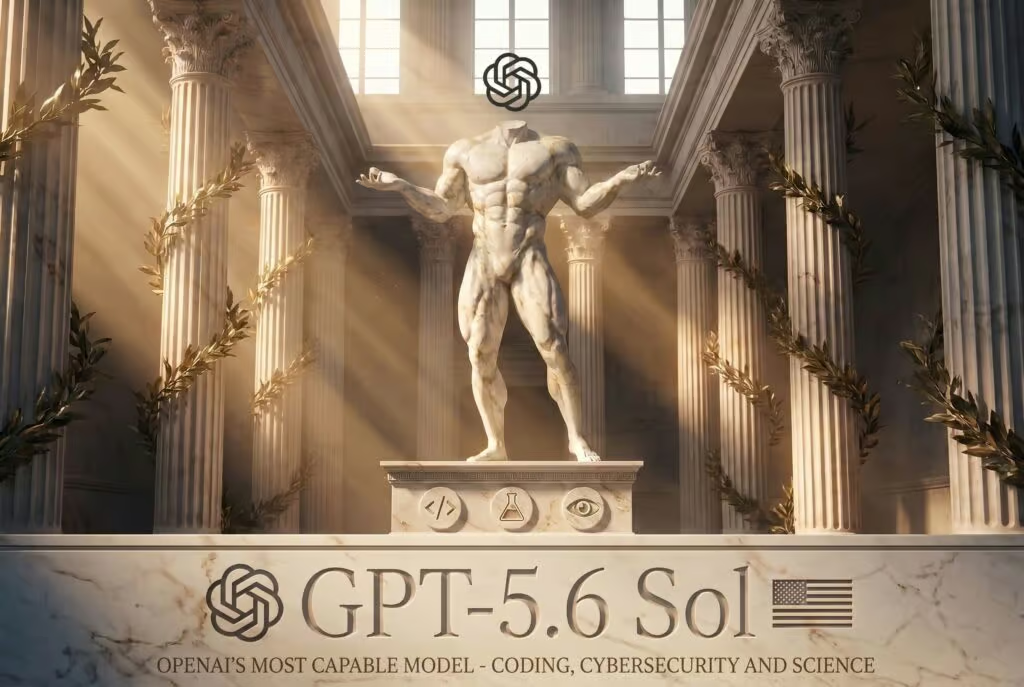
OpenAI is previewing GPT-5.6 Sol, the flagship of a three-model series that introduces a new reasoning architecture called ultra mode. The model launches with the company’s strongest safety envelope yet and, unusually, a limited partner-only rollout requested by the U.S. government. The preview signals a significant step in AI’s ability to plan and coordinate complex, multi-step work without constant human oversight.
GPT-5.6 Sol pairs parallel subagent reasoning with a hardened safety stack, and a government-requested limited release.
Why It Matters
Each generation of frontier model narrows the distance between a prompt and a finished result. A model that can plan, iterate, and coordinate tools on its own changes what a single AI session can accomplish, shifting the work from issuing one instruction at a time to delegating a whole objective. GPT-5.6 Sol is OpenAI’s clearest move yet in that direction, and it arrives wrapped in safeguards that reflect how seriously the company and the U.S. government now treat advanced AI’s cyber capabilities.
The release also matters because of how it is being released. A partner-only preview requested by the government is a departure from OpenAI’s usual broad launches, and it sets a precedent for how the most capable models may reach the public in the future.
How Does GPT-5.6 Sol Work?
Sol is the most capable model in the GPT-5.6 family, sitting above the balanced Terra model and the low-cost Luna tier. Two new reasoning modes set it apart. First, a max reasoning effort gives Sol the deepest thinking time possible under the hood. Second, the ultra mode goes beyond a single agent by spinning up subagents that work in parallel or sequence to accelerate complex workflows. In practice, that means Sol can decompose a large task into coordinated sub-tasks and execute them as one job, rather than requiring a separate prompt for each step.
OpenAI is also reinforcing the model’s defensive posture. The safety stack includes a layered architecture tuned specifically for high-risk cyber requests, automated red-teaming that pressure-tested the system for weeks, and misuse monitoring designed to make prohibited offensive activity more difficult, uncertain, and detectable without choking off legitimate defensive work like vulnerability research and patch development. According to OpenAI’s announcement, the goal is to ensure GPT-5.6 Sol helps people find and fix vulnerabilities far more reliably than it can carry out end-to-end attacks.
The Numbers
- Terra is 2x cheaper than GPT-5.5 while remaining competitive in everyday performance.
- Sol matches Mythos Preview on ExploitBench using only about 1/3 of the output tokens, a large efficiency gain for long-horizon security tasks.
- Stronger results on GeneBench v1, a genomics benchmark, while using fewer tokens than GPT-5.5.
- New state of the art on TerminalBench 2.1, which tests command-line workflows requiring planning, iteration, and tool coordination.
- Sol, Terra, and Luna all improve on ExploitGym, a benchmark built with UC Berkeley researchers, as reasoning effort increases.
We don’t believe this kind of government access process should become the long-term default. It keeps the best tools from users, developers, enterprises, cyber defenders, and global partners who need them. , OpenAI announcement
The launch reflects a broader industry push toward models that do not just output text but orchestrate sequences of actions, planning, calling tools, and checking their own work across multiple steps.
What Comes Next?
OpenAI plans to make GPT-5.6 Sol, Terra, and Luna generally available in the coming weeks. During the limited preview, the company continues testing with trusted partners and coordinating with the U.S. Administration to develop a cyber Executive Order framework. The aim is to create a repeatable process for future model releases that balances security with broad access. Once the gates open, developers and enterprises will be able to build on subagent reasoning for more autonomous, multi-step applications.
What This Means in Practice
For developers and businesses, a model that reasons deeply and coordinates subagents points toward applications that can take on whole objectives instead of single replies. A request that once meant chaining several prompts by hand could be handed off as one task, with the model planning the steps, running them, and returning for approval. The efficiency gains, such as matching a competing model’s security performance on roughly a third of the tokens, also lower the cost of running these longer workflows at scale.
The cybersecurity framing is the other half of the story. By tuning safeguards to favor defensive work over end-to-end attacks, OpenAI is trying to make the same reasoning power useful to security teams hunting and patching vulnerabilities while harder to turn against them. For context on the political backdrop, read our coverage of the government-led restrictions on the GPT-5.6 rollout.
This preview is less about any single benchmark and more about an approaching era where AI does not just reply but plans, decomposing large problems into coordinated steps it can carry out on its own.
The Bigger Picture
GPT-5.6 Sol can act as a creative and analytical partner in addition to a single-shot text generator. The release also tests a new model for distributing frontier AI to the public, with the government involved in deciding access order and timing.
FAQ
What is GPT-5.6 Sol?
GPT-5.6 Sol is the flagship model of OpenAI’s GPT-5.6 series, previewed with a max reasoning effort and an ultra mode that spins up subagents to coordinate complex, multi-step work. It sits above the balanced Terra model and the low-cost Luna tier, and it launches with OpenAI’s strongest safety envelope so far, including a partner-only rollout requested by the U.S. government.
Why is the initial rollout limited to partners?
The U.S. government requested a partner-only preview for GPT-5.6 Sol. OpenAI has accepted this short-term step while working with the Administration on a cyber Executive Order framework, and the company stated it does not believe such government access processes should become the long-term default.
When will GPT-5.6 Sol be generally available?
OpenAI plans to make GPT-5.6 Sol, Terra, and Luna generally available in the coming weeks, after the limited preview with trusted partners and continued coordination with the U.S. Administration conclude.