Local Visibility Is Shrinking: Local SEO in 2026: Why Your Visibility Radius Is Shrinking (And What To Do)
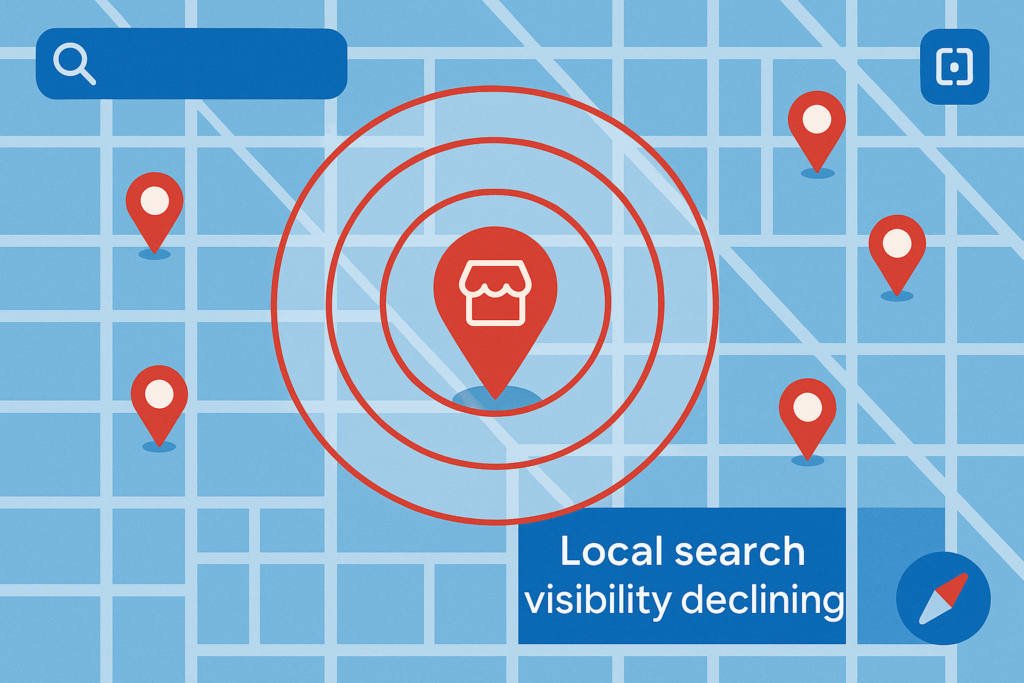
Google’s local visibility radius, the geographic range from which your business surfaces in map results, is contracting from 15-20 miles down to often less than five. The shift is being driven by AI-powered intent models, behavioral proximity signals, and dramatically heavier weighting on Google Business Profile activity. For social media managers, this isn’t a side conversation about SEO. It’s a direct reshuffling of what your feed, photos, and engagement work need to accomplish.
Why It Matters
Local search intent is enormous and growing. BrightLocal’s annual Local Consumer Review Survey shows 98% of consumers used the internet to find information about a local business in 2023, up from 90% in 2019. 87% used Google specifically, and 76% of mobile local searches result in a same-day in-store visit.
The catch in 2026: appearing in those results is harder than it used to be. The visibility radius, what Moz’s Local Search Ranking Factors study consistently ranks among the top three drivers of local pack results, is compressing. A business that was confidently ranking for searches 12 miles away two years ago may now sit invisible at four. For multi-location brands and agencies juggling several rooftops, the contraction is uneven and unforgiving: dense urban markets compress fastest, suburban markets follow.
For the social media manager handling a brand’s overall presence, this is now your problem. The signals Google uses to draw that radius, photo freshness, post cadence, review velocity, response rate, look exactly like the work your team already does on Instagram and TikTok, just routed through a different surface.
Local visibility is no longer a directory problem, it’s a social signal problem, and your feed is the loudest signal Google reads.
What’s New and How It Works
Three forces are tightening the radius simultaneously.
Intent precision. Google’s MUM (Multitask Unified Model) and Gemini-based search layers now interpret nuance, distance tolerance for the category, quality expectations from the device and phrasing, the competitive density nearby, instead of just matching keywords to listings. A search for “best ramen” in a dense neighborhood gets treated very differently from the same query in a suburb.
Hyper-local behavioral data. When users repeatedly choose businesses two miles away over options five miles away, Google learns that proximity is the dominant quality signal for that category in that area. Multiplied across billions of clicks, this is what physically compresses the radius year over year.
GBP signals are now load-bearing. Google Business Profile signals, review quantity and recency, category accuracy, photo freshness, post activity, and Q&A completeness, now account for a materially larger share of local ranking than they did two years ago. A dormant GBP is no longer a missed opportunity; it’s a ranking penalty in slow motion.
The Numbers
BrightLocal’s research and adjacent 2026 ranking studies put concrete figures on what’s actually moving local results:
- 98% of consumers used the internet to find information about a local business in 2023, up from 90% in 2019.
- 87% of consumers used Google as their primary platform for evaluating local businesses.
- 76% of local searches on a smartphone result in a same-day in-store visit.
- 57% of consumers will only consider businesses with four stars or more.
- Reviews older than three months are weighted significantly less than fresh reviews.
“Google’s MUM (Multitask Unified Model) and Gemini-based search systems can now interpret local search intent with much greater precision than keyword matching alone allowed.”
That precision is what’s compressing the radius, and what’s rewarding the brands posting most consistently and most authentically at the neighborhood level.
What Comes Next
Expect the next 12-18 months to push three trends harder.
Hyperlocal content moves from optional to default. Generic city- or county-level pages are getting outranked by neighborhood-specific content that names landmarks, streets, and community context only someone embedded locally would reference. The same logic applies to social: your TikTok geo-tag and your Instagram location pin matter more than they did last year.
GBP becomes social media. Google Business Profile signals, including review quantity and recency, category accuracy, photo freshness, post activity, and Q&A completeness, now account for a larger share of local ranking than they did two years ago. Weekly Google Posts, fresh photos, Q&A activity, and timely review responses are no longer set-and-forget. They’re a content calendar, and one that maps directly onto the cadence and tooling a social media manager already runs.
Review workflows integrate with content workflows. Brands winning local visibility in 2026 are running review generation as a campaign, not a feature: post-service text follow-ups, in-store QR-code prompts, link-in-bio review CTAs that route Instagram and TikTok fans straight to the GBP review link.
What This Means for You
If you run social for a brand with physical presence, even one location, the shrinking radius means your job description just expanded. The neighborhood-level relevance Google is rewarding is built from the exact materials you already produce: fresh photos, current posts, real engagement, owner responses to comments and reviews.
A few moves that pay off fast:
Treat Google Business Profile as another channel in your social publishing rotation. Weekly Google Posts, monthly photo refreshes, and Q&A updates should sit alongside your Instagram and TikTok calendar, not in a separate folder no one opens. A multi-platform scheduler like Feedsta is how brands keep this cadence sustainable across rooftops, brands, and locations.
Convert link-in-bio traffic into review velocity. If your link-in-bio page is collecting social traffic and pointing nowhere useful, route a CTA to your Google review link. A small percentage of the warm fans coming from Instagram or TikTok will leave a review if you ask cleanly, and review recency is one of the weightiest signals you have.
Make hyperlocal content a habit, not a campaign. Your brand’s branded search is what Google trusts most as a local quality signal, and as covered in our breakdown of branded search as the most underrated SEO lever, the work that lifts branded search is the same work that lifts local prominence: name your neighborhood, tag specific streets, feature local staff.
Lean into real-person content. Google’s E-E-A-T framework and the local algorithm are converging on the same answer: corporate polish is losing to genuine human presence. Our piece on why real creators beat corporate feeds walks through how to operationalize that across your social and GBP content.
None of this is glamorous. It’s the unsexy weekly drumbeat, and that’s exactly why most competitors will skip it.
The Bigger Picture
The visibility radius isn’t shrinking because Google decided to punish small businesses. It’s shrinking because Google has finally figured out how to read what local actually means. The signals it now trusts most are the ones a competent social media operator already produces: fresh content, frequent posts, real responses, authentic neighborhood context. Brands that connect their GBP, social calendar, and review workflow into one disciplined cadence will keep, and recapture, radius. Brands that keep treating local SEO as a directory listing will keep losing it.