Multi-Location Social Media Management: 2026 Operator Playbook
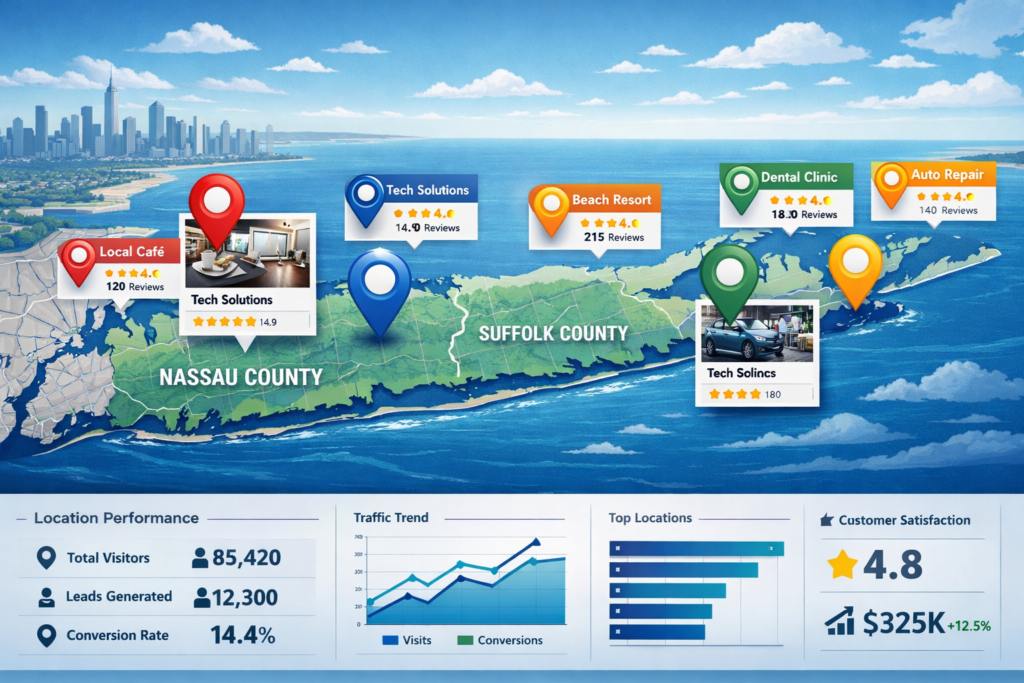
Multi-location operators should run each location as a separate brand entity on social, with its own Google Business Profile, its own content, and its own review workflow, because duplicate content, templated responses, and rollup metrics now cap growth at the weakest location. Roughly 821,000 U.S. franchise establishments and a growing layer of multi-unit healthcare, restaurant, and service brands are competing on those rules in 2026.
Why does multi-location social media need its own playbook?
The franchise and multi-location economy is bigger than ever. The International Franchise Association projects roughly 821,000 franchise establishments operating in the U.S., contributing more than $897 billion in annual economic output. Add in healthcare systems, dental groups, multi-unit restaurants, regional service contractors, and the dental-services groups buying up independent practices across the country, and a meaningful share of marketers are now juggling multiple brand entities, not just multiple platforms.
The single-location playbook does not scale. Posting cadence, content variation, review handling, and analytics all become a different problem when you cross from one location to five, fifteen, or fifty. The cost of getting it wrong shows up as uneven local-pack rankings, lopsided review profiles, and AI search engines that simply refuse to recommend your weaker locations.
What’s new: multi-location as a social discipline
The instinct most operators have wrong: treat every location as the same brand on social, post the same content from a master account, and call it done. Google’s own Business Profile guidelines require a separate profile per physical location with a unique address and phone number, and the AI answer engines pulling from social bios are following suit.
Multi-location brand accounts function as a connected group of separate accounts rather than a single account.
- A separate Google Business Profile per location, each with its own posts, photos, and Q&A activity
- Either dedicated location handles on Instagram, Facebook, and TikTok, or a single brand handle with rigorously geotagged, location-specific posts
- Location-specific landing pages and link-in-bio destinations that don’t read like duplicates of the master site
- Review monitoring across every social and listing channel, not just Google
- NAP (Name, Address, Phone) consistency across every directory and every social bio
The duplicated-content trap is everywhere. A location page that reads "We serve Springfield, [same content as the Fairview page]" gets detected by Google’s duplicate-content systems and stripped of ranking value. The same logic is starting to apply to social bios and pinned posts: identical copy across five location accounts is a signal, and not a good one.
Multi-location social media isn’t one brand with five pins on a map, it’s five brands sharing a logo, and the algorithm knows the difference.
Which numbers actually matter at scale?
The reporting framework changes too. Rollup metrics, total followers across all accounts, total impressions across the brand, hide the underperforming location quietly bleeding share. The numbers that actually matter at scale:
- ~821,000 franchise establishments operating in the U.S. (IFA, 2024)
- $897B+ in franchise economic output annually
- 10+ reviews read on average before a consumer trusts a local business (BrightLocal Local Consumer Review Survey)
- 5x+ local-pack ranking variance commonly observed between locations of the same multi-unit brand
- GBP impressions, action rate, review velocity, and average rating, tracked per location, not just rolled up
The templated-response problem is one most enterprises sleep on:
“Thank you for your feedback! We are pleased to serve you!” applied to every review across every location is detectable as automation and reduces the trust signal reviews are supposed to provide.
Translated for social: copying and pasting the same DM reply, the same comment response, or the same review thank-you across thirty locations doesn’t just look lazy, the engines see it, and your prospects see it.
What changes through 2026 and into 2027?
Two trends are accelerating through 2026 and into 2027. First, the AI answer engines, ChatGPT search, Gemini, Perplexity, are weighting entity consistency more heavily. When a model is deciding whether to recommend “the best dentist near you,” it’s cross-referencing your GBP, your Instagram bio, your Facebook page, your Yelp listing, and your website. Discrepancies in business name, hours, or phone number across those sources lower confidence and lower placement.
Second, platforms themselves are exposing more location-level signals. Instagram is testing richer location tagging in Reels surfaces, TikTok’s local discovery keeps improving, and Meta’s location-page hierarchy now lets parent brands manage child location pages with finer permissioning. The platforms are building infrastructure for multi-location operators, the brands that adopt it cleanly will compound the advantage.
For franchise networks and enterprise service operators, the next 12-24 months will widen the gap between brands with disciplined per-location social and citation hygiene and brands that “go viral” once a quarter from a corporate account.
What should operators do this quarter?
If you’re managing more than three locations on a single calendar and a single inbox, you’ve already outgrown your setup. The operating model has to shift from “one brand voice” to “one brand voice executed locally”, and that demands a tooling layer built for multi-brand workflows.
Practical moves to make this quarter:
- Audit every social bio, link-in-bio destination, and GBP listing for NAP consistency. The Social Profiles Are Listings Now NAP playbook walks through this exact audit step by step.
- Move multi-brand management onto a platform built for it. Feedsta, an AI-powered social media platform, gives each location its own posting calendar, inbox, and analytics view while keeping portfolio-level visibility for the operator.
- Use a per-location shortener and QR code system so direction requests, menu downloads, and booking links can be attributed back to the specific location that drove them.
- Fold Google Business Profile into the publishing schedule the same way you treat Instagram or TikTok. The 2026 Google Business Profile guide covers cadence and content types.
And on review responses: assign them, don’t template them. A response written by a person who actually knows that location reads differently, both to humans and to the AI systems summarizing your business, than one fired from a shared inbox.
What is the bigger picture?
The unglamorous work, per-location landing pages, citation cleanup, individualized review responses, separate review-velocity audits per market, is the work that compounds. Multi-location social media management isn’t a content problem; it’s an architecture problem. The brands that treat each location as a separate entity, resource it as a separate entity, and measure it as a separate entity will quietly own their local markets in 2026 while their competitors keep wondering why the corporate Reel didn’t move the needle in their weakest market.
FAQ
Do I need a separate Google Business Profile for each location?
Yes. Google’s Business Profile guidelines require one profile per physical location with a unique address and phone number, and combining multiple locations into one profile can result in suspension and forfeits ranking in each location’s local 3-pack.
Can I post the same content across all my location social accounts?
No. Identical copy across location accounts triggers duplicate-detection logic on search and is increasingly visible to AI answer engines cross-referencing your bios. A workable hybrid is to start from a master template and require each location to add 2-3 local elements (a landmark, a staff member, a regional offer) before publishing.
How should multi-location operators handle review responses at scale?
Delegate them, don’t template them. Assign review response to a person tied to that specific location (manager, assistant, or regional coordinator) with response-time SLAs and a brand-voice guide. Centralized monitoring is fine; centralized response writing is not, and each reply should reference something specific from the review.