Poolside releases Laguna S 2.1, an open-weight coding model it says beats rivals 10x its size
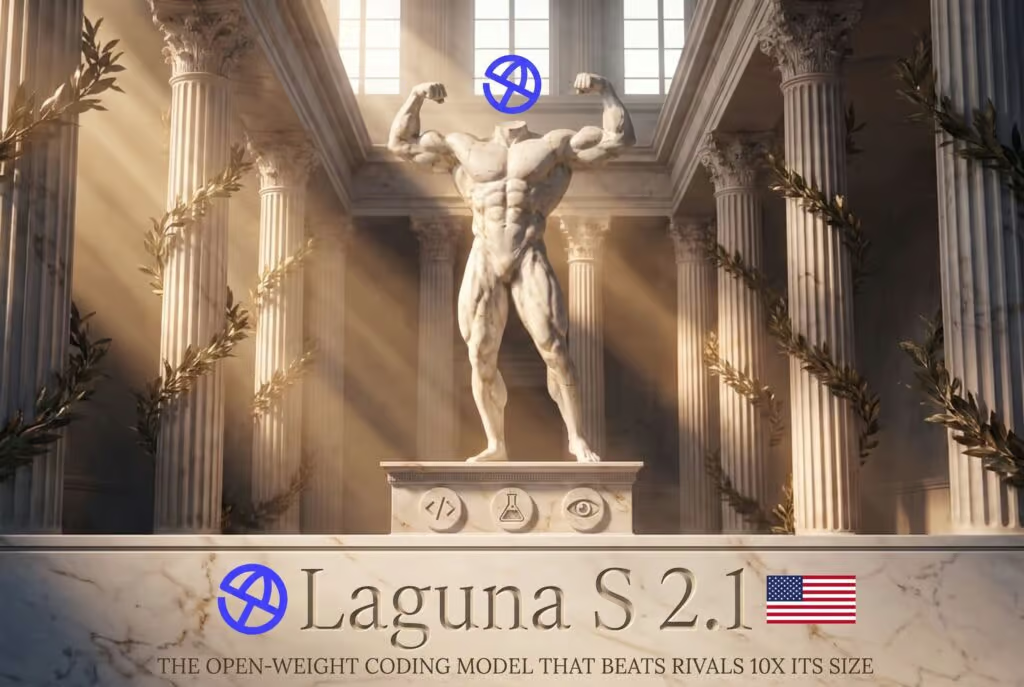
Poolside, a San Francisco AI lab known for selling coding models to governments and defense agencies, released Laguna S 2.1 on Tuesday, July 21, 2026. The model is a 118-billion-parameter Mixture-of-Experts (MoE) coding model that activates 8 billion parameters per token and supports a context window of up to 1 million tokens. Poolside is positioning the release as a Western open-weight counterweight to a wave of Chinese open-weight models from DeepSeek, Qwen, Kimi, GLM, and Tencent Hunyuan.
What is Laguna S 2.1?
Laguna S 2.1 is a sparse Mixture-of-Experts model with 256 routed experts and one shared expert. It uses grouped-query attention and interleaved sliding-window layers. Because only 8 billion parameters activate per token, inference costs scale with that active size, and the model is small enough to run on a single Nvidia DGX Spark. The weights are available on Hugging Face under the permissive OpenMDW-1.1 license, making it openly licensed for modification and redistribution.
How was it trained and shipped?
Pre-training began on May 22, 2026, and the model launched in under nine weeks. Training was conducted on 4,096 Nvidia H200 GPUs. Poolside said it has shipped three models in three months.
How does Laguna S 2.1 perform on benchmarks?
On Terminal-Bench 2.1, a long-horizon terminal-task benchmark, Laguna S 2.1 posted 70.2 percent. That placed it 11th on Poolside’s compiled leaderboard and ahead of DeepSeek-V4-Pro-Max, a 1.6-trillion-parameter model that scored 64.0, Thinking Machines Inkling (975 billion parameters, 63.8), and Nvidia Nemotron 3 Ultra (550 billion parameters, 56.4). On SWE-Bench Multilingual, Laguna S 2.1 scored 78.5 percent, and on the SWE-Bench Pro public dataset it scored 59.4 percent. On its hardest benchmark with thinking mode enabled, the model consumes roughly 249,000 completion tokens per trajectory.
Why is Poolside framing this as a Western open-weight story?
Poolside argues that no Western lab has released open weights in this size class for 11 months, with the last comparable release being OpenAI’s gpt-oss-120b last August. The company points to recent open-weight releases from Chinese labs, naming DeepSeek, Qwen, Kimi, GLM, and Tencent Hunyuan as examples of the gap Poolside wants to close. Co-CEO Jason Warner said the West needs open-weight models it can trust, run, and build on. Co-founder and co-CEO Eiso Kant wrote on X that intelligence should and will become a commodity.
Who is Poolside, and what is its business?
Poolside is a San Francisco AI lab that has spent most of its three-year existence selling coding models to governments and defense agencies. The release of Laguna S 2.1 broadens its footprint beyond government customers by dropping an openly licensed coding model into the Hugging Face ecosystem, where anyone can download, run, and fine-tune the weights under the OpenMDW-1.1 license.
FAQ
What is Laguna S 2.1?
Laguna S 2.1 is a 118-billion-parameter open-weight Mixture-of-Experts coding model released by Poolside on July 21, 2026. It activates 8 billion parameters per token and supports up to 1 million tokens of context.
How did Laguna S 2.1 compare to larger models on coding benchmarks?
On Terminal-Bench 2.1, Laguna S 2.1 scored 70.2 percent, ahead of DeepSeek-V4-Pro-Max at 64.0, Thinking Machines Inkling at 63.8, and Nvidia Nemotron 3 Ultra at 56.4. It scored 78.5 percent on SWE-Bench Multilingual and 59.4 percent on SWE-Bench Pro.
Where can developers download Laguna S 2.1?
The weights are available on Hugging Face under the permissive OpenMDW-1.1 license, and the model is small enough to run on a single Nvidia DGX Spark.