Qwen3.8-Max ships with benchmarks and pricing, but open weights are still missing
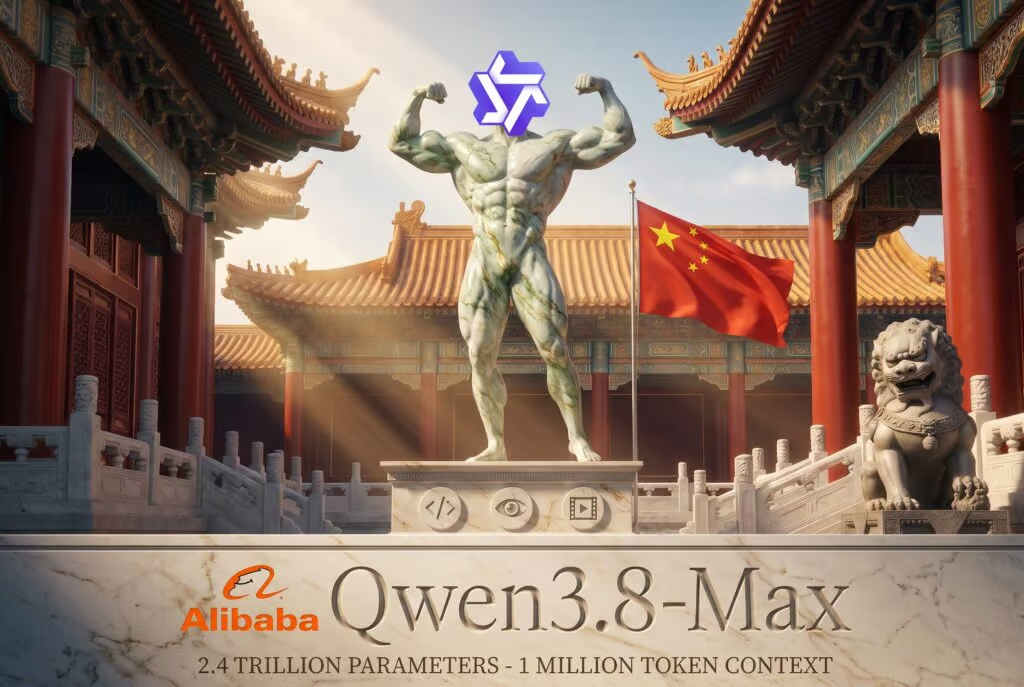
Alibaba released Qwen3.8-Max to general availability on August 3, 2026, two weeks after previewing it at WAIC Shanghai with nothing but a slide. This time the 2.4 trillion-parameter Mixture-of-Experts model shipped with a published benchmark table, real per-token pricing, a production API, and native text, image, and video input. The one piece still missing is the open-weight release Alibaba promised for the week of August 10, which had not appeared on Hugging Face or ModelScope as of August 11.
What Qwen3.8-Max is
Qwen3.8-Max is a 2.4 trillion-parameter sparse MoE model with roughly 95 billion active parameters per token, according to third-party reporting. It carries a 1-million-token context window (991K max input, 131K max output, with reasoning chains up to 262K) and accepts text, image, and video input while producing text output. Alibaba describes the model less as a chatbot upgrade and more as an autonomous-agent flagship, building on the architecture introduced with Qwen3.7-Max and extending multimodal input above the trillion-parameter mark for the first time in the family.
Key specifications
- Provider: Alibaba (Qwen team)
- Parameters: 2.4 trillion total, sparse MoE, roughly 95 billion active per token
- Context window: 1,000,000 tokens
- Modalities: Text, image, and video input; text output
- Input price: $2.00 per million tokens (cache miss)
- Output price: $6.00 per million tokens
- Cached input: $0.25 per million (implicit) to $0.17 per million (explicit read)
- Rate limits: 2M tokens per minute, 15,000 requests per minute
- API protocols: OpenAI-compatible and Anthropic Messages-compatible
Benchmark performance
Alibaba’s published table puts Qwen3.8-Max against Claude Fable 5, GPT-5.6, and Claude Opus 4.8. The pattern is consistent enough to trust directionally, though every number is vendor-run by Alibaba and no independent evaluator has reproduced the full table yet.
- OSWorld-Verified: 86.1, ahead of Fable 5 (~85.0), GPT-5.6 (83.2), and Opus 4.8 (not published)
- PaperBench: 93.0, ahead of GPT-5.6 (90.5), Fable 5 (88.8), and Opus 4.8 (80.3)
- Terminal-Bench 2.1: 86.6, behind GPT-5.6 (88.8) and ahead of Fable 5 (84.6) and Opus 4.8 (84.6)
- SWE-bench Pro: 67.7, behind Fable 5 (80.0), Opus 4.8 (69.2), and ahead of GPT-5.6 (64.6)
- GPQA Diamond: 92.6, behind GPT-5.6 (94.1), tied with Fable 5 (92.6), and ahead of Opus 4.8 (92.0)
- IFBench: 82.8, well ahead of Fable 5 (63.5), GPT-5.6 (72.7), and Opus 4.8 (62.2)
- HLE (Humanity’s Last Exam): 43.6, last of the four; Fable 5 at 53.3, GPT-5.6 at 47.2, Opus 4.8 at 45.7
Qwen3.8-Max leads the four-way comparison on agentic computer-use and long-document tasks, including OSWorld-Verified, PaperBench, and IFBench. It holds its own on general terminal agentic work but trails Claude Fable 5 by 12 points on SWE-bench Pro, the harder of the two coding benchmarks in the table. On broad-knowledge reasoning measured by HLE, it finishes nearly 10 points behind Fable 5. Alibaba’s own Arena.ai citation puts the model at rank 5 on Text Arena, sandwiched between four different Claude configurations.
Pricing and availability
Qwen3.8-Max is live now on QwenCloud at $2.00 per million input tokens and $6.00 per million output tokens, with cached reads as low as $0.17 per million on explicit cache hits. That undercuts Moonshot AI’s Kimi K3, listed at $3.00/$15.00, by a wide margin and roughly matches Qwen3.7-Max’s prior $2.50/$7.50 rate card despite the jump in scale.
Access runs through the QwenCloud API under model ID qwen3.8-max, Alibaba Cloud Model Studio’s international scope, and the Vercel AI Gateway at zero markup (alibaba/qwen3.8-max). Alibaba also shipped a day-one Anthropic Messages-compatible endpoint, which means Claude Code can point at Qwen3.8-Max by changing ANTHROPIC_BASE_URL and ANTHROPIC_MODEL with no other workflow changes, the cheapest way to run a side-by-side comparison against Claude models inside an existing agent setup.
Where Qwen3.8-Max stands out
Long-horizon autonomous coding
Alibaba’s headline demonstration is oh-my-cli, a command-line agent framework the model built entirely on its own: turning incoming requests into GitHub issues, claiming them through a state machine, writing code, running end-to-end tests, and merging its own pull requests. As of July 30 the run had produced 265 commits, 127 pull requests, and 151 issues over 16 days without human intervention. The repository was still active at publication, showing 797 commits, 61 open issues, an Apache-2.0 license, and a commit merged within the hour. That is a more convincing agentic-coding demonstration than a static benchmark score, even though it remains a controlled demo project rather than an independent test.
Research and competition tasks
Alibaba reports Qwen3.8-Max reproduced a published paper on data selection for LLM reasoning, writing roughly 7,600 lines of code and running 33 GPU training rounds over five days to land a +2.71 point improvement on AIME24 over the original paper’s method. In a separate 24-hour coding competition, the model’s entry reportedly beat 458 of 526 human teams, landing in the 87th percentile.
Native multimodal agents at scale
Qwen3.8-Max processes documents past 200 pages and video past 100 hours using what Alibaba calls video memory graphs, and pairs GUI screen operation with visual feedback loops for verifying its own output, evaluated internally against Alibaba’s RecreationBench. This carries forward the multimodal push started with Qwen3.6-Max-Preview, now applied to a model an order of magnitude larger.
The open-weight promise is still pending
The unresolved piece is the open-weight release. Alibaba said weights for Qwen3.8-Max and a smaller Qwen3.8-27B would land on Hugging Face and ModelScope during the week of August 10. One day past that window’s start, no repository has appeared for either model and no license has been named. That leaves an open question of whether a Max-class open weight would ship under the permissive Apache-2.0 license used for smaller Qwen releases like Qwen3.6-27B, or something more restrictive. Until weights land, the model should be labeled open-source false regardless of what has been promised.
FAQ
Is Qwen3.8-Max open source?
Not yet. Alibaba promised open weights for Qwen3.8-Max and a smaller Qwen3.8-27B during the week of August 10, 2026, but as of August 11 neither model has appeared on Hugging Face or ModelScope, and no license has been confirmed.
How much does Qwen3.8-Max cost?
$2.00 per million input tokens and $6.00 per million output tokens on QwenCloud, with cached reads as low as $0.17 per million. That is roughly one-third of Kimi K3’s per-token cost.
Does Qwen3.8-Max beat GPT-5.6 and Claude Fable 5?
It depends on the task. Alibaba’s own table shows it ahead on OSWorld-Verified, PaperBench, and IFBench, but behind Fable 5 by 12 points on SWE-bench Pro and behind all three rivals on HLE. It is not a clean sweep in either direction.
Related coverage
This article summarizes reporting from awesomeagents.ai.