The 6-Step Social Media Content Marketing Process for 2026
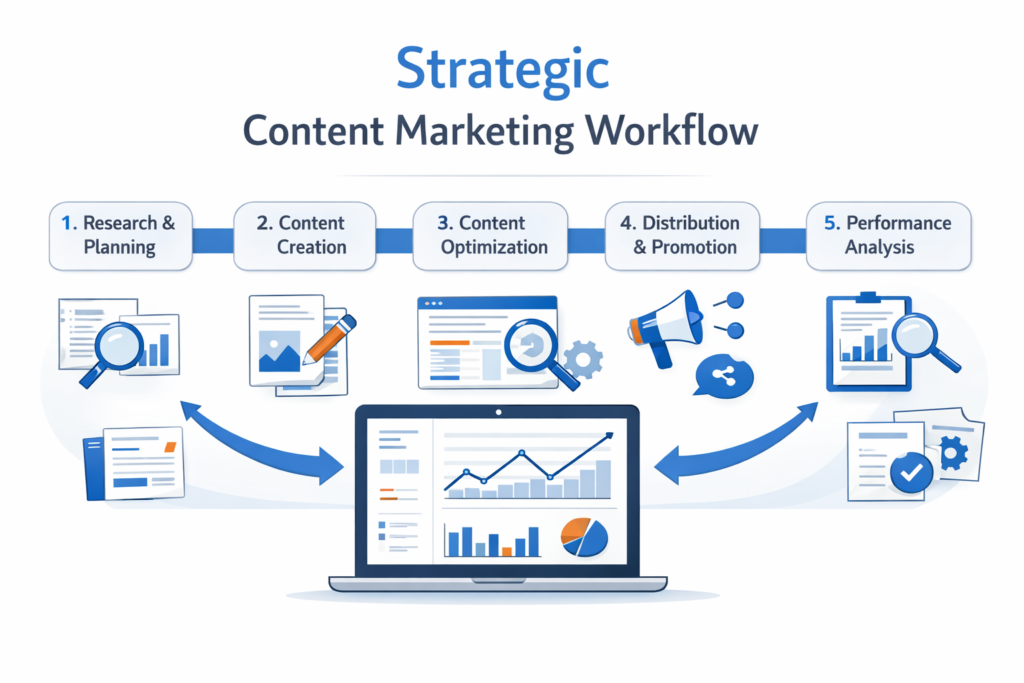
The gap between brands that scale their content and the ones that plateau isn’t talent, budget, or follower count, it’s process. In 2026, social feeds move through faster algorithm cycles, more platforms, and a punishing publishing cadence, which is why winning teams run a connected six-step content engine built around research, a calendar, creation, and measurement. Run it as a system and you can start on Monday morning.
Why It Matters
Most brands aren’t short on ideas, they’re short on the disciplined process that connects audience research to creation to distribution to measurement. Brands now manage multiple active channels simultaneously, and platform algorithm updates ship across TikTok, Instagram, X, and YouTube on a constant cycle. Without a repeatable system, even a strong creative team burns out chasing trends instead of building compounding reach.
This isn’t a social-vs-search debate either. The same six steps that earn organic visibility, research, planning, creation, optimization, distribution, measurement, map cleanly to how AI-driven feed algorithms decide what to amplify. Google’s long-running guidance on creating helpful, people-first content applies almost verbatim to the social feed: demonstrate experience, show expertise, satisfy the searcher. The brands winning across both surfaces in 2026 share a common operating discipline.
Social content marketing in 2026 isn’t about posting more, it’s about running a six-step engine that compounds while you sleep.
How Does the Six-Step Process Work?
The six steps can be adapted to a publishing schedule as follows.
Step 1: Research what your audience is actually searching and scrolling
Keyword research isn’t just for Google anymore. TikTok’s search bar, Instagram’s Explore, and YouTube’s suggestion engine all reward content that maps to real audience queries. Pair Ahrefs or Semrush data with each platform’s native search suggestions to identify 20-50 topic clusters with genuine demand. The key is to think like your customer, not like your industry.
Step 2: Build a calendar with intent, not just slots
Every post needs a job, awareness, consideration, or conversion. A well-structured calendar balances awareness content, consideration content, and conversion content across a consistent publishing schedule. For most brands, two to four high-quality long-form pieces a month plus daily platform-native repurposes outperforms a daily firehose of thin content.
Step 3: Create content that outperforms what’s already winning
Open the platform, look at what’s ranking or going viral for your topic, then ask what you can do that’s materially better. Local specificity, original data, and direct customer outcomes are the differentiators both human audiences and recommendation algorithms reward.
Step 4: Optimize every piece for the algorithm AND the human
On social, that means platform-native formats, accurate first-frame hooks, captions that match search intent, real alt text, and clean tagging. Landing pages linked from bios or carousels need to clear the bar Google sets for Core Web Vitals, slow pages kill the conversion you worked all week to earn.
Step 5: Distribute across the stack, not just post and pray
A single asset should land as a Reel, a Short, a carousel, a Pin, a thread, an email cutdown, and a link-in-bio update. Distribution is where most teams underbuild and where compounding reach actually lives.
Step 6: Measure and refine quarterly
Set a real dashboard, assign dollar values to conversion actions, and prune the formats that aren’t earning their slot. Refreshing an existing high-performer almost always beats writing the seventh new piece on the same topic.
The Numbers
- 6 connected steps form the full content engine
- 20-50 topic clusters per brand at the research phase
- 2-4 high-quality long-form pieces per month outperforms daily thin posts
- 6+ active social channels is now the median for serious brands
- 90 days is the right cadence for full performance review and refinement
- 2-3 seconds is the maximum tolerable page load on linked landing pages
“Content marketing without measurement is guesswork.” Most teams skip the sixth step.
What Comes Next
The next wave of social content marketing is being shaped by AI search and platform AI features simultaneously. Google’s AI Overviews, Perplexity, ChatGPT, and Gemini all increasingly cite social-platform content in their answers, which means a TikTok caption or LinkedIn thought-leadership post can now influence whether your brand surfaces in an AI answer. Meanwhile, platforms themselves are baking AI suggestion engines deeper into the feed, Instagram’s 2026 ranking leans heavily on semantic clustering, and TikTok’s search bar increasingly behaves like a vertical AI assistant.
Expect AI keyword clustering tools, real-time best-time-to-post recommendations, and automated repurposing across formats to become table stakes inside the next twelve months. The brands that already have steps 1-6 running smoothly will benefit most from layering AI on top; the brands without a process will simply get faster at producing the wrong content.
What This Means for You
If you’re juggling four or more brands, the takeaway isn’t “post more.” It’s “run a process.” Build your topic clusters once a quarter. Lock your calendar a month ahead. Use AI to draft and repurpose, not to replace your point of view. Optimize for each platform’s native search and recommendation surfaces, not just the feed.
That’s where a unified workflow earns its keep. Feedsta, an AI-powered social media platform, is built to run all six steps in one place: multi-brand calendars, AI-assisted creation, cross-platform scheduling, native analytics, and the inbox where audience signals come back in, with short links, QR codes, and link-in-bio updates rolling into the same calendar so distribution stops living in a separate tool.
For deeper plays on the research and creation steps, our 2026 local content strategy playbook shows how location signals translate to social. And if you’re still operating on assumptions about how search and social interact in 2026, the SEO myths breakdown is worth a re-read, several of the “rules” you may still be following stopped applying two algorithm updates ago.
The Bigger Picture
Social content marketing in 2026 is a systems game. The brands whose reach keeps growing aren’t the ones with the loudest creators; they’re the ones whose research, calendar, creation, distribution, and measurement work together in a weekly system. Get those six gears turning together, and AI plus consistency does the rest.
FAQ
What is the social media content marketing process?
It’s a six-step operating system that turns scattered posting into compounding reach: research what your audience is searching and scrolling, build an intent-driven calendar, create assets that outperform what’s already winning, optimize for both the platform’s algorithm and the human reading it, distribute across the full stack, and measure and refine quarterly.
How many social media posts should I publish per month in 2026?
For most brands, two to four high-quality long-form pieces per month plus daily platform-native repurposes outperforms a daily firehose of thin content. Quality cadence and intent beat raw volume every time.
How often should you review social media analytics?
Run a deeper review every 90 days to refresh topic clusters, prune underperforming formats, and double down on what earns its slot. The quarterly cadence matches step 6 of the framework and prevents overreacting to weekly noise.