SpaceX’s AI1 Orbital Data Center: Implications for Social Teams
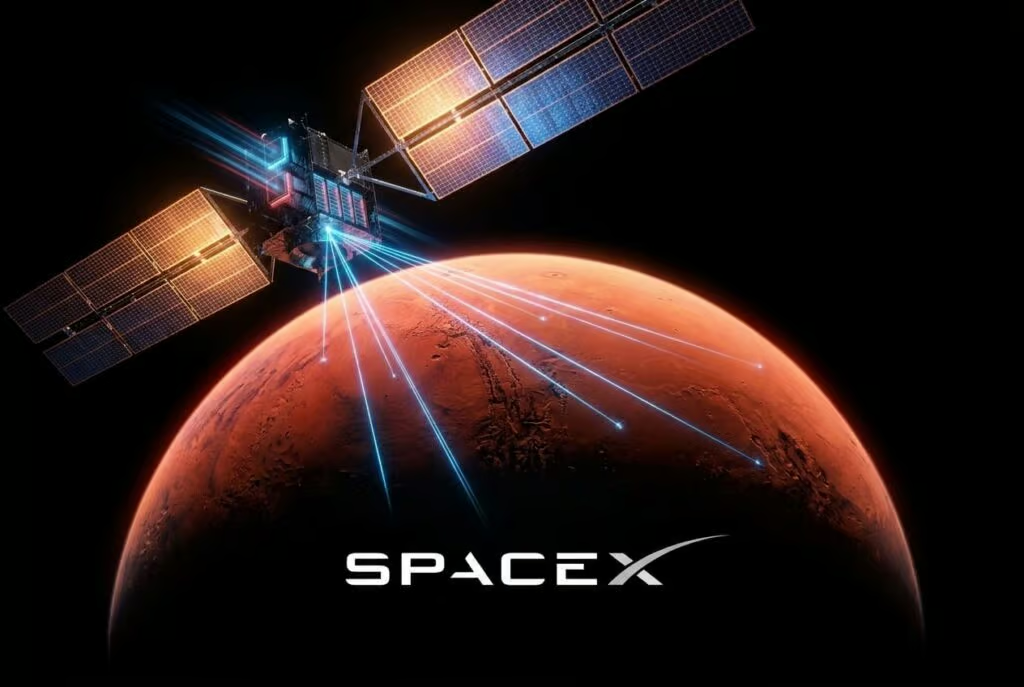
AI compute is about to leave the cloud and take up orbit. SpaceX is pushing its AI1 satellite toward launch later this year, a solar-powered data center that will run artificial intelligence workloads in space, and Google and Anthropic are already signed on as the first customers. For social media teams that rely on these same AI models for content creation, scheduling, and audience engagement, the orbital shift isn’t a distant headline; it’s a signal that the infrastructure behind your tools is about to change.
Why It Matters
Today’s social media managers use AI to draft captions, repurpose videos, analyze engagement, and schedule posts across platforms. Those capabilities depend on massive cloud data centers that consume land, power, and water. SpaceX’s AI1 satellite rewrites that equation: it places AI compute in low Earth orbit, powered entirely by the sun and linked to the ground via Starlink’s laser mesh. The goal is to deliver low-latency AI inference anywhere on the planet, including regions where terrestrial data centers are sparse or overloaded.
Google’s Gemini models and Anthropic’s Claude already power a growing share of social content workflows. Moving a portion of that compute to orbit could make real-time AI-assisted publishing faster and more resilient, especially for field teams, event coverage, and creators in underserved connectivity zones. As AI becomes embedded in every part of a social manager’s stack, where and how that AI runs becomes a competitive lever.
What’s New: The AI1 Orbital Data Center
AI1 is not a traditional communications satellite. It’s a flat-panel experimental spacecraft built on SpaceX’s Starlink bus, carrying a dedicated compute payload designed to test on-orbit processing for artificial intelligence workloads. The satellite is designed to harness solar energy directly, without the cooling demands of a terrestrial facility, and will connect to Starlink’s existing constellation via optical inter-satellite links, beaming processed results to the ground with minimal delay.
The Federal Communications Commission application for AI1 lists Google LLC and Anthropic PBC as experiment collaborators, confirming that the first orbital AI workloads will run some of the world’s most advanced large language models. The filing describes the mission as an experiment to evaluate on-orbit AI inference under real-world conditions, with a target launch window in the second half of 2026.
The Numbers
- The AI1 satellite is a flat-panel design, approximately 200 kg, leveraging the Starlink bus and optical laser links.
- The solar array generates around 1.5 kW, dedicated to the onboard compute payload, a fraction of what a ground data center draws for the same tasks.
- Google and Anthropic are explicitly named as experiment collaborators in the FCC experimental authorization (FCC application SAT-LOA-20260423-00038).
- Launch is targeted for late 2026, with on-orbit experiments to begin shortly after deployment.
- Sundar Pichai confirmed Google’s involvement on X, stating the company is “proud to partner with SpaceX on AI1, an orbital data center that will run Google’s AI models in space.”
“The purpose of the experimental authority is to test on-orbit processing capabilities for artificial intelligence workloads.”, FCC Experimental Application SAT-LOA-20260423-00038
What Comes Next
If AI1 succeeds, SpaceX plans to scale orbital compute into a full constellation, effectively building a distributed AI supercomputer in space. Google and Anthropic would be able to run inference at the edge of the network, reducing the need for round-trip traffic to terrestrial servers. This could accelerate the deployment of AI features inside social media management platforms, real-time content generation for live events, and AI-assisted moderation that works even when cellular networks are congested.
Regulatory questions will follow. Orbital AI raises new questions about data sovereignty, environmental impact from launch activity, and the governance of AI models running outside any nation’s jurisdiction. But for now, the mission is experimental and focused squarely on technical feasibility.
Space is the next frontier for AI compute, and social media content creators will feel the boost.
What This Means for You
As a social media manager, you won’t need to launch anything to benefit from orbital AI. The models you already use inside tools like Feedsta, whether it’s generating posts, optimizing captions, or analyzing performance, could run faster and reach you even when you’re far from a reliable data center. An orbital layer makes always-on, low-latency AI feasible, which matters when you’re scheduling live-event coverage or managing multiple brand accounts across time zones.
Feedsta surfaces AI-powered content creation and scheduling inside a single cross-platform dashboard. As Google and Anthropic push their models into orbit, the quality and responsiveness of those features should improve without your team changing a single setting. You’ll also want to keep an eye on how orbital compute affects AI availability in emerging markets, handy if you manage global brands. For a snapshot of how your business shows up in AI-driven tools today, run a free visibility scan at BizScoreAI.
We’ve covered the implications of Anthropic’s latest model for social teams (Claude Fable 5 breakdown), and just as zero-click searches forced a re-think of platform strategy, orbital AI will shift how fast and where you can generate content, particularly in bandwidth-constrained locations (zero-click searches at 68%).
The Bigger Picture
AI is no longer bound to Earth-bound data centers. SpaceX’s AI1 satellite, with Google and Anthropic as early customers, marks the point where the infrastructure that powers social content creation literally leaves the ground. For social media professionals, that means the tools you depend on are about to become faster, more accessible, and powered by a new kind of renewable energy, direct sunlight in orbit. Staying ahead of this shift doesn’t require a degree in aerospace engineering. It just requires understanding that the cloud now has an orbital address, and the content you publish next year may be shaped by an AI running in space.