Trump administration reportedly reviving push to ban Chinese AI models after Kimi K3 launch
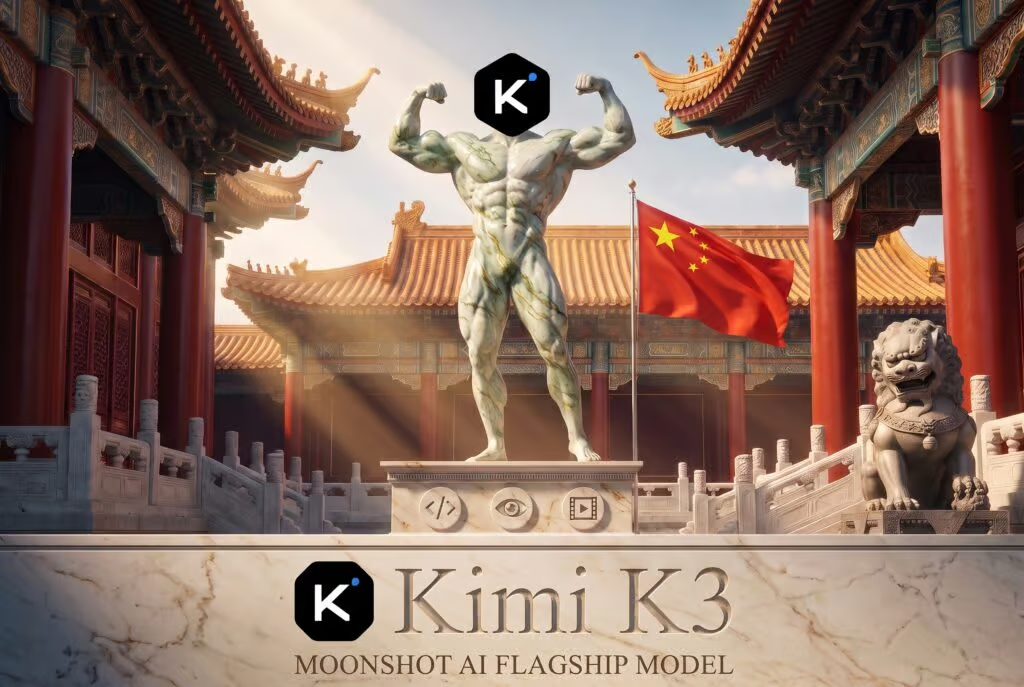
The Trump administration is reigniting its effort to restrict leading Chinese AI models in the United States, according to an Axios report published on July 20, 2026. The renewed push follows the release of Kimi K3, an open-weight model from the Chinese startup Moonshot AI, and comes amid rising adoption of Chinese systems by American companies. Officials cite cybersecurity concerns, while critics inside and outside government warn that an outright ban would be hard to enforce and would entrench a closed-model duopoly at home.
Why the policy push has restarted
According to Axios, citing sources close to the administration, the White House had paused several earlier measures aimed at Chinese AI labs over concerns about market impact. Those measures are now back on the table following the arrival of new Chinese open-weight models such as Kimi K3 and DeepSeek V4. Options reportedly under consideration include adding multiple Chinese AI labs to the U.S. Department of Commerce “Entity List,” a trade blacklist maintained by the Bureau of Industry and Security (BIS), issuing a joint National Security Agency and Office of the National Cyber Director advisory to discourage use of Chinese AI, and drafting an executive order that would hold U.S. companies liable for security breaches involving hosted Chinese models.
Outside advisers have publicly objected. David Sacks, an outside White House AI adviser, wrote on X on Sunday: “We are at a critical inflection point in AI policy. The leading closed labs, already a duopoly in terms of AI model revenue, want the government to eliminate their open-source competition.” Former White House adviser Sriram Krishnan has also raised concerns, according to the report, which suggests OpenAI and Anthropic may be influencing the push. Critics argue the policy would entrench a domestic duopoly rather than improve security.
What is driving U.S. enterprise adoption
Chinese AI models such as DeepSeek V4 and Kimi K3 are open-weight, meaning their trained parameters are published for download. That structure lets enterprises keep data in-house by running models on private infrastructure, a setup that also cuts inference costs. Coinbase CEO Brian Armstrong noted that the exchange runs models including GLM-5.2 and Kimi in production, cutting overall AI spending by roughly half even as token consumption spiked. Pricing underscores the gap: DeepSeek-V4-Pro lists output tokens at $0.87 per million, compared with $50 per million for Anthropic’s frontier Claude Fable 5 model, per the report.
Self-hosting is not free. It shifts spending on GPUs, electricity, maintenance, networking, and model operations to the customer, which makes local hosting most economical for organizations with sustained, high-volume AI usage. Even so, the combination of lower API prices and the option to run models behind a firewall has been enough to draw in U.S. developers and large enterprises.
Why an outright ban is hard to enforce
Open-weight models present a different enforcement problem than closed APIs. The weights are mirrored on public repositories such as Hugging Face and across independent torrents, and once published they are difficult to recall. An American enterprise that has downloaded the weights can run the model offline inside an air-gapped data center, limiting regulators’ visibility into what is running locally.
Three technical factors compound the challenge:
- Provenance erosion. Companies routinely fine-tune, quantize, or distill downloaded Chinese base models with their own data, blurring the line between a foreign model and a domestic derivative.
- Distributed hosting. Even with download restrictions, firms could host models through subsidiaries, though cloud-provider know-your-customer rules and the extraterritorial reach of U.S. export controls create friction.
- Consumer workarounds. For individuals, a virtual private network can route around a website or app block, though limited app availability and payment restrictions still act as practical limits.
Rather than pursue a flat prohibition, the administration’s reported strategy leans on procurement rules, Entity List threats, and public pressure campaigns to get U.S. firms to drop the models voluntarily. Government sources told Axios officials will also work to highlight the potential for backdoors and weak governance in Chinese systems.
Broader U.S.-China AI context
Any new restrictions would extend a broader trade conflict that has spread into AI. Washington previously restricted exports of advanced computing hardware to China, later eased some of those curbs, and continues to frame AI as an area where the U.S. intends to maintain dominance. Beijing, for its part, has pushed Chinese firms to rely on domestic technology stacks. The Kimi K3 launch and the U.S. response are the latest round in that contest, with open-weight distribution at the center of the policy debate.
FAQ
What is Kimi K3 and who built it?
Kimi K3 is an AI model released by the Chinese startup Moonshot AI. It is an open-weight system, meaning its trained parameters are published for download and self-hosting.
Why does the U.S. want to restrict Chinese AI models?
The Trump administration cites cybersecurity concerns. Officials are weighing Entity List additions, an NSA-led advisory, and an executive order that would hold U.S. companies liable for breaches involving hosted Chinese models, according to an Axios report from July 20, 2026.
Why would a ban on Chinese open-weight models be hard to enforce?
Open-weight files are mirrored across public repositories such as Hugging Face and can be run offline inside private data centers. Fine-tuning and distillation also blur the line between a foreign base model and a domestic derivative, limiting regulators’ visibility into what is running locally.
Related coverage
This article summarizes reporting from tomshardware.com.