How Agentic AI Is Changing Social Media Work
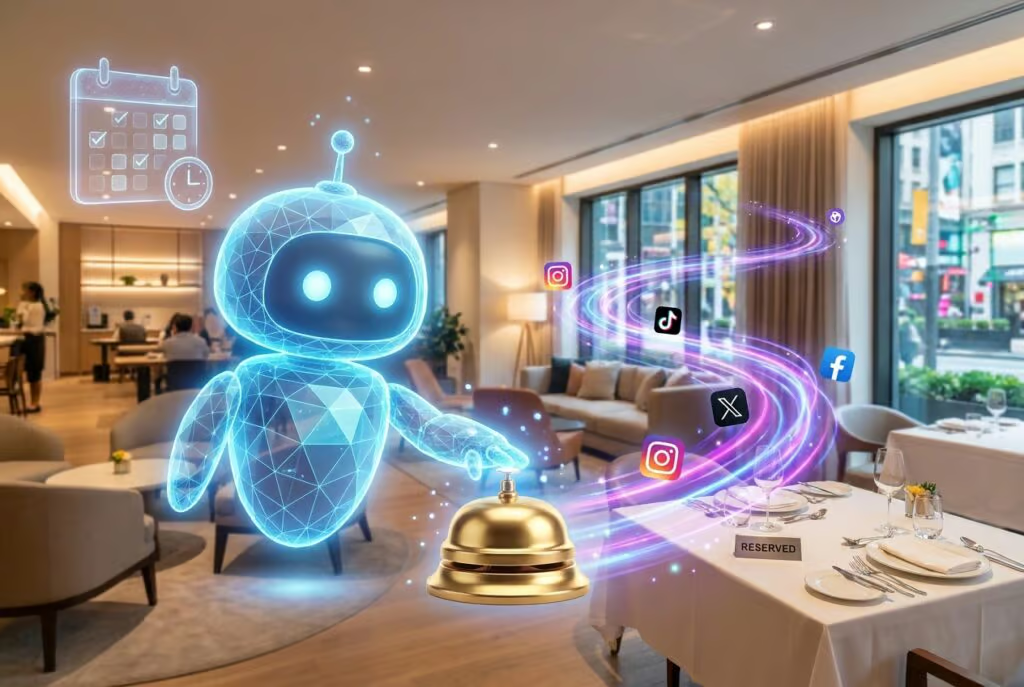
Agentic AI, autonomous software that plans, creates, and publishes social content without a human clicking every button, is moving from concept to everyday tool. Gartner forecasts that 33% of enterprise software will embed agentic AI by 2028, and Buffer’s 2025 survey found 68% of social media professionals already use AI assistance. The shift turns social media management from a manual, button-pressing job into a strategy-and-oversight role, with agents handling scheduling, cross-posting, and optimization in the background.
Why Agentic AI Matters for Social Media
A typical social media workload now spans six to eight platforms, often topping 50 pieces of content a week. Much of that work is repetitive, resizing images, writing variations of the same caption, scheduling across time zones, pulling analytics. Generative AI (the kind that writes copy or generates images) already lifted some of that weight. But it still expects a human to prompt it, review it, and push publish. Agentic AI goes further: it can take a goal (“promote the summer sale on all channels this week”) and autonomously generate the content calendar, create platform-specific posts, queue them at optimal times, and pause anything that underperforms, all while staying inside brand voice and compliance rules.
Agentic AI isn’t about smarter chatbots, it’s about autonomous agents that schedule, create, and manage a brand’s social presence while people focus on the bigger picture.
What Exactly Is Agentic AI, and How Does It Work?
Agentic AI combines a large language model with a planner, memory, and the ability to call external APIs (or tools). Think of it as an “if this, then that” engine on steroids. The agent receives a high-level objective, breaks it into subtasks, executes them step by step, and checks each outcome before proceeding. If something goes wrong, say, a scheduled post fails because a TikTok audio track got removed, the agent can retry, pick a new track, or flag it for a human review without crashing the whole campaign.
In social media, agentic AI can tap platform APIs to read past performance data, check trending sounds, scan mentions, and even draft responses that match a brand’s tone. Google Cloud’s recent Agentic AI Startup School signaled how quickly the industry is moving, and how seriously big tech is betting that autonomous agents will become the default way software operates.
The Numbers: Agentic AI Adoption is Accelerating
Two data points illustrate how agentic AI is reshaping the social media stack:
- 33% of enterprise software will include agentic AI by 2028. Gartner predicts that a third of all enterprise applications will embed agentic capabilities, up from less than 1% in 2024 (Gartner, 2024).
- 68% of social media professionals already use AI tools. A 2025 survey by Buffer found that two-thirds of social media professionals rely on some form of AI assistance, from caption generation to scheduling (Buffer, State of Social Media 2025).
By 2028, one-third of enterprise software will embed AI agents that act autonomously, and the social media tools you rely on today will either lead that shift or get left behind.
What’s Next: Guardrails, Governance, and the Agency Model Shift
The leap from assisted to autonomous raises hard questions about brand safety. An agent that can publish without a human in the loop must be trained on strict governance rules, no unapproved replies during a PR crisis, no off-brand humor on LinkedIn, and no hallucinated data in performance reports. The $500 million mistake reportedly made by Anthropic’s Claude in early 2026 is a blunt reminder: unchecked AI agents can run up costs or publish content that backfires fast.
Agencies and in-house teams will likely adopt a “supervised autonomy” model, agents run day-to-day execution, while people set the direction, approve high-stakes posts, and review outlier decisions flagged by the system. Many platforms are already laying the groundwork, with AI-assisted content creation that, in an agentic future, could schedule and optimize multi-brand campaigns without constant manual oversight.
What This Means for Your Social Strategy Today
Agentic AI isn’t a distant sci-fi promise, it’s being woven into the tools you already use. Treat it as an amplifier, not a replacement, to get the most out of it.
- Audit your stack for autonomous touchpoints. Check whether your scheduling, analytics, and inbox tools can accept AI-driven commands or offer triggers you can chain together.
- Adopt a single platform that unifies your brands. Managing multiple clients or brands from one dashboard reduces the manual load that agentic AI can later automate. A tool like Feedsta, an AI-powered social media platform, centralizes publishing across TikTok, Meta, LinkedIn, and more, so when agents arrive they have a clean data environment.
- Understand how your content shows up beyond social feeds. As AI-generated posts grow, your brand’s presence in AI-driven search matters too, so it’s worth checking how AI assistants describe your business.
Dig deeper into how AI tools are reshaping social content by reading our analysis of AI Mode vs. AI Overviews and the implications for your content.
The Bigger Picture
Agentic AI marks the end of social media management as a button-pressing job. In the next two years, the smartest approach won’t be writing 47 captions on a Sunday night, it will be training an agent to know a brand voice so well that it writes 47 variations while you sleep, and learning to trust (and verify) its work. The people who lean into that shift will spend more time on creative direction and less time on copy-paste. The agents are coming, but they work for you.
FAQ
What is agentic AI?
Agentic AI is software that autonomously plans multi-step tasks, calls external tools and APIs, and adapts based on outcomes, without a human prompting each step. In social media, it can take a high-level goal like promoting a sale across all channels and independently build the content calendar, create platform-specific posts, schedule them, and pause underperformers.
How does agentic AI differ from generative AI?
Generative AI creates content, such as text, images, or video, in response to a prompt and stops once it produces an output. Agentic AI uses generative models as one component but adds planning, memory, and the ability to take action in external systems. In practice, generative AI might write a caption; agentic AI writes it, resizes it for each platform, schedules it at the best time, and pauses it if engagement drops.
What are the risks of using agentic AI in social media?
The biggest risk is loss of brand control: an autonomous agent can post off-message content during a PR crisis, misinterpret trending topics, or hallucinate data in performance reports. There are also cost and security risks, since an unmonitored agent could run up API bills or leak internal data. The article points to Anthropic Claude’s early-2026 $500 million mistake as a cautionary example, and recommends strict governance rules, human approval for sensitive posts, and platforms that centralize multi-brand oversight.