User Experience Is Now a Social Media Ranking Signal in 2026
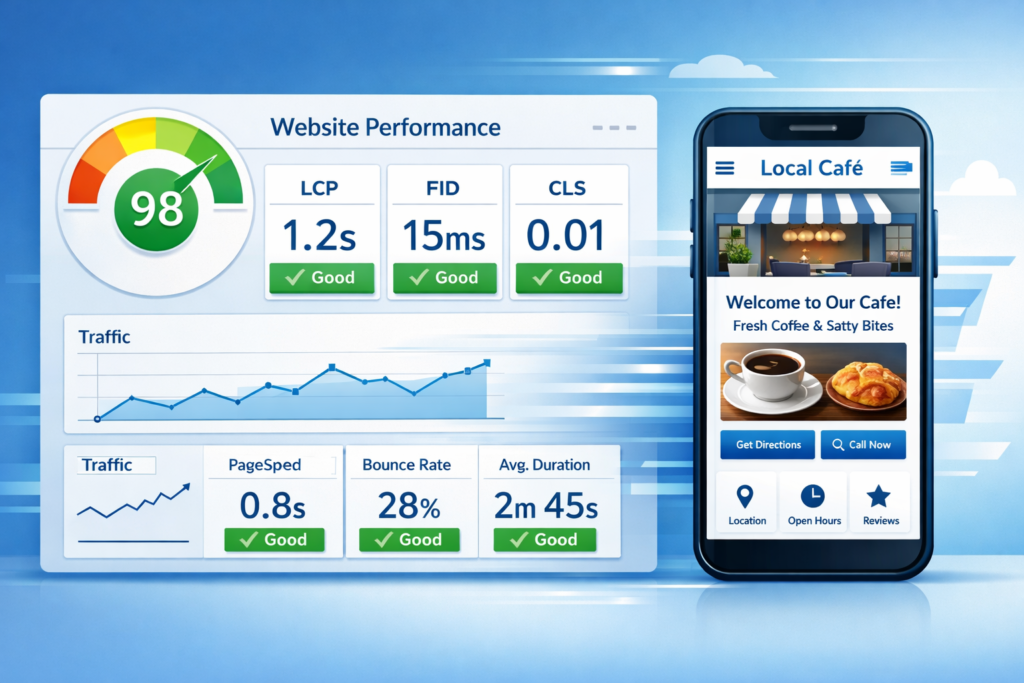
More than 70% of local searches now happen on smartphones, and Google measures whether your page responds to a tap inside 200 milliseconds before deciding where to rank you. That same UX scrutiny has crept into every social profile, every link-in-bio page, and every paid social landing page your audience touches, and the platforms are now keeping score.
Why It Matters
For years, social media managers could hand the “page speed problem” to a developer and move on. That handoff stopped working in 2026. Google’s Core Web Vitals remain a confirmed ranking factor, and every major platform, TikTok, Instagram, Pinterest, LinkedIn, now quietly weights destination experience when it decides which posts to amplify. When 70% of local searches happen on a phone, the link in your bio is judged on the same axis as a top-ranking Google result.
The competitive pressure is blunt. A landscaping company, a dental practice, and a restaurant in the same town are competing in the same local pack, the same TikTok feed, and the same Instagram explore page. The pages that earn placement aren’t the prettiest. They’re the fastest, the most readable, and the most thumb-friendly. Everything else slips down the ranking, the algorithm, or both.
What’s Changed in 2026
Three Core Web Vitals now decide whether Google trusts your page: Largest Contentful Paint (LCP), which measures how quickly the main content loads; Interaction to Next Paint (INP), which replaced First Input Delay in 2024 and tracks how snappy your page feels when users tap, click, or type; and Cumulative Layout Shift (CLS), which penalizes pages where elements jump as they render.
The translation to social is direct. Every social platform tracks its own engagement signals, watch-through rate on TikTok, profile-visit-to-follow on Instagram, swipe completion in Stories, time-on-tap on Pinterest, and they all reward the thing Web Vitals reward: a destination that doesn’t make the user wait, doesn’t shift around, and answers intent fast. A slow link-in-bio tap is a fast unfollow. Google didn’t invent UX as a ranking signal. It just gave the rest of the social stack permission to copy it.
The penalties for getting it wrong are tightening too. Google’s AI Overviews now synthesize answers from multiple sources, and only sites with well-structured content, clean headings, and strong UX make the citation set. If your linked landing page can’t be cleanly parsed because the layout shifts, the JavaScript bloats, or the mobile experience breaks, you’re invisible in both classic search and the AI answer box.
The Numbers Social Managers Should Memorize
- 2.5 seconds: the LCP threshold Google considers acceptable for the main content of a page.
- 200 milliseconds: the INP target for how fast a tap or click should produce a visible response.
- 70%+: share of local searches that happen on smartphones, meaning mobile UX is the experience for the majority of your audience.
- 7% conversion drop for every one-second delay in page load.
- $3,500/month at risk for a small e-commerce business doing $50,000 in monthly online revenue from a single second of added latency.
Industry data shows that a one-second delay in page load time reduces conversions by an average of seven percent. For an e-commerce business generating $50,000 per month in online revenue, that single second of delay could represent $3,500 in lost monthly sales.
Speed isn’t a developer problem anymore, every link-in-bio tap, every Story swipe-up, every paid social click is a UX vote the platforms now count.
What Comes Next
Three forces are converging. First, AI Overviews and Perplexity-style answer engines will increasingly cite the fastest, cleanest mobile sources, meaning your social-driven landing pages need to be parseable and lightweight or they vanish from the citation pool. Second, TikTok and Instagram have already started weighting destination-experience signals in their algorithms; expect the public confirmations of that to land in 2026 ad-product release notes. Third, Google PageSpeed Insights and Chrome’s Lighthouse audit are quietly tightening benchmarks every few quarters, so a passing score in 2024 may be a failing one by year-end.
The strategic implication: your social content calendar and your site-performance calendar should be the same calendar. Auditing your link-in-bio quarterly, retesting your top three landing pages every time you launch a campaign, and treating destination UX as a creative input, not a post-launch fix, is the operating model that wins from here.
What This Means for You
If you manage social for a local small business, three actions matter most this quarter:
- Audit every destination your social content links to. Run PageSpeed Insights on your homepage, your three highest-traffic service pages, and every page your link-in-bio sends to. Fix LCP first, INP second, CLS third.
- Build dedicated, speed-tuned landing pages for paid social. A generic homepage drop tanks conversion. A purpose-built landing page with one offer, one form, and zero scripts you didn’t put there yourself is the highest-ROI campaign asset you can ship.
- Connect destination UX to social analytics. Pair each post with a tracked URL and watch the round trip, impression to click to scroll-depth to conversion, inside one analytics view, so a slow page can’t hide behind “the post just didn’t convert.”
If your Google Business Profile is part of the social stack you manage, walk through our 2026 GBP guide for social media managers next, the same UX signals that decide your search rank now decide whether your profile surfaces in the local pack. And if you haven’t audited the bios and link cards on your social profiles in the last 90 days, our 2026 NAP playbook for social profiles is the next thing on the list.
The Bigger Picture
UX and ranking signals, search or social, are no longer separate disciplines. The post that ranks is the post that loads. The link that converts is the link that doesn’t jitter on a mid-range Android. The businesses that treat UX and SEO as a single integrated strategy rather than separate projects are the ones dominating local search results in 2026. Swap “social” in for “SEO” and the sentence is just as true, and just as urgent.