AI Overviews: Why Structure Beats Length
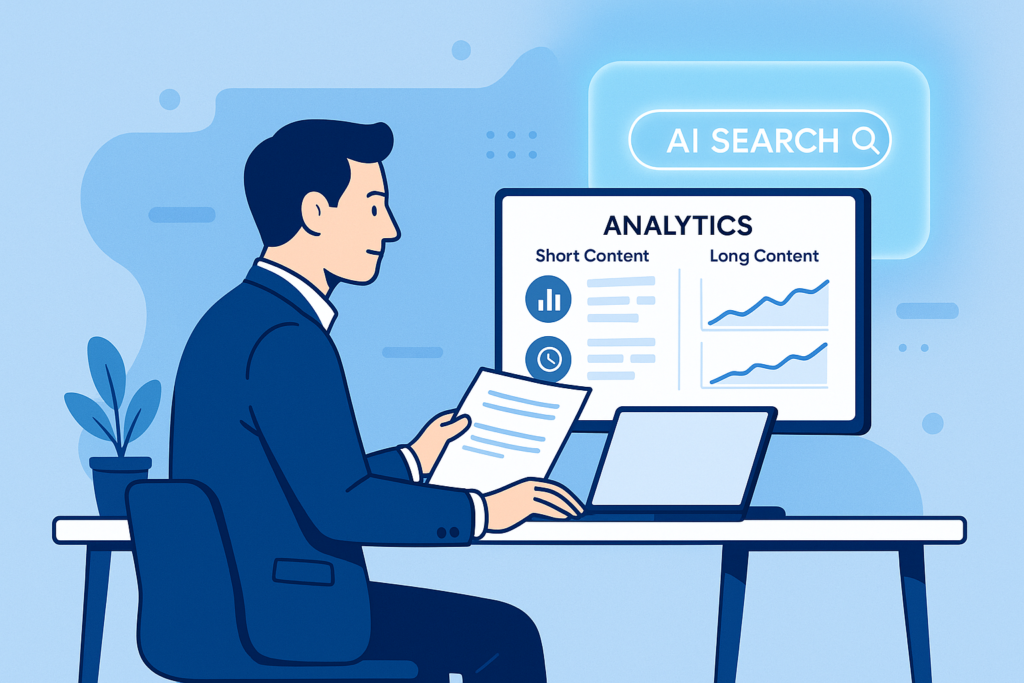
Google’s AI Overviews reward extractable structure over word count, and a tight 300-word landing page can out-cite a 2,000-word article. For social brands, that flips how every link-in-bio page, landing page, and pinned caption needs to be written. The citation itself is now the visibility, because most users never scroll past the synthesized answer.
Why does structure beat length in AI Overviews?
When a potential follower searches "best Pilates studio in Austin" or "how to fix Instagram Reels reach," Google increasingly answers them at the top of the page with a synthesized response, pulling citations from sources it considers structured and authoritative. According to Google’s own announcement of AI Overviews, the feature now influences what users see before they ever scroll to traditional results.
Many users never scroll. Pew Research has documented sharp drops in click-through on AI-summarized pages, meaning the citation itself is becoming the visibility, not the click. For social brands, that’s a real strategic shift. Your link-in-bio page, your landing pages, your FAQ blocks, even your Google Business Profile descriptions are all candidate sources AI can pull from. If your surfaces aren’t structured for extraction, your competitor’s are.
How do AI Overviews actually pick citations?
The old SEO logic was "longer is better, more keywords, more authority." That logic does not apply to AI extraction. AI Overviews look for content that’s easy to read and easy to pull a clean answer from. For a "what is" or "how much" query, a tight one-sentence definition will outperform a rambling paragraph every time. For a "how does it work" or "X vs Y" query, depth matters, but only if it’s organized.
This matters because Google increasingly treats link-in-bio pages, brand landing pages, and structured FAQ blocks as candidate sources for local and product queries. If your link-in-bio is a wall of emoji and CTAs with no extractable copy, AI has nothing to cite. If your landing page buries the price 800 words down, AI pulls a cleaner number from a competitor’s pricing block.
The shift also changes how short captions and Pinterest pin descriptions earn downstream pickup. AI doesn’t crawl Instagram or TikTok captions in real time, but it does pull from the landing pages your captions drive traffic to. That makes your destination surfaces, not just your posts, the real social-SEO battleground.
What makes content earn AI Overview citations?
Here’s how content earns AI Overview citations today:
- Paragraphs of 40-60 words are easier for AI to isolate than dense walls of text
- The answer should appear in the first two sentences of any section
- Definition queries reward clean one-or-two-sentence answers up top
- Pricing pages with specific numbers in clear blocks outperform vague copy
- FAQ pages in direct Q&A format are among the most AI-friendly structures available
- Comparison content needs structured tables and real depth to earn citation
- Outdated pages are routinely skipped, freshness is a citation signal
"The businesses that win AI Overview citations in the next few years won’t be the ones with the longest content, they’ll be the ones with the most extractable content.
Structure is beating size. The brands that win AI citations in 2026 aren’t writing more content; they’re structuring it in blocks AI can lift cleanly.
What comes next for AI citation signals?
Expect the AI citation lens to widen. AI Overviews already pull from Google Business Profiles, review platforms, and structured directory data, which means your business bio, your Google Posts, and your link-in-bio page are all candidate sources. As Google’s Search Central documentation on AI features continues to evolve, the structured-data signals that work for traditional SERPs, FAQ schema, Product schema, LocalBusiness schema, will likely become explicit AI-citation signals too.
Brands investing in structured FAQ blocks and answer-first landing pages are already seeing disproportionate AI citation share, even when their domain authority is lower than competitors’. The lesson for social-first brands is straightforward: stop trying to out-write the legacy publishers in your niche. Out-structure them instead.
Expect more platforms to surface their own AI-summary layers as well. TikTok and Pinterest have both signaled deeper investment in AI-generated discovery experiences. The brands whose content surfaces are structured for extraction today will be the ones cited across those layers tomorrow.
What should social brands change first?
If you’re juggling brands across platforms, the play isn’t to rewrite every page tomorrow. It’s to audit the surfaces AI is most likely to pull from and tighten them. A free BizScoreAI visibility scan is a fast way to see which of those surfaces are already working and which aren’t.
Start with your link-in-bio page, the destination most of your traffic lands on. Make sure the brand definition, primary CTA, and FAQ-style answers appear in the first viewport, in extractable blocks. Move emoji and decoration down. Move answers up.
Next, look at your campaign landing pages. If you’re running paid Reels or Pins to a landing page that hides the offer in long-form prose, AI cannot cite you for the product query that matters. Restructure with answer-first sections, clean pricing blocks, and a dedicated FAQ.
Third, posting cadence matters more than ever. Scheduling consistent content across platforms keeps your brand surfaces fresh, and freshness is one of the signals Google’s AI weighs. Stale brand pages get bypassed.
For a deeper read on the structural changes Google’s AI search now rewards, our recent breakdown of Google’s new AI search rules walks through the playbook page-by-page. And if you want the non-commodity-content framing of the same trend, Google’s AI Overviews want non-commodity content covers what makes content stand out to the model.
What is the bigger picture for social brands?
Content length was never the moat, it was just the easiest proxy for "we put work into this." AI Overviews don’t care about effort signals. They care about extractability. For social brands, the winners over the next 18 months will be the ones who treat every brand surface, bio, link-in-bio, landing page, scheduled post, as a citable source designed for the model deciding whether a human ever sees their work.
FAQ
Do AI Overviews pull from link-in-bio pages?
Yes, indirectly and increasingly directly. AI Overviews crawl the public web, which includes hosted link-in-bio pages, landing pages, and any structured brand surface Google can index. If your link-in-bio is a wall of emoji and CTAs with no extractable text, there’s nothing for AI to cite. If it contains a clean brand definition, a structured FAQ, and clear product or service descriptions in the first viewport, it becomes a candidate source. Treat your link-in-bio as a mini landing page, not just a list of buttons.
How should FAQ content be structured for social brands?
Use direct question-and-answer format with the question as a clear heading and the answer in the first one or two sentences below it. Keep answers between 40 and 150 words, avoid burying answers in long preambles, and cover the questions customers actually ask in DMs and comments: pricing, hours, locations, how it works, and what makes you different. A well-organized FAQ page is one of the highest-ROI content investments for AI visibility, especially for local and product queries.
How often should landing pages be refreshed for AI citations?
Freshness is a citation signal, and pages that haven’t been updated in 18-24 months are often skipped in favor of fresher competitor content. For high-traffic landing pages, plan a quarterly review to update statistics, refresh examples, and verify pricing is current. For seasonal or campaign-specific pages, refresh whenever the offer changes. Small, dated updates with new data or examples are enough to signal currency to Google’s AI.