AI Search Visibility in 2026: The Social Signals That Pick Winners
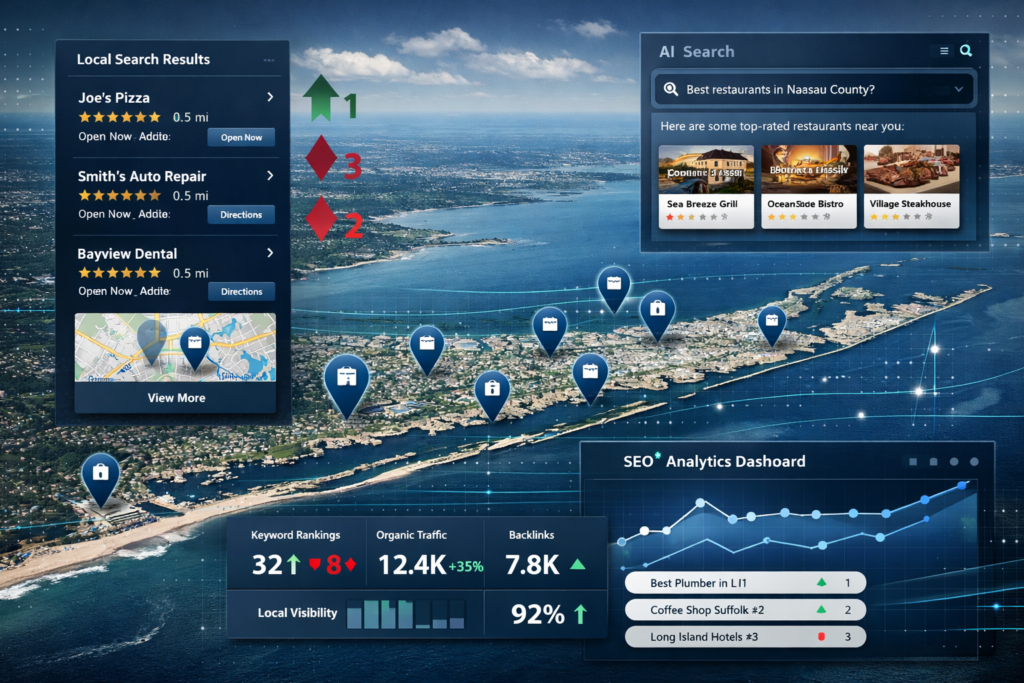
AI Overviews may now appear in more than 40% of local business queries, and when they do, they may surface only about a third as many businesses as the traditional Google Maps 3-pack. Local search has effectively split into two algorithms, and the newer one names far fewer winners. The trust signals that decide who makes the AI cut, including reviews, photos, posts, and consistent entity data across every published channel, are largely the ones multi-location brands and agencies are already producing.
Why It Matters
Local discovery used to be a single game. Optimize for proximity, ratings, and your Google Business Profile, and the Maps 3-pack carries the load. That layer still moves real revenue, but it now sits beneath a second layer that selects far fewer winners. AI Overviews, ChatGPT recommendations, Perplexity answers, and Gemini summaries are increasingly the first thing a searcher sees, and they recommend two or three businesses by name. Everything ranked below that gets skipped. For brands managing multiple locations or accounts, "good enough" Google visibility no longer guarantees AI visibility, and the gap between the two is widening every quarter.
This is a social media problem dressed up as a search problem. The AI layer reads how a business is described across the web, not just on its own site. Inconsistent NAP (name, address, phone), thin photo libraries, missing review responses, and stale platform profiles all register as trust-signal weakness. The work of keeping that picture coherent across TikTok, Instagram, Facebook, Pinterest, X, LinkedIn, YouTube, and GBP is exactly the work social teams already do, but it now drives outcomes much further down the funnel than impressions and engagement.
What’s New: Two Algorithms, One Set of Signals
Traditional local SEO still centers on the 3-pack. Those rankings are driven by proximity, review volume and quality, GBP completeness, and on-site relevance. That layer rewards consistency over time.
The AI layer reads a different set of signals: entity consistency (does your business information match across every platform you appear on?), review consensus (do multiple sources say similar things about you?), topical authority (is your brand recognized as a credible source in its category?), and GBP data quality. Businesses that rank in traditional search but have thin or inconsistent social profiles increasingly get filtered out of AI recommendations.
What used to be "set and forget" is now an active channel. GBP impressions show measurable decay if no photos or posts are added within 30 days, the same cadence logic that drives Instagram and TikTok feeds. The platforms diverge, but the rhythm doesn’t.
The Numbers
- AI Overviews appear in more than 40% of local business queries.
- When AI Overviews appear, some users click results below them.
- AI Overviews surface about 32% as many businesses as the traditional Maps 3-pack.
- GBP impressions begin measurable decay after 30 days without a new post or photo.
- Review responses within 24-48 hours affect ranking signals and on-profile conversion rate.
- Mobile PageSpeed scores below 70 suppress even strong content from surfacing.
"AI Overviews are not a supplement to traditional results, they’re a replacement layer for a large share of searchers. Visibility is consolidating."
What Comes Next
The trend points one direction: more queries get answered by AI, fewer brands get named, and the ones that do get named are the ones with the cleanest, most-active, most-consistent presence across the channels AI crawls. That is not just Google. ChatGPT, Perplexity, Gemini, and the next wave of agentic search assistants are training on and citing content from social platforms, review sites, video transcripts, and third-party listings.
The strategic response is structural. Expect brands to consolidate publishing into single workflows that hit GBP, social, listings, and link-in-bio destinations from one source of truth. Expect more emphasis on schema markup and entity-level metadata, on review-velocity tooling, and on response-time SLAs for inbound messages and comments. What used to be search, listings, and reputation work is quietly folding into the social media role.
Some AI search tools narrow local businesses to roughly three results, drawing trust signals from feeds similar to yours.
What This Means for You
If you run social for a local brand or a portfolio of locations, here is the shift. Stop treating GBP as a directory listing and start treating it like another social account in your rotation, with weekly posts, fresh photos every two to three weeks, Q&A monitoring, and response times that match what you already deliver on Instagram DMs.
That cadence is hard to sustain by hand across multiple brands. A scheduler that publishes to GBP alongside TikTok, Meta, Pinterest, X, LinkedIn, and YouTube from one calendar is the only realistic way to keep a 30-day freshness window across every location. Keeping the destinations consistent, with the same campaign, landing pages, and tracking, feeds the entity-consistency signal AI layers reward.
To see where your business currently stands, a free BizScoreAI visibility scan checks how AI search tools read your listings, reviews, and cross-platform entity data, and shows which trust signals are keeping you out of the AI answer.
For deeper tactical playbooks, the social signals Google reads in 2026 covers the review and photo cadence specifics, and how to get cited by ChatGPT, Perplexity, and Google AI Overviews walks through the LLMO and GEO mechanics in detail. The short version: an active, consistent, well-responded social presence is no longer a brand exercise. It is now a measurable input into whether AI recommends your business at all.
The Bigger Picture
Local search has not disappeared; it has become more focused. Some brands rank in local search because their social presence, reviews, and Google Business Profile activity reinforce one another and are updated often enough for the algorithms to treat them as active. Most brands were already doing this work on social. In 2026, the work now determines whether the brand appears in the answers, not just the feeds.
FAQ
Does social media activity affect AI search visibility?
Yes. AI search systems like Google AI Overviews, ChatGPT, Perplexity, and Gemini use entity consistency, review consensus, and topical authority signals that draw heavily from social platforms, review sites, and Google Business Profile. Active accounts with consistent business information, fresh photos, regular posts, and timely review responses send stronger signals than dormant or inconsistent profiles.
How often should I post to my Google Business Profile?
The post points to measurable decay in GBP impressions after roughly 30 days without new posts or photos. Treat GBP like a social channel: aim for at least one post per week and fresh photos every two to three weeks. A social scheduler that queues GBP posts alongside other platforms keeps the cadence consistent without becoming a separate manual workflow.
What is the difference between traditional local SEO and AI search optimization?
Traditional local SEO targets the Google Maps 3-pack and is driven by proximity, reviews, GBP completeness, and on-page signals. AI search optimization targets recommendations inside AI Overviews and assistants like ChatGPT and Perplexity, which rely more on entity consistency across the web, review consensus from multiple sources, topical authority, and schema markup. AI search can surface about a third as many businesses as the traditional 3-pack, so the bar for getting named is significantly higher.
Related coverage
- How Consumers Search for Local Businesses in 2026: Mobile, Google, and the Role of AI
- Google’s Generative AI Search Guide Signals What Content Will Survive