Amazon’s 2.5B-Gallon AI Water Bill: What It Means for Social Teams
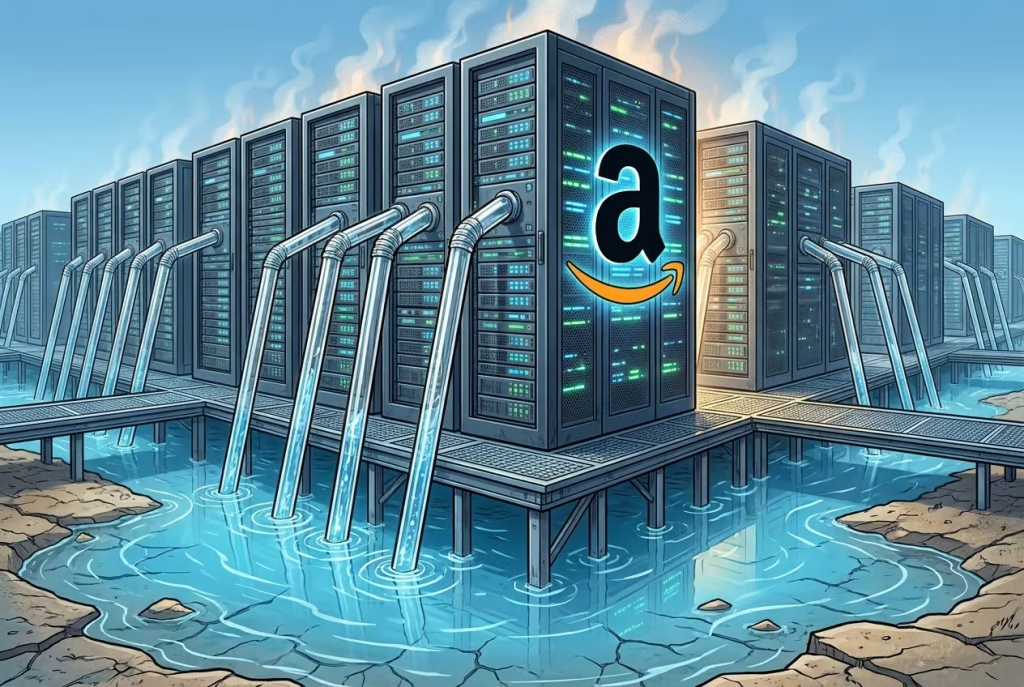
In 2025, Amazon publicly disclosed that its global data centers consumed 2.5 billion gallons of water, the first time the company has voluntarily shared this figure. For social media managers, content creators, and agencies who now depend on AI-powered tools to generate captions, schedule posts, and analyze engagement across platforms, that number is not just an environmental headline. It is a direct line to the invisible infrastructure behind every AI-assisted piece of content they publish, and a signal that the cost of AI-generated social content extends far beyond a subscription fee.
Why It Matters
The AI models powering social media content creation, from automated caption generators and image editors to scheduling algorithms and sentiment analysis tools, all run inside hyperscale data centers. These facilities generate enormous heat, and cooling them requires massive volumes of water. A single large data center can consume millions of gallons daily, often pulling from the same municipal water supplies that serve local communities.
As AI adoption accelerates across social media workflows, the environmental footprint of every automated task grows alongside it. More than 75% of social media marketers now use AI tools in their content workflows, according to industry surveys, and that number climbs each quarter. The water cost of generating a month’s worth of AI-assisted social content is not zero, it is just invisible to the user who clicks “Generate caption” or “Schedule post.”
Amazon is not alone. Google, Microsoft, and Meta all operate AI data centers with significant water demands. But Amazon’s disclosure, coming after years of public pressure and internal strategy documents that surfaced showing the company had discussed keeping water usage figures out of public view, marks a shift toward transparency that the entire tech industry will have to reckon with.
Every AI-generated social caption runs through a data center consuming millions of gallons of water, and your audience is starting to count.
What’s New: Amazon’s Water Disclosure
Amazon published the 2.5-billion-gallon figure on its corporate sustainability blog, framing the number as evidence of efficiency rather than excess. The company claims its data centers are “7x more water-efficient than the industry average,” citing internal engineering and third-party audits of utility water meters as the basis for its calculations.
The company detailed several strategies for reducing water consumption:
- Air cooling as the default: Amazon says its data centers rely primarily on outside air for cooling, switching to water-based cooling only during the hottest days of the year.
- Reclaimed water: The company operates 26 facilities running on 100% reclaimed water sourced from wastewater treatment plants rather than from drinkable municipal supplies, with 130 additional reclaimed-water facilities under contract globally.
- Water positive by 2030: Amazon has committed to returning more water to communities than it consumes across its data center operations, and reports it has reached 75% of that goal.
The disclosure also included a striking comparison: according to EPA data, Americans use roughly 3.3 trillion gallons annually to water lawns and gardens, meaning landscape irrigation uses over 1,300 times more water than Amazon’s entire global data center fleet.
The Numbers
Amazon’s disclosed figures paint a complex picture. The headline numbers are striking, but context matters, especially for social media professionals trying to understand the real cost of the AI features baked into their daily tools.
- 2.5 billion gallons, Amazon’s disclosed global data center water consumption in 2025, per Amazon’s sustainability reporting
- 7x more water-efficient than the industry average, according to Amazon’s internal metrics
- 26 facilities operating on 100% reclaimed water, with 130 more under contract
- 75% progress toward Amazon’s “water positive by 2030” goal
- 924+ data centers worldwide, a number expected to grow significantly as AI-specific facilities come online
- 3.3 trillion gallons, annual US residential landscape irrigation, per EPA, or 1,300x Amazon’s data center water use
“To put that in perspective, Americans use roughly 3.3 trillion gallons a year to water their lawns and gardens, according to the EPA, meaning every year landscape irrigation uses over 1,300 times more water than our data centers.”
Amazon Sustainability Team, 2026
What Comes Next
Amazon’s disclosure is unlikely to be a one-off. As AI infrastructure expansion continues at a breakneck pace, driven by demand for models that can generate text, images, and video for platforms like TikTok, Instagram, YouTube, and LinkedIn, regulatory pressure and community scrutiny will only intensify.
The company’s “water positive by 2030” commitment will face its hardest tests in water-stressed regions where new AI data centers are being built. Amazon has acknowledged that reclaimed water infrastructure requires significant municipal partnership and investment, and scaling from 26 facilities to over 150 globally presents logistical and political challenges that engineering alone cannot solve.
More broadly, the AI industry is beginning to face the same kind of supply-chain transparency demands that reshaped fashion, food, and electronics. For social media platforms and the tools that serve them, environmental disclosures about the infrastructure behind AI features are likely to become a competitive differentiator, and a potential reputational risk for those who stay silent.
What This Means for You
If you manage social media for a brand or agency, the water-cost conversation is arriving whether you are ready for it or not. Your audience, especially Gen Z and millennial consumers, increasingly evaluates brands on their environmental footprint, and that scrutiny now extends to the AI tools those brands use to produce content.
Here is what you can do right now:
- Audit your AI tool stack. Which tools in your social workflow are AI-powered, and what do their providers disclose about environmental impact? If a vendor publishes nothing, that silence is itself a data point.
- Batch your AI usage. Every “Generate caption” or “Enhance image” request triggers compute cycles in a data center. Batching creative work into focused sessions, rather than peppering AI tools with ad-hoc requests all day, reduces redundant processing and the associated water cost.
- Schedule smarter. Using a platform like Feedsta to plan, batch-create, and schedule your social content across TikTok, Instagram, LinkedIn, and other channels reduces the back-and-forth that multiplies AI compute cycles. Efficient scheduling is not just a time-saver, it quietly shrinks the environmental overhead of your content operation.
- Track your brand’s AI visibility. As AI-generated content floods social feeds, transparency and authenticity become ranking signals. Run a free scan at BizScoreAI to see how AI assistants like ChatGPT, Gemini, and Perplexity describe your brand, and whether your sustainability positioning is reaching the audiences that care about it.
For a deeper look at how AI model choices affect your social workflow, read our breakdown of Claude Fable 5 and what Anthropic’s top model means for social teams. And if you are rethinking what metrics actually matter in an AI-saturated social landscape, our analysis of why your social media KPIs are lying to you is essential reading.
The Bigger Picture
Amazon’s 2.5-billion-gallon disclosure is not really about water. It is about visibility. For years, the infrastructure cost of digital content, the energy, the water, the rare-earth minerals in the servers, stayed hidden behind a seamless interface. AI makes that cost too large to ignore, and too concentrated in specific communities to escape scrutiny. Social media managers occupy a unique position in this shift: they are among the heaviest daily users of AI tools and among the most public-facing practitioners. Knowing what powers the tools you use, and being able to speak about it honestly, is becoming a baseline professional competency, not a niche sustainability concern. The water is already on the meter. The only question is whether your social strategy acknowledges it.