Most Americans Oppose Local AI Data Centers More Than Nuclear Plants, Gallup Finds
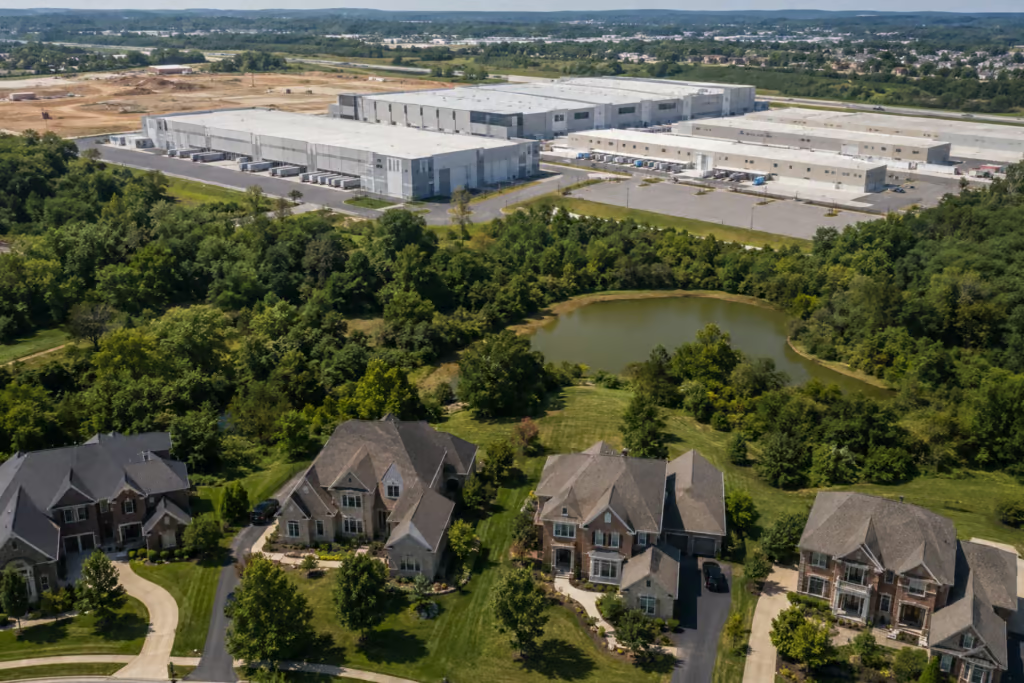
Americans are more opposed to the construction of artificial intelligence data centers in their own neighborhoods than they are to nearby nuclear power plants, according to new Gallup polling released Wednesday. The survey found 71% of respondents somewhat or strongly opposed local AI data centers, compared with 53% who opposed a nuclear energy plant in their community, even though more than one-third of the U.S. population lives or works within 50 miles of an existing nuclear facility.
What concerns are driving the opposition?
Seventy percent of those surveyed said they were worried to some degree about how data centers would affect the local environment. Other respondents pointed to quality-of-life concerns, economic worries, and general unease about artificial intelligence itself. Just 7% strongly favored having a data center built nearby, with another 20% somewhat in favor, citing expected economic benefits such as job creation and increased tax revenue.
Opposition crossed most major demographic and political lines, though women and Democrats were significantly more likely than Republicans to strongly oppose local data center construction.
Why do data centers raise unique concerns?
AI data centers are specialized, high-performance facilities built to handle the mass training of artificial intelligence models. Before the AI boom, data centers typically spanned around 100,000 square feet and largely supported internet-based businesses and cloud computing. The demands of training modern AI models have since pushed the development of megacampuses covering millions of square feet and hundreds of acres.
These facilities house hundreds of thousands of graphics processing units (GPUs) and can draw as much power as hundreds of thousands of households, accounting for both operations and cooling. Major projects are underway from companies including OpenAI, Oracle, SoftBank, Amazon, and Microsoft, with construction expanding fastest in Texas, Virginia, and Georgia.
How much water and energy do data centers use?
Large data centers can consume around 5 million gallons of water per day, a figure comparable to the daily water use of a town with 10,000 to 50,000 residents. Half of those who opposed local data centers in the Gallup poll said they were most worried about resource impacts, including water and energy consumption and the loss of farmland or wildlife habitat.
Nearly a quarter pointed to quality-of-life issues, specifically mentioning higher utility bills and broader increases in the cost of living. Other concerns included noise, light, air and water pollution, as well as ethics, job stability and the lack of regulation around the AI industry.
What does the strain on local infrastructure look like?
In one of the more striking examples of the strain these facilities can place on local infrastructure, nearly 50,000 residents of Lake Tahoe have been told their utility, NV Energy, will stop providing them with electricity in 2027. The utility plans to redirect that power to data centers in northern Nevada, one of the fastest growing data center corridors in the country, where Google, Microsoft, and Apple have built or announced facilities, according to Fortune.
Residents have until next May to find a new electric provider, underscoring how the rapid expansion of AI infrastructure is already reshaping energy access in some communities.
FAQ
How many Americans oppose local AI data centers?
According to the Gallup survey, 71% of respondents are somewhat or strongly opposed to AI data centers being built in their area, while 53% said they would oppose a nuclear energy plant in their community.
What concerns do Americans have about nearby data centers?
Seventy percent said they were worried about how data centers would affect the local environment, and half of those opposed pointed to resource impacts such as water and energy consumption and the loss of farmland or wildlife habitat. Other concerns included higher utility bills, cost-of-living increases, noise, light, air and water pollution, ethics, job stability, and lack of AI regulation.
Which companies are building major AI data centers?
Major projects are underway from OpenAI, Oracle, SoftBank, Amazon, and Microsoft, with construction expanding fastest in Texas, Virginia, and Georgia. In northern Nevada, Google, Microsoft, and Apple have built or announced facilities.