Anthropic Suspends Claude Fable 5 and Mythos 5 After US Government Order
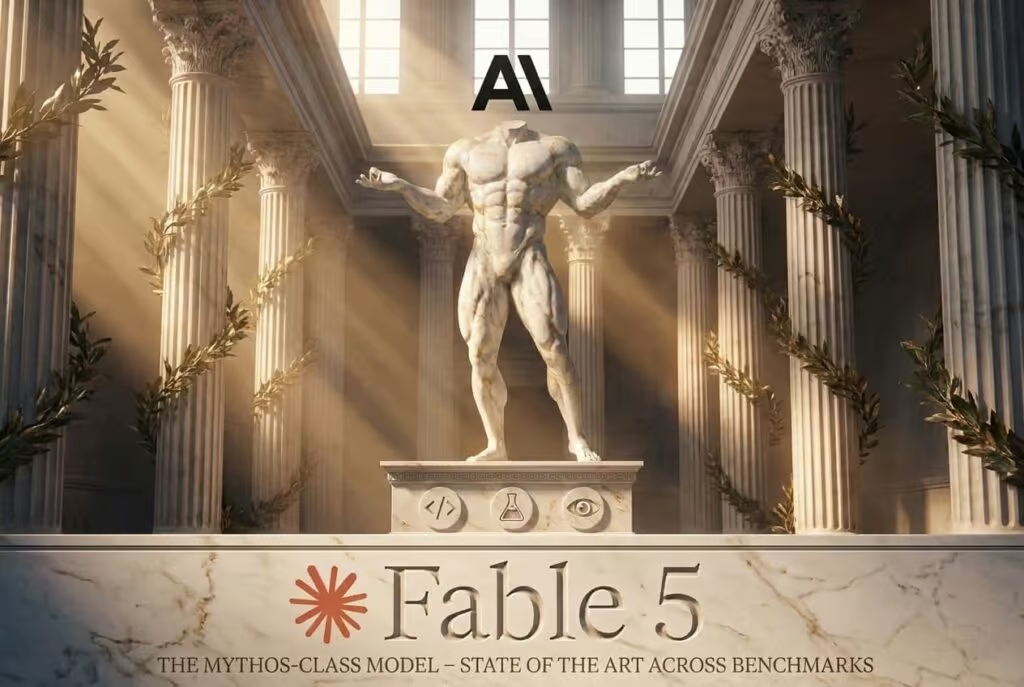
Anthropic disabled access to its Claude Fable 5 and Mythos 5 models on June 13, 2026, after the U.S. Department of Commerce ordered the company to suspend foreign nationals from using the tools, citing undisclosed national security concerns. Because the order could not be enforced across Anthropic’s global user base, the company pulled both models for every customer at once. Older Claude models remain available.
Why It Matters
Generative AI has become a core layer of content and software production. A recent survey by the Content Marketing Institute found that 71% of B2B marketers and 65% of B2C marketers now use AI for at least one content task. When a tool as widely adopted as Claude Fable 5 vanishes overnight, every workflow built on it can stall. Beyond the logistical disruption, the shutdown raises urgent questions about AI reliability, the scope of government authority over civilian software, and what happens when a popular model is pulled from the market after millions of users have already built habits around it.
What’s New / How It Works
On June 13, 2026, Anthropic posted a statement confirming it had received an order from the U.S. Department of Commerce that prohibited foreign nationals from using Claude Fable 5 and Mythos 5. Because the company could not technically enforce that restriction across its global user base, it took the more sweeping action of disabling access for all customers, effective immediately. The government did not publicly detail the exact threat, but Anthropic believes the trigger was a demonstration of a jailbreaking technique that could make the model identify previously known software vulnerabilities. Anthropic reviewed the technique and said the vulnerabilities it uncovered were minor, and that other publicly available AI models could find them without a bypass. Nevertheless, the order forced a complete takedown.
Fable 5 is the production version of Anthropic’s Mythos architecture, the same model family the company had earlier described as “too powerful to release.” Ahead of the public launch, Fable 5 had been made available for free through June 22, earning rapid adoption among developers, creators, and businesses who praised its long-context reasoning and creative fluency.
The suspension doesn’t affect older Claude models, but it does underscore a pattern: Anthropic is already locked in a separate lawsuit with the Trump administration after the Pentagon labeled the company a “supply chain risk” and tried to bar agencies from using its AI. A federal judge temporarily blocked that Pentagon directive, but the broader regulatory friction is far from settled.
The Numbers
- Two flagship models disabled. Claude Fable 5 (the public-facing powerhouse) and Mythos 5 (the enterprise backbone) were both taken offline, affecting every Anthropic customer.
- Free access had supercharged adoption. Fable 5 was free through June 22, leading thousands of users to test it for long-form drafting, summarization, and creative work.
- Jailbreak demo triggered the order. The government was shown a bypass that extracted minor, previously known vulnerabilities from Fable 5. Anthropic noted the same vulnerabilities are discoverable by other publicly available models without any bypass.
- Pre-release red flags were already raised. Anthropic allowed a small group of organizations to preview Mythos in April specifically to probe its cybersecurity risks, acknowledging that the model’s exploit abilities were advanced enough to warrant caution before a wide release.
“The net effect of this order is that we must abruptly disable Fable 5 and Mythos 5 for all our customers to ensure compliance.”, Anthropic, official statement suspending the models
A frontier model that millions had built workflows around can disappear overnight when a government decides it is too capable.
What Comes Next
Anthropic says it is working with authorities to understand the exact scope of the order and explore ways to restore access, but no timeline has been shared. The European Union, which had only just obtained access to Mythos after weeks of negotiations, called the development further proof that the bloc needs “technological sovereignty,” a signal that non-US governments may accelerate their own AI infrastructure projects. Meanwhile, the Trump administration’s broader posture toward AI companies perceived as security risks is intensifying, and the outcome of Anthropic’s lawsuit over the “supply chain risk” label could set a precedent for how the government can throttle civilian access to advanced AI tools.
What This Means in Practice
For anyone who had integrated Claude Fable 5 into a product or workflow, the suspension is an unplanned outage with no announced end date. The practical lesson is the value of not depending on a single model. Teams that route through multiple providers, or that keep a tested fallback model ready to switch on, can absorb a takedown like this without grinding to a halt. The episode is a reminder to treat any single AI provider as a potential single point of failure and to design around it.
It also matters for how organizations evaluate AI risk. A model can be removed not because it failed technically but because of a regulatory decision outside the provider’s control. That argues for portability: prompts, templates, and integrations that are not so tightly coupled to one model that they cannot be moved. For deeper context, read our earlier breakdown of the Claude Fable 5 launch and why AI guardrails matter after an earlier Claude incident reportedly cost one enterprise $500 million.
The Bigger Picture
The story involves a company’s compliance scramble. It also signals that frontier AI models are now being treated as dual-use technologies, and governments will intervene swiftly, sometimes without clear public explanation, when they decide a tool is too capable. The broader takeaway is that AI has become an indispensable engine for many businesses, yet no single engine should be irreplaceable in a serious deployment. Resilient systems are built so that a government order, a policy reversal, or a jailbreak headline does not take the whole operation down with it.
FAQ
Why did Anthropic suspend Claude Fable 5 and Mythos 5?
Anthropic received an order from the U.S. Department of Commerce that banned foreign nationals from using Claude Fable 5 and Mythos 5 due to undisclosed national security concerns. Because the company could not reliably enforce that restriction on a global scale, it suspended both models for all users to remain compliant.
What triggered the government’s order?
Anthropic believes the trigger was a demonstration of a jailbreaking technique that could make Fable 5 identify previously known software vulnerabilities. Anthropic reviewed the technique, said the vulnerabilities uncovered were minor, and noted that other publicly available AI models could find them without a bypass.
Are other Claude models still available?
Yes. The suspension applies only to Fable 5 and Mythos 5. Older Claude models remain available and unaffected, so workflows built on those versions can continue without interruption.