Claude Opus 4.8: What Its AI Upgrade Means for Social Teams
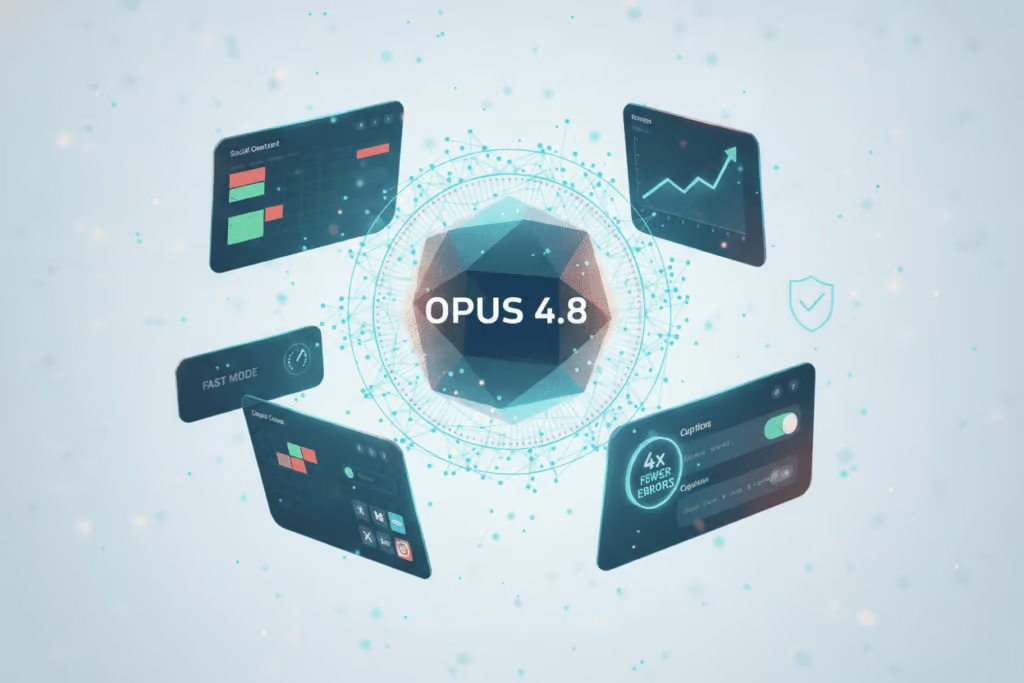
Anthropic shipped Claude Opus 4.8 on May 28, 2026, and the single number that should grab any social media operator’s attention isn’t a benchmark score, it’s this: the model is around four times less likely than its predecessor to let flaws in the work it produces slip by unremarked. For teams that hand a draft caption, a content calendar, or a multi-brand repurposing job to AI and then have to babysit every line, that shift from “confident guesser” to “careful collaborator” is the whole story. And it ships at the same price as Opus 4.7.
Why It Matters
The bottleneck in modern social media management is not ideas, it’s throughput at quality. A single manager might run six platforms across four brands, each with its own voice, cadence, and format. AI already drafts a lot of that output, but the catch has always been trust: a tool that fabricates a stat, mangles a brand’s tone, or confidently turns in broken copy creates more work, not less, because everything needs a human re-check.
That’s why the headline economics here matter to operators specifically. Opus 4.8 keeps regular pricing at $5 per million input tokens and $25 per million output tokens, while its “fast mode”, the model running at 2.5× speed, is now three times cheaper than on previous models, per Anthropic’s announcement. Cheaper, faster, and more reliable at once is rare. It’s the difference between AI as a novelty and AI as a line item you actually plan your week around.
What’s New / How It Works
Opus 4.8 is an upgrade to Anthropic’s top-tier “Opus” class, built on Opus 4.7 with gains across coding, agentic tasks, and knowledge work. Three changes stand out for content teams.
Honesty as a feature. Anthropic trains its models to avoid claims they can’t support, but models have historically jumped to conclusions, declaring a task done on thin evidence. Early testers report Opus 4.8 is more likely to flag uncertainty and less likely to make unsupported claims. In practical terms, that means an AI that says “I couldn’t verify this statistic” instead of inventing one for your post.
Effort control. A new setting alongside the model picker lets you dial how hard the model works on a given task. Higher effort means deeper thinking and better answers; lower effort means faster replies that burn through usage limits more slowly. For a social team, that maps cleanly to the job: max effort for a quarterly campaign brief, low effort for batch-drafting fifty short captions.
Dynamic workflows. In a research preview, Claude can now plan a large job, spin up hundreds of parallel sub-agents in one session, and verify its own outputs before reporting back. The demo case is a codebase migration across hundreds of thousands of lines, but the same pattern (decompose, fan out, self-check) is exactly what a multi-brand content refresh or a full-catalog repurposing sweep looks like.
A model that flags its own mistakes turns the social workflow from constant supervision into something closer to real delegation.
The Numbers
The figures Anthropic and its early testers reported sketch a model tuned for long, unattended, multi-step work, the kind agencies actually run:
- ~4× fewer unremarked flaws in its own output versus Opus 4.7.
- 84% on the Online-Mind2Web computer-use benchmark, called a meaningful jump over both Opus 4.7 and GPT-5.5.
- 61% cheaper token cost than Opus 4.7 when reasoning over PDFs, diagrams, and other unstructured content, per Databricks’ Genie team.
- 2.5× speed in fast mode, now 3× cheaper than prior fast modes.
- Same regular pricing as Opus 4.7: $5 / $25 per million input / output tokens.
On the safety side, Anthropic’s internal review was blunt about the gains. As the company’s Alignment team put it:
“reaches new highs on our measures of prosocial traits like supporting user autonomy and acting in the user’s best interest.”
One creative-leaning tester framed the day-to-day feel more concretely, calling 4.8 “a major quality-of-life update over Opus 4.7: faster, easier to collaborate with, and better at carrying context and style direction across a long session.” Carrying style direction across a long session is the exact thing that breaks when you ask AI to stay on-brand across forty posts.
What Comes Next
Anthropic is candid that 4.8 is a “modest but tangible” step, and it laid out two roads ahead. First, it’s working to deliver Opus-level capability at lower cost, good news for high-volume publishers watching their per-post economics. Second, it teased a new class of model “with even higher intelligence than Opus,” previewed as Claude Mythos under Project Glasswing, currently limited to a small group doing cybersecurity work until stronger safeguards are ready. The company says Mythos-class models should reach all customers “in the coming weeks.”
Also shipping the same day: the Messages API now accepts system instructions mid-conversation, letting a running agent update its permissions or context without breaking its cache. For builders wiring AI into a publishing pipeline, that’s a quiet but real plumbing upgrade. Anthropic, which recently raised $65B in Series H funding, is clearly investing in the agentic-work direction these features point toward.
What This Means for You
If you run social at scale, the practical takeaway is to stop treating AI output as a first draft you fully rewrite and start treating it as work you review, because a model that proactively flags its own weak spots is finally trustworthy enough for that. Use the new effort control deliberately: max effort for strategy, campaign briefs, and anything reader-facing where a wrong fact costs you; lower effort for high-volume batch jobs like caption variants and hashtag sets.
Inside a platform like Feedsta, that maps directly onto multi-brand workflows, you can lean on sharper AI to draft and adapt content per platform, then schedule it across TikTok, Meta, Pinterest, X, LinkedIn, and YouTube without losing each brand’s voice. The model’s better grip on style direction across a long session is what makes that “one prompt, many on-brand outputs” pattern actually hold. Pair the drafting with the Feedsta toolkit, shortener, QR codes, landing pages, and link-in-bio, so every AI-assisted post ships with trackable links baked in.
This also reinforces a theme we keep returning to: capability isn’t the edge anymore, judgment is. As we argued in our breakdown of non-commodity content, generic AI output gets replaced; distinctive, well-verified content survives. And because AI discovery now reads your activity directly, see why posting cadence became a ranking signal, a faster, cheaper model is most valuable when it helps you publish consistently and accurately, not just more.
The Bigger Picture
The story of Claude Opus 4.8 isn’t a bigger benchmark, it’s a more honest one. For social media managers, the value of AI was always capped by how much you had to double-check it; an upgrade that cuts unremarked errors fourfold, holds brand voice across a long session, and costs the same is the kind of change that actually moves work off your plate. The teams that win this year won’t be the ones publishing the most AI content. They’ll be the ones who learned to delegate the volume and keep the judgment.
Frequently Asked Questions
What is Claude Opus 4.8?
How much does Claude Opus 4.8 cost?
What does Claude Opus 4.8 mean for social media managers?
What is the new effort control in Claude?
What are dynamic workflows in Claude Code?
Is Claude Opus 4.8 better than GPT-5.5 for content work?
What is Claude Mythos?
Sources
- Anthropic (2026-05-28)