DuckDuckGo Surges 30% as Users Flee Google’s AI Search
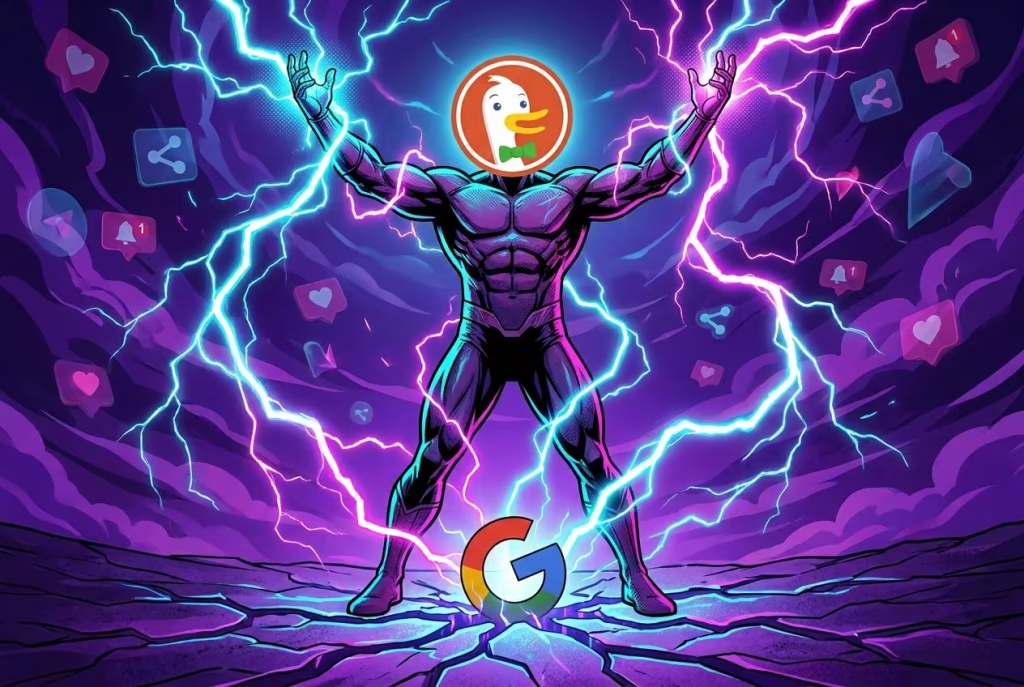
DuckDuckGo installs jumped as much as 30.5% in a single day, and nearly 70% on iOS, in the week after Google rebuilt Search around AI-generated answers. The privacy-first engine says the spike, which ran for six straight days between May 20 and May 25, 2026, is being driven by users hunting for a way back to plain blue links. If your audience lives across search and social, that migration is a signal worth reading closely, because it tells you where discovery is heading next.
Search is splintering into a dozen front doors. The brands that win build for all of them, not just the one Google controls.
Why It Matters
Search is no longer a single front door you optimize once and forget. Google still commands close to 90% of the global search market, according to StatCounter, while DuckDuckGo holds well under 1%. In raw share, this is a rounding error. But the direction of travel is what marketers should care about: when a meaningful slice of users actively opts out of AI-heavy results in a single week, it confirms that the audience for “traditional” web discovery hasn’t disappeared, it’s relocating.
The deeper issue is the open web itself. Critics argue Google’s AI-first approach reduces traffic to publishers and websites, because an AI answer that summarizes a page removes the reason to click through to it. For anyone who depends on referral traffic, bloggers, creators, SMBs, agencies running client sites, fewer clicks from the dominant engine means distribution has to come from somewhere else. That “somewhere else” is increasingly social platforms and AI assistants, not a second search engine.
What’s New / How It Works
At its annual developer conference, Google unveiled a sweeping transformation of Search, replacing the familiar list of blue links with AI-generated answers capable of completing tasks, summarizing information, and even monitoring queries in the background. Even users who skip the new AI Mode now see AI Overviews with follow-up chat prompts, making the experience feel far closer to a chatbot than the search engine people relied on for years. Google frames this as the future of Search; you can follow the company’s own rollout on the Google Search blog.
DuckDuckGo’s counter-move is to sell choice. The company is promoting a dedicated “no AI” search page that disables AI-written summaries and synthetic image results by default, offering a deliberately traditional experience. Notably, DuckDuckGo isn’t abandoning AI, it also runs Duck.ai, a chatbot with access to models from OpenAI, Anthropic, and Meta. The difference is governance: DuckDuckGo says it removes users’ IP addresses before requests are processed, does not store chat histories permanently, and does not use conversations to train models. Founder and CEO Gabriel Weinberg argues users are being “force-fed” AI features without meaningful opt-out options, and that DuckDuckGo’s goal is to give people greater control over how much AI they interact with online.
The Numbers
Here are the headline metrics DuckDuckGo reported for the week of Google’s announcements:
- +18.1% average week-on-week US app installs (May 20-25 vs. the prior week)
- +30.5% peak install growth on May 25, after six straight days of gains
- +33% average weekly install growth on iOS, peaking at nearly +70% in a single day
- +22.7% average week-on-week visits to the “no AI” search page, peaking May 24
“Search results were becoming worse, not better.”, Gabriel Weinberg, founder and CEO of DuckDuckGo, on why users are looking for an exit.
A 30% week is not a market takeover, DuckDuckGo remains a small player. But it is a clean, measurable spike that lines up precisely with a single trigger event, which is exactly the kind of signal that tends to precede a longer behavioral shift.
What Comes Next
DuckDuckGo isn’t the only beneficiary of search fatigue. As Google pushes AI deeper into Search, a cluster of alternatives is gaining attention. Brave offers a Chromium-based browser and search engine whose standout feature, “Goggles,” lets users reshape results with filters like “Tech Blogs,” “News from the Left,” or even “No Pinterest”, and it lets users switch AI features on or off. Ecosia, also Chromium-based, markets itself as an environmentally conscious option, saying it directs around 80% of its profits toward reforestation. Startpage takes a different tack, acting as a privacy proxy that strips identifying information before passing queries to Google, so users get familiar results without handing over personal data.
The through-line is that “control over AI” is becoming a product feature people will switch engines for. Expect Google to keep expanding AI Mode and AI Overviews, and expect challengers to keep positioning the opt-out as their wedge. For marketers, the practical takeaway is that the search audience is fragmenting into segments with different tolerances for AI, and no single optimization strategy reaches all of them.
What This Means for You
If a 30% install swing can happen in a week, the lesson for social and content teams is blunt: do not bet your whole funnel on one engine’s rules. The audience is scattering across Google AI Mode, DuckDuckGo, Brave, and conversational assistants like ChatGPT, Gemini, and Perplexity. Your job is to be present and quotable wherever they land, which is a social distribution problem before it’s a search problem. We unpacked the same dynamic when DuckDuckGo’s traffic first spiked in our look at DuckDuckGo’s 28% traffic shift, and it’s also why the clicks-versus-revenue gap keeps widening, as we covered in why your social KPIs are lying in the AI era.
Three moves that compound while search reshuffles:
- Publish natively across platforms, not just for Google. Schedule and automate a consistent cadence across TikTok, Instagram, LinkedIn, Pinterest, X, and YouTube with Feedsta, an AI social media manager built to keep one brand voice across every channel.
- Own your link layer. When referral traffic from search gets unpredictable, link-in-bio pages, branded short links, and QR codes inside the Feedsta app become primary distribution, not an afterthought.
- Measure AI visibility, not just rankings. Run a free BizScoreAI scan to see how often AI assistants like ChatGPT, Gemini, and Perplexity actually recommend your business, the metric that now sits upstream of clicks.
None of this requires guessing which engine wins. It requires being the answer regardless of which front door the user walks through.
The Bigger Picture
The DuckDuckGo spike isn’t really a story about one search engine, it’s an early reading on a fracturing discovery landscape, where users now choose how much AI they want between them and the open web. For brands, the takeaway isn’t to chase the challenger of the month; it’s to stop treating Google as the entire map. Build a social-first presence that publishes consistently, controls its own links, and shows up inside AI answers, and the next 30% swing in anyone’s search share becomes a tailwind instead of a threat.
Frequently Asked Questions
Why are people leaving Google Search for DuckDuckGo in 2026?
What is DuckDuckGo’s ‘no AI’ search page?
How does Google’s AI Search affect website and publisher traffic?
Should social media managers care about search fragmentation?
What are the best Google Search alternatives in 2026?
How do I stay visible as search splits across engines and AI assistants?
Is DuckDuckGo’s growth a real threat to Google?
Sources
- StatCounter GlobalStats (2026-05-01)
- Google Search Blog (2026-05-20)