How to Get Cited by ChatGPT, Perplexity, and Google AI Overviews
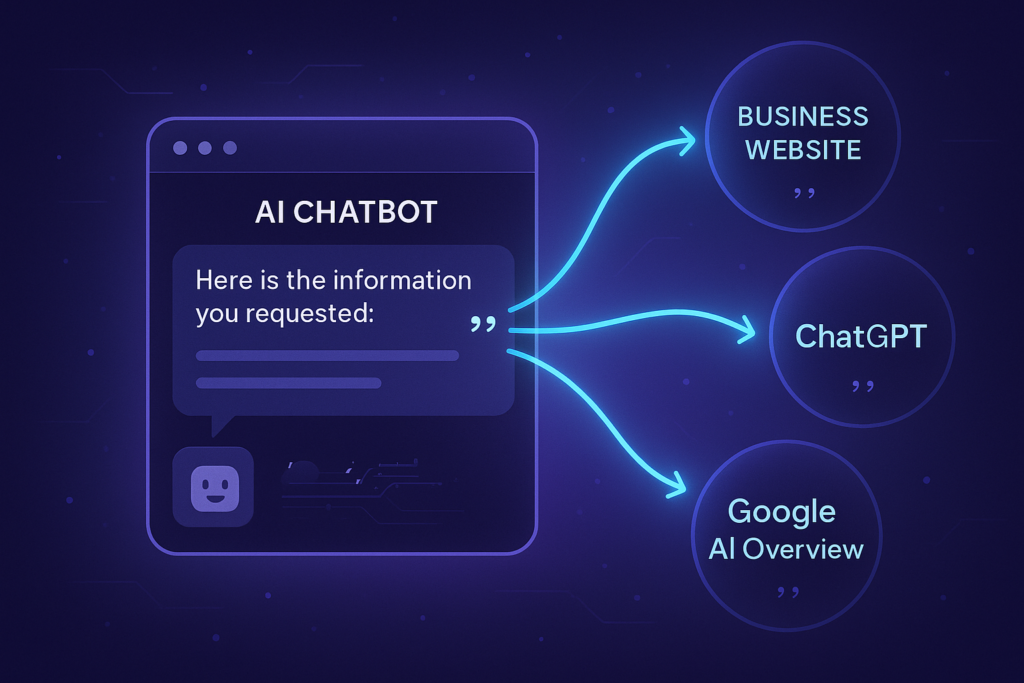
Brands that apply Generative Engine Optimization (GEO) tactics such as embedded citations, statistics, and fluent authoritative language can lift their AI citation visibility by up to 40%, per a 2023 Princeton, Georgia Tech, and IIT Delhi study. Consumers are now asking ChatGPT, Perplexity, and Google AI Overviews what to buy, who to hire, and where to go, so brands that aren’t feeding those synthesized answers are being skipped before a click ever happens. Winning this new discovery layer requires entity consistency, structured content, and social proof across every platform the audience touches.
Why It Matters
The traditional funnel, search Google, click a blue link, land on a website, is fracturing. Consumers increasingly treat AI chat interfaces like discovery engines: they type a natural question and accept a synthesized answer that pulls from dozens of sources at once. That shift moves the visibility battle from “rank in the top 10 results” to “be one of the few sources the AI cites in its response.”
Brands with an active social presence are uniquely positioned for this fight. AI systems aggregate entity signals from across the open web, Google Business Profile, LinkedIn, brand sites, press mentions, and yes, social profiles. Every consistent bio, every cross-platform mention, every repost of an expert quote strengthens the AI’s confidence that your brand is the right answer to a query. Inconsistency does the opposite. Moz Local’s citation research has long shown that consistent NAP (name, address, phone) data across directories underwrites both local search and AI entity recognition.
For brands juggling Instagram, TikTok, LinkedIn, X, YouTube, Pinterest, and Facebook, that’s a coordination problem. The payoff, being cited inside conversational AI search, is large, but it demands every platform tell the same story.
How LLMO and GEO Work
Two emerging disciplines define the new playbook: Large Language Model Optimization (LLMO) and Generative Engine Optimization (GEO).
LLMO focuses on making your content extractable. AI systems reward factual precision over hedging language. The principle is straightforward: instead of writing “many businesses see results from email marketing,” write “according to HubSpot’s 2024 State of Marketing report, email generates $36 for every $1 spent.” That precision is the difference between a sentence the AI ignores and a sentence the AI quotes.
GEO is the broader practice of optimizing for AI-generated search experiences. The Princeton, Georgia Tech, and IIT Delhi research paper identified the levers explicitly: citations to authoritative sources, fluent authoritative tone, embedded statistics, and structured formatting. These aren’t ranking signals, they’re extraction signals. AI systems are scanning for content that’s easy to lift and easy to credit.
How do AI search engines decide who to cite?
Tools like Perplexity and Google AI Overviews don’t rank pages the way classical search does. They synthesize answers from sources they consider authoritative, accurate, and well-structured. Two streams feed every decision: training data baked into the model up to a cutoff date, and real-time retrieval that fetches live web pages for current queries. Your content has to win on both fronts. Semrush’s analysis of Google AI Overview citations found that pages ranking in the top 10 organic results were cited dramatically more often, but ranking alone isn’t enough. Schema markup, factual density, and clear hierarchical structure all play independent roles.
The Numbers
The data points that should reshape your content calendar:
- Up to 40% lift in AI citation visibility from applying GEO tactics, citations, fluent authoritative language, and embedded statistics (Princeton / Georgia Tech / IIT Delhi).
- $36 returned for every $1 spent on email marketing, the kind of specific, data-backed claim AI systems extract and quote (HubSpot 2024 State of Marketing).
- Top-10 organic pages are cited in Google AI Overviews at dramatically higher rates than lower-ranking pages (Semrush AI Overview citation analysis).
- A single expert quote in a credible publication is worth more to AI entity recognition than hundreds of low-quality directory listings.
“Most small businesses have not yet started optimizing for AI visibility, which means there is a real first-mover advantage available right now.”
AI search engines don’t rank brands, they cite them. Your online presence now shapes the inputs that determine which brands are cited.
What Comes Next
The AI citation landscape is new, has few established players, and is changing quickly. Three trends stand out about where it’s heading.
First, entity consistency is becoming the foundation. AI systems build entity models by aggregating mentions across the web. A brand that shows up the same way, same handle, same bio, same product names, on Instagram, LinkedIn, TikTok, and YouTube is dramatically easier for an AI to model than one with fragmented presences.
Mentions of brands now appear more often in data used to train AI. Brands that get cited in respected industry publications see those mentions flow into both training cycles and real-time retrieval indexes.
Third, structured data is no longer optional. Schema.org vocabulary, especially LocalBusiness, Article, FAQ, and Review schema, hands AI systems machine-readable signals that require zero interpretation. The brands implementing schema in 2026 are quietly building the infrastructure that pays off across every generative search engine for years.
What This Means for You
If you run social for one brand, or fifteen across an agency, what you already do overlaps directly with how AI systems decide which sources to cite.
Lock down entity consistency across every platform. Identical brand names, bios, URLs, and category descriptions across TikTok, Instagram, LinkedIn, X, YouTube, Pinterest, and Facebook. If you’re running multiple brands, doing this by hand is painful; a single source of truth that feeds every channel is what keeps it consistent. The deeper backdrop on why social signals matter to AI discovery lives in the breakdown of why your brand is invisible to AI.
Repurpose your highest-authority content in formats AI can extract. A LinkedIn article with embedded stats, a Threads recap of those same stats, an Instagram carousel translating the data visually, each one becomes a citable entity touchpoint. A cross-platform publishing workflow lets you ship that pattern without burning a day duplicating posts.
Make your bios and link-in-bio pages AI-readable. AI agents need to find a clear, structured answer to “what does this brand do?” in a few characters. Vague taglines lose; specific, factual descriptions win. The recent post on AI contactability walks through the bio-level fixes that move the needle fastest.
To see which of these signals AI can already read for your brand, a free BizScoreAI visibility scan checks how ChatGPT, Perplexity, and AI Overviews currently read your listings, citations, and entity data, and flags the gaps keeping you out of the answer.
The Bigger Picture
Brands cited by ChatGPT, Perplexity, and Google AI Overviews in 2027 and 2028 are the ones now building consistent entities, structured content, portable social proof, and a repeated story across multiple platforms used by their audience. Whoever runs your channels is no longer just running the feed; they are also building the entity model that AI search engines may use to decide who gets quoted.
FAQ
What is LLMO and how is it different from SEO?
LLMO (Large Language Model Optimization) is the practice of making your content easier for AI systems like ChatGPT, Perplexity, and Google AI Overviews to extract, synthesize, and cite. It builds on SEO fundamentals, factual accuracy, clear structure, authoritative sourcing, but adds new dimensions like writing in extractable formats (clear Q&A, definition boxes, FAQ sections) and using specific data points instead of vague claims. Traditional SEO targets search engine ranking; LLMO targets being chosen as a source when an AI synthesizes an answer. Both matter, and the underlying signals overlap, but optimizing for LLMO means writing content an AI can lift cleanly into a response without rewording.
How do AI search engines decide which sources to cite?
AI search engines synthesize answers by pulling from sources they consider authoritative, accurate, and well-structured. Two streams feed those decisions: training data (massive web datasets baked into the model up to a cutoff date) and real-time retrieval (live web fetches for current queries). Citation likelihood depends on factual density, schema markup, entity consistency across the web, mentions in credible third-party publications, and clear hierarchical structure (H2s, H3s, FAQ blocks). Pages ranking in the top 10 organic results are cited at dramatically higher rates, but Semrush research shows ranking is necessary, not sufficient on its own.
How long does it take to start getting cited by AI search engines?
Entity recognition by AI systems isn’t instant, training data has cutoff dates, and real-time retrieval indexes update on their own schedules. That said, brands implementing the full playbook (entity consistency, structured content, third-party mentions, schema markup) typically see early citation signals within 60 to 90 days, with compounding visibility over 6 to 12 months. The biggest variable is third-party authority, getting quoted in a credible publication can move the needle faster than months of internal content work. The brands seeing fastest results treat AI citation as a coordinated cross-channel discipline, not a one-off content project.