Google Ads for Dental Practices: The 2026 Full-Funnel Playbook
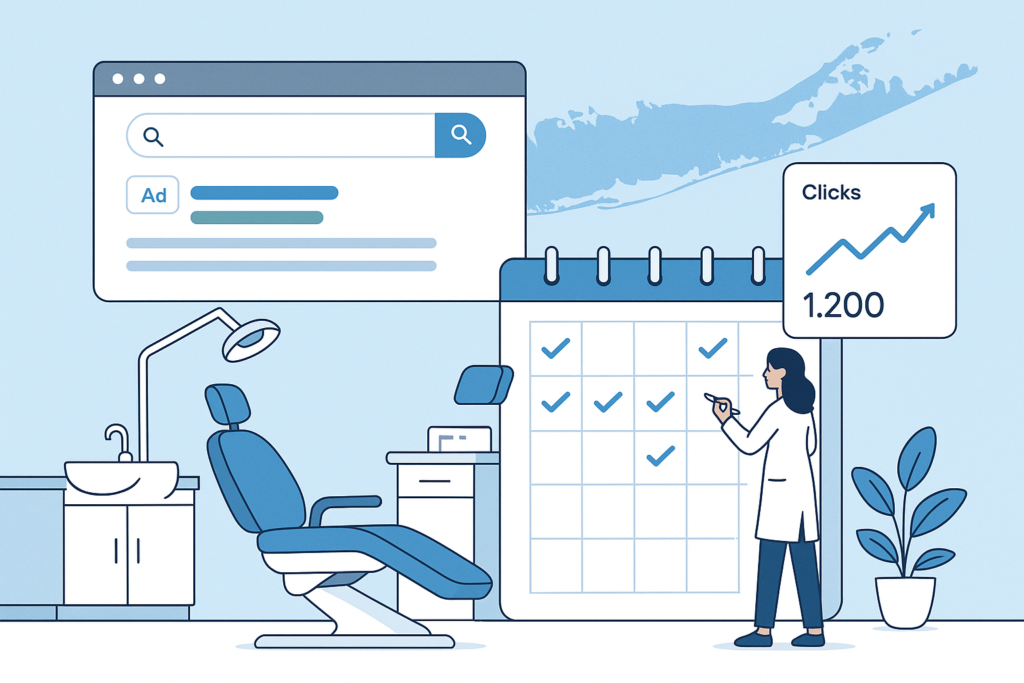
A local dental practice running smart Google Ads can pay $40 for a click that converts into a $30,000 implant patient, but the patient who actually books is the one who scrolled your Instagram, skimmed your reviews, and tapped your link-in-bio before picking up the phone. In 2026, general dentistry practices should expect to invest $2,000 to $5,000 per month in Google Ads alone just to stay visible, and whoever runs marketing owns the entire post-click experience.
Why It Matters
Dental services are intensely local, and the 2026 buying journey lives across at least four touchpoints: search, reviews, social, and the booking page. According to the American Dental Association’s Health Policy Institute, dentistry is one of the most fragmented local-service markets in the country, with no national chain holding meaningful share. Every practice is competing on the same Google results page against a dozen near-identical neighbors.
Ad spend without trust signals, without a social presence the patient checks while they’re deciding, is the most expensive kind of marketing waste. Whoever runs marketing for the practice is increasingly responsible for the photos prospects see when they Google your name, the reviews they scroll, and the link-in-bio that routes them to the booking page.
What’s New / How It Works
The PPC playbook for local dentists has crystallized in 2026 around three principles that practitioners should know before spending on paid social.
One: intent-driven keywords beat broad keywords every time. The data points to specific long-tail phrases, “Invisalign dentist in [your city],” “same-day dental crown in [your town],” “affordable dental implants near [your area],” as the keywords that actually convert. The lesson translates directly to social: stop running generic “smile” posts and start producing service-specific, location-tagged content that matches what real patients type and ask out loud.
Two: negative keywords. A maintained exclusion list cuts wasted ad spend by 20 to 30 percent by blocking searches for dental schools, DIY treatments, assistant jobs, and insurance directories. The social equivalent is audience suppression, excluding employees, current patients, and out-of-service geographies from paid social campaigns so you don’t pay to reach people who can’t convert.
Three: geographic precision. Google’s 2026 location targeting allows bid adjustments by zip code, and the same logic should run through your paid social campaigns. The difference between a profitable PPC campaign and a money pit comes down to strategy: the right keywords, the right targeting, and the right landing pages working together. A practice should bid higher in its highest-value neighboring towns, and your Meta and TikTok ads should run against the same geo overlays your search campaigns use.
The Numbers
Here are the metrics worth committing to memory:
- $2,000, $5,000/month: typical Google Ads investment for general dentistry practices
- 10-15 miles: optimal geographic targeting radius for general dentistry
- 25 miles: extended radius for specialty services like oral surgery or cosmetic procedures
- 20-30%: wasted-spend reduction from a maintained negative keyword list
- 3 seconds: maximum mobile landing-page load time before conversion rates collapse, per Google’s own benchmarks
- $5,000, $30,000: revenue from a single new dental implant patient
- 60-90 days: minimum window to measure PPC results before scaling spend
A missed call from a paid click is among the most expensive kinds of waste.
If your paid traffic, whether search or social, lands on a slow page or a brand with an abandoned-looking Instagram, you pay full price for a click that converts at a discount.
Google Ads handles the click. The social presence around the practice can drive appointment bookings. Those two jobs are now handled together.
What Comes Next
Google’s AI-powered bidding tools in 2026, Performance Max and enhanced Smart Bidding, are pulling more campaign decision-making into the algorithm. The human levers shift toward the inputs Google’s models can’t fully see: social proof, reviews velocity, photo cadence on the Google Business Profile, landing-page conversion rate.
The next frontier for dental practices isn’t a smarter bidding strategy. It’s a tighter feedback loop between paid search and organic social. Conversion data from Google Ads feeds back into bidding algorithms, but those algorithms reward landing pages and brand pages that look alive. A practice with two Instagram posts in the last 90 days will lose nearly every keyword auction against a competitor posting three times a week, all else equal.
Expect 2026 to bring even tighter integration between Google’s ad products and social signals. Google Business Profile posts, review schemas, and cross-platform consistency are already showing up as inputs into Performance Max’s optimization signals. Marketers who can demonstrate that posting cadence drives both organic visibility and paid conversion will be the ones winning dental retainers, and the same logic extends to every other high-CPC local vertical, from law firms to home services.
What This Means for You
If you manage social for a local dental practice (or any service business with a paid search budget), your job in 2026 isn’t to “do social.” It’s to make the entire paid-plus-organic funnel work as one system.
One: own the post-click experience. The landing page the Google ad sends a prospect to is your domain too. Make sure it has fresh patient photos, a current reviews count, and clear routes to active social profiles. A single link-in-bio and landing-page setup handles exactly this: one bio page that routes booking, reviews, and social proof in the order the patient actually needs them.
Two: keep posting cadence high and topic-aligned to the practice’s PPC keywords. If the practice bids on “Invisalign in [your city],” the content calendar needs Invisalign content the same week. Use Feedsta, an AI-powered social media platform, if maintaining multi-platform cadence across Instagram, TikTok, and Facebook without burning out the practice manager who has actual patients to see is a priority.
Three: read the adjacent playbooks. The law firm social media playbook covers reviews, credibility signals, and case-inquiry funnels that map almost 1:1 onto dental marketing, high-trust local service, long consideration window, big lifetime value. And the web design checklist for social-driven traffic tells you exactly what to demand of the landing pages your paid clicks are about to touch.
The Bigger Picture
Practices that succeed in 2026 don’t succeed because of their Google Ads bidding or Instagram design. It wins because every touchpoint, including search ads, landing pages, Google Business listings, Instagram, link-in-bio, and the booking flow, is run as one connected system, using the same keywords, the same neighborhoods, and the same proof points reinforcing each other. The work that practices are paying agencies to handle has grown, and agencies’ fees have grown alongside it.
FAQ
How much should a local dental practice spend on Google Ads in 2026?
Most general dentistry practices should budget $2,000 to $5,000 per month for Google Ads to maintain meaningful visibility. Specialty practices offering implants, oral surgery, or full-mouth reconstruction can justify higher spend because a single new patient may represent $5,000 to $30,000 in revenue. Start at the low end of the range, measure cost-per-acquisition for 60 to 90 days, and scale only after the data proves the funnel converts. Pair the ad spend with active social media so the brand looks alive when prospects check before booking.
What’s the difference between Google Ads and paid social for a dental practice?
Google Ads captures high-intent demand, people actively searching for a dentist, an emergency appointment, or a specific procedure right now. Paid social on Meta, TikTok, and Instagram creates demand and reinforces brand familiarity, reaching local residents before they need a dentist. The two work together: Google Ads brings the click, social media earns the trust that turns the click into a booking. Anyone running both should align keyword themes, geographic targets, and audience exclusions across channels rather than treating them as separate budgets fighting for credit.
How does social media activity affect Google Ads performance?
Google’s 2026 bidding algorithms increasingly weigh signals from outside the ad account, including Google Business Profile posts, review velocity, landing page engagement, and cross-channel consistency. A practice with an inactive Instagram and stale reviews will see lower Quality Scores and higher cost-per-click than a competitor with a steady social cadence, even when bidding on identical keywords. Performance Max in particular pulls signals from the wider digital footprint to decide which businesses to surface. Maintaining three or more weekly posts across Instagram, Facebook, and TikTok directly subsidizes paid search efficiency.
Related coverage