Google Gemini for Social Media Managers: The 2026 Visibility Playbook
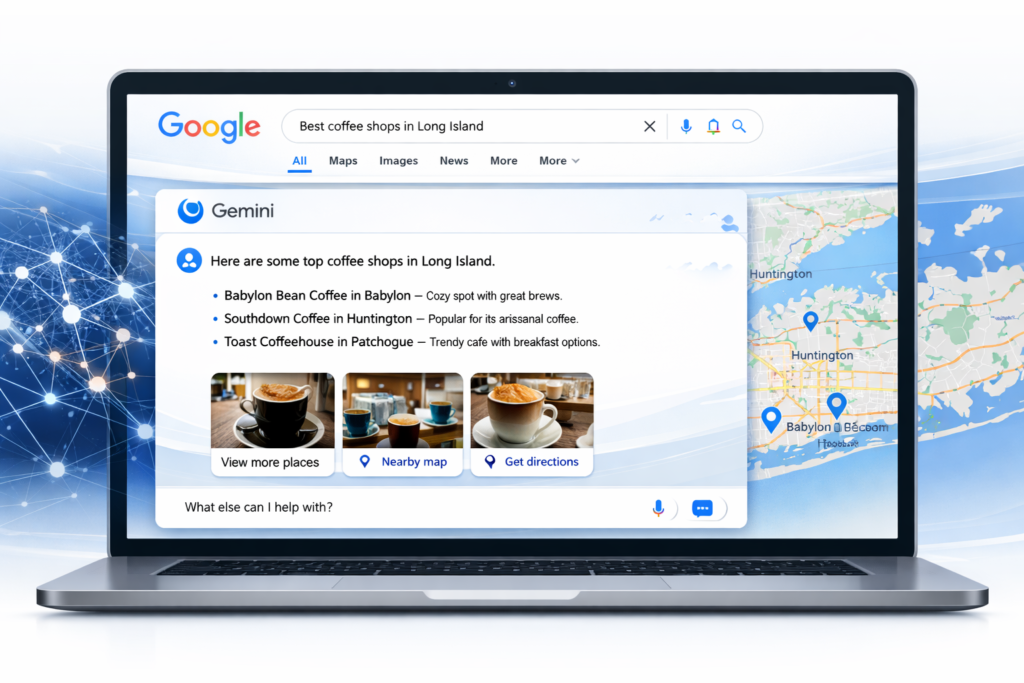
Google Gemini surfaces only about 11% of qualifying businesses when it answers a local search query, roughly a third the volume of the traditional Google 3-pack. For social media managers, that math reshapes how every post, review, and platform mention gets weighted in 2026. The brands that win Gemini citations aren’t the ones with the most polished website. They’re the ones with the most consistent, active, and credible social entity profile.
Why It Matters
Gemini is no longer a chatbot you opt into. It’s the AI model family running underneath Google Search, Google Workspace, and Google Cloud, the same engine powering the AI Overviews that now show up in more than 40% of local business queries. When a customer searches for a service, plenty of those queries get answered before the user ever scrolls to a traditional listing.
For social media managers, the change is structural. Google isn’t just ranking pages anymore; it’s synthesizing recommendations. And it’s drawing on a much wider set of signals than the old SEO checklist, including the activity, reviews, and entity consistency that live on social platforms. According to Google’s search documentation on generative AI, AI Overviews are designed to surface sources the model considers authoritative across the open web, not just indexed HTML.
What’s New / How It Works
Gemini Advanced runs on Gemini Ultra, Google’s most capable model. It replaced Bard in early 2024 and has been embedding itself into Google’s ecosystem ever since. As of early 2026, 70% of Google Cloud customers actively use Gemini features, and the model is bundled inside Google Workspace Business Standard at $14/user/month and above. Gemini isn’t a separate product you opt into, it’s infrastructure that’s already embedded in tools you may already use.
The visibility mechanics matter most for marketers. Gemini synthesizes its recommendations from three signal layers, and all three have a social dimension:
- Google Business Profile data, name, address, phone, hours, services, categories, and recent photos. Photo cadence is a social workflow problem more than a website problem.
- Review consensus, not just stars, but the themes and language that repeat across reviews. Substantive reviews beat generic five-stars.
- Entity consistency across the web, your brand as a documented entity the model can confidently reference. Social profiles, directory listings, and citations all feed this signal.
That third layer is where social media managers earn or lose ground. A brand that posts inconsistently, names itself differently across platforms, or lets profile data go stale becomes harder for Gemini to verify. The model defaults to safer answers, meaning competitors with cleaner social entity data get cited instead.
The Numbers
- 40%+ of local business queries now display a Gemini-generated AI Overview at the top of results.
- 70% of Google Cloud customers actively use Gemini features as of early 2026.
- ~35% of qualifying businesses surface in the traditional Google 3-pack.
- ~11% of qualifying businesses surface in Gemini-powered AI results, three times more selective.
- $14/user/month, the Workspace Business Standard tier where Gemini features are bundled at no extra cost.
“Gemini-powered AI results surface only about 11% of qualifying businesses, three times more selective. The businesses that appear there are those with the most complete, consistent, and authoritative information profiles.”
When Gemini picks 11% instead of 35%, the brands with the most consistent social entity profile get cited, and the rest disappear from view.
What Comes Next
Gemini isn’t a static product. Google is layering vertical-specific summaries (legal, medical, home services), conversational follow-ups, and tighter integration between Search, Maps, and Workspace agents. The selection model gets more refined with every iteration, and social signals get weighted more, not less, as the model leans on real-world activity as a trust check.
The next twelve months will also bring more Workspace agents into customer-facing roles. Larger businesses are already deploying Gemini-powered chat assistants for FAQs, appointment intake, and routing. For social media managers, that means inbox automation, AI-drafted responses, and analytics summaries are about to converge with the same model deciding whether your brand gets surfaced in search at all.
Brands that build entity authority now, through review velocity, profile completeness, and consistent posting cadence, are the ones compounding visibility as the AI layer grows. The teams waiting are watching a window close.
What This Means for You
Social media managers can’t directly edit how Gemini picks its citations. But they own three of the signals it weights most. Here’s how to put that ownership to work.
1. Treat every social profile as an entity signal. Name, bio, contact info, category, link-in-bio destination, all of it needs to match exactly across TikTok, Instagram, Facebook, LinkedIn, X, Pinterest, and YouTube. Inconsistency creates entity confusion. A platform like Feedsta keeps profiles and posting cadence aligned across every channel from one workspace, so the entity stays coherent without manual upkeep on each platform.
2. Build review velocity systematically. Recency matters as much as count. A 24-48 hour post-service review prompt, sent via text or email with a direct review link, keeps fresh, specific reviews flowing. Aim for 4-6 net new reviews per month to stay competitive in AI selection.
3. Keep photo and post cadence visible. Gemini reads activity as a trust signal. A brand that posts twice a month looks dormant next to one publishing four times a week. Scheduling consistent content, including short-form video repurposed across platforms, is exactly the kind of work the Feedsta app was built to automate.
If you want the structural picture of how social signals feed AI search, our breakdown on AI search visibility and the social signals that pick winners walks through the citation mechanics. And if you’re trying to get cited by name in AI answers, our LLMO playbook for social media managers is the next step.
The Bigger Picture
Gemini isn’t replacing search, it’s tightening the funnel. The same brands that already win the local 3-pack don’t automatically win Gemini citations. The new selection criteria reward entity discipline: consistent identity, active presence, and credible reviews across every surface where customers (and AI models) look. Social media managers are no longer just feeding the funnel. In 2026, they’re the operators keeping the brand legible enough to be cited at all.