Vibe Coding Hits Mobile: A Social Media Manager’s Google I/O 2026 Playbook
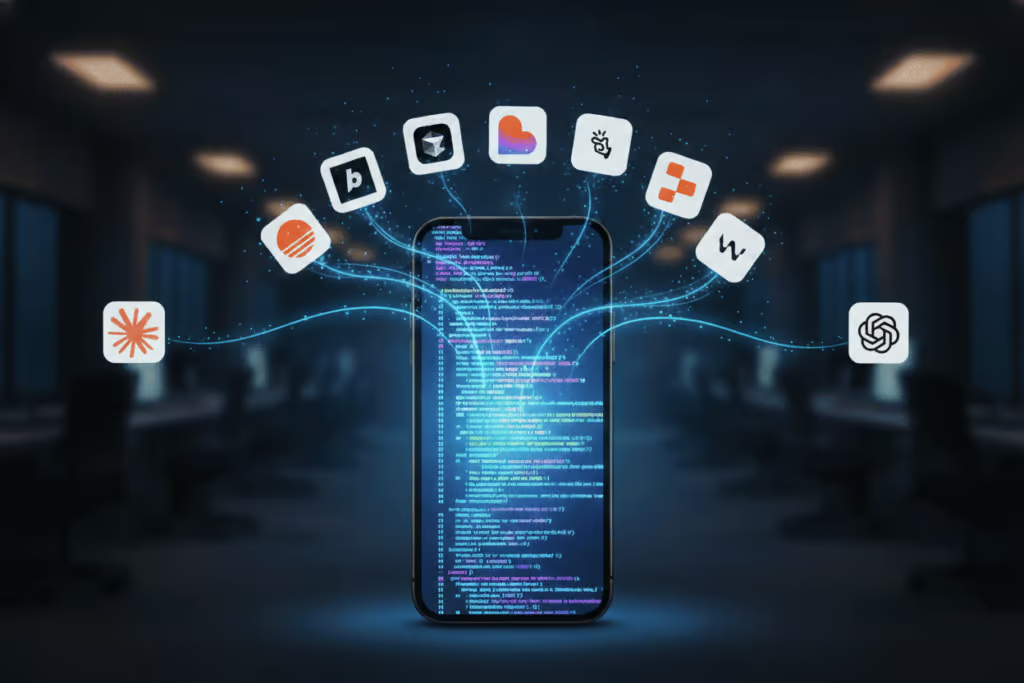
At Google I/O 2026, Google announced that AI Studio can now generate native Android apps from a plain-English prompt and export them to a phone in “a matter of minutes.” The feature starts narrow, personal utility apps only, but for social media managers the implication is large. The custom posting checklist, the cross-brand scheduling widget, the one-glance reporting screen you have wished existed is now a Saturday-afternoon prompt away.
Why It Matters
Social media managers have spent fifteen years living inside other people’s apps. The analytics tool that almost shows what you need. The scheduler that handles eleven networks but not the twelfth. The reporting dashboard that takes half a Monday morning to rebuild in a spreadsheet. Mobile drives the majority of social discovery and consumption traffic, yet the tools we use to manage that traffic are still desktop-first, or worse, browser-tab-first, because shipping a native mobile companion required a developer, a budget line, and a roadmap quarter.
The barrier has never been ideas. It has been the cost of turning an idea into something a teammate could install on a phone. Mobile vibe coding attacks exactly that barrier, and the social teams that notice first will be the ones who quietly build five years of internal tooling over a few weekends.
What’s New / How It Works
The headline announcement at Google I/O 2026: an update to Google AI Studio that lets anyone describe an app in plain English and receive a native Android build, exportable to a phone in minutes. The tool draws on Gemini’s knowledge base, so the model can reason about APIs, data shapes, and interface patterns the way an experienced engineer would. Distribution rules have not changed, putting an app on the Play Store still means clearing Google’s existing review process, but for internal team tools you side-load to your own devices, the engineering bottleneck is effectively gone.
Google also previewed AI-generated widgets at last week’s Android Show. Demos included widgets that surface specific weather metrics or suggest recipes, small, single-purpose surfaces that used to require a developer or a willingness to fight Tasker. Google frames the widget feature as the first step toward what it is calling a “generative UI,” where the phone composes interface elements on the fly based on what a user needs in the moment.
Apple is reportedly working in the same direction. The company is building a prompt-driven path for iOS Shortcuts that lets users describe an automation, “open the transit app when I get to the bus stop,” for example, instead of assembling it block by block. iOS 27 is the expected vehicle.
The Numbers
- Build time: “a matter of minutes” from prompt to installed Android app, per Google’s I/O demo
- Initial scope: personal utility apps only, broader categories gated for now
- Play Store rules: unchanged, distribution still goes through Google’s review process
- Widget examples shown: targeted weather metrics, recipe suggestions, and other single-purpose surfaces
- Underlying model: Gemini, with full access to its knowledge base
- Apple counter-move: prompt-built Shortcuts reportedly arriving with iOS 27
“While I don’t think we want to wake up every morning and have our devices have different UI, I do think there’s a level of personalization and customization to the user that could be delightful,” said Android president Sameer Samat.
What Comes Next
Google is positioning prompt-built apps and AI widgets as Act One of a larger generative-UI program. The eventual vision sketched at I/O is a phone that composes the screen you need in the moment instead of forcing you to navigate a fixed grid of icons. That is years away, and Samat himself is hedging on how aggressive that personalization should be, but the direction is set.
Reviewer Allison Johnson, who covered the announcement, sounded a useful caution: “I’ve heard a lot of promises over the past few years from tech company execs about how AI will fundamentally change how we interact with mobile devices.” Until widgets ship at scale and survive contact with real users, the feature is a demo, not a platform shift.
Apple’s prompt-based Shortcuts work, expected alongside iOS 27 later this year, will turn the announcement into a two-platform story. Once both stores treat “describe what you want” as a first-class input method, the question for social media managers stops being whether to build internal mobile tools and becomes which ones to build first.
The mobile engineering bottleneck just disappeared. For social media managers, the new constraint is knowing exactly what to ask for.
What This Means for You
If you manage social for a brand, or twelve, the practical takeaway from I/O 2026 is that the cost of internal mobile tooling is about to fall through the floor. A custom posting checklist, a widget that shows today’s scheduled queue across every brand you run, a quick-look reporting screen for the campaign your client keeps asking about, these used to require a freelancer, a SaaS subscription, or a half-built spreadsheet. They are now a Saturday-afternoon project.
A few starting points worth running this week:
- Audit the dashboards your team opens on a phone. Each one is a candidate for a personal-utility app that lives on the home screen instead of a browser tab. Pair it with the social analytics view you already check so the daily glance happens before the laptop opens.
- List the widgets you wish your home screen had. Today’s scheduled posts across brands. This week’s top-performing reel. Community replies older than two hours. Each is now a prompt away, and a natural companion to your content workflow.
- Plug vibe-coded tools into your link stack. A widget that pings you when a particular link-in-bio page or short URL crosses a click threshold turns one of the most-checked screens in your day into a single home-screen tile.
- Track what AI is doing inside the ad stack at the same time. Our companion piece on Meta’s AI Ads Connector covers how ChatGPT and Claude can now run Facebook and Instagram campaigns directly, the same prompt-driven shift, one layer up the funnel.
The Bigger Picture
The smartphone has spent fifteen years being a place where social media managers consume software other people wrote. Google I/O 2026 is the first credible signal that the next fifteen may look different, phones as places where every operator can shape the exact tool they need, on the device they already carry. For social teams, the win is not just cheaper apps. It is the disappearance of the gap between noticing a workflow problem and fixing it. The teams that capture that win will be the ones already comfortable describing what they want to an AI, because the new bottleneck is no longer engineering. It is taste.