Non-Commodity Content: Why Generic Content Gets Replaced in AI Search
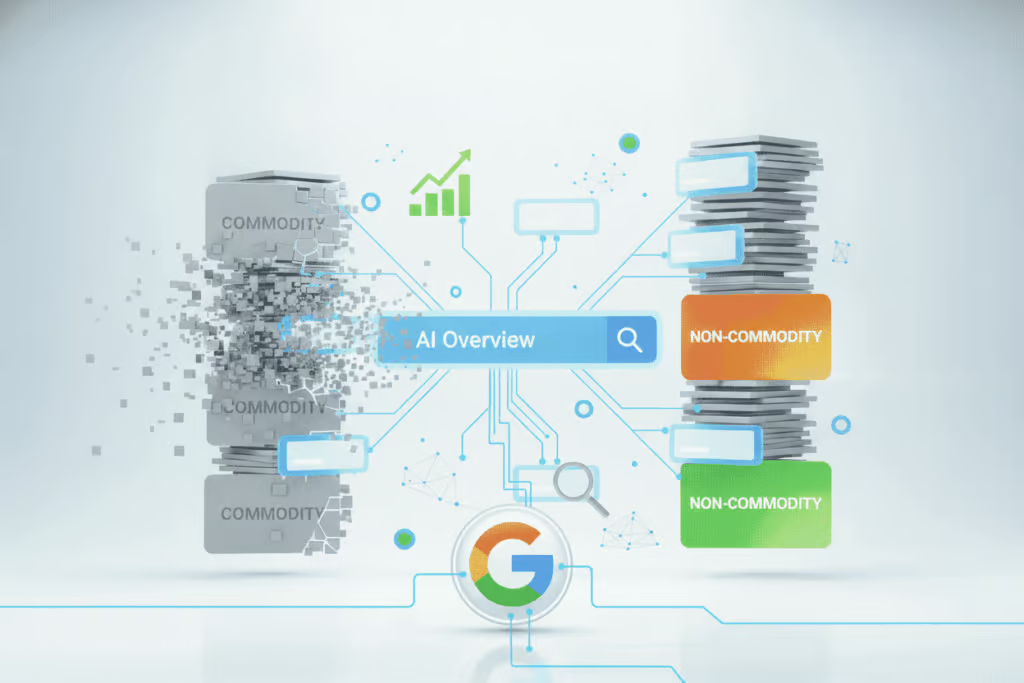
Google just published an official guide on how its AI systems pick the content they surface, and the core message is blunt: AI Overviews are built to synthesize and replace commodity content (generic, replaceable material anyone can produce) while elevating non-commodity content (first-hand, experienced material only you could produce). The guide was filed under SEO Fundamentals, signaling that the same rules now govern AI discovery and every other AI-mediated surface.
Why It Matters
Google quietly dropped its guide to optimizing for generative AI features inside the Search Central documentation a week after Google I/O wrapped, the same I/O where the company confirmed AI Overviews now reach billions of users and that Search is becoming an interactive surface where AI agents watch the web around the clock. Click rates to publisher sites have been sliding, and an entire consulting market has sprung up around GEO audits, AEO frameworks, and llms.txt files sold as the new must-have fixes.
Here is why anyone publishing at volume should care: the guide was filed under SEO Fundamentals, not in a new AI section. Google is signaling that the rules governing AI discovery are the same rules that govern everything else, and those rules are leaking into every AI-mediated surface, including the AI search boxes and assistants that increasingly pull from public social profiles. The bar Google just described is fast becoming the bar for all discovery, not just blue links.
How Does Google’s AI Search Pick Content?
Two mechanics explain Google’s “just do good SEO” message. The first is RAG (retrieval-augmented generation): AI Overviews are assembled from real pages in Google’s index. If your page is indexed, ranks, and is eligible to show a snippet, it can be pulled into an AI answer. The second is query fan-out: instead of matching one query, Google fires off several related searches at once and stitches the results together. A deep, genuinely useful page can surface because it answered a sub-question, not because it matched the exact keyword.
The most revealing part of the guide is the “what you don’t need to do” section, where Google names and dismisses tactics being sold as AI optimization. llms.txt files get no special treatment from Googlebot. Structured data is not an AI Overviews lever. Inauthentic, planted brand mentions are treated as spam, exactly as in regular search. And the popular advice to chop your content into short, AI-digestible chunks? Debunked. As the guide puts it, “Google’s systems understand context across multi-topic pages and can surface the relevant section to users without the content being pre-segmented for them.”
There is also one technical detail worth a same-day check: a page must be eligible to show a snippet to appear in AI features. A stray nosnippet tag can quietly lock a strong page out of AI Overviews entirely.
The Numbers
- Billions of users now see AI Overviews, per Google’s I/O announcements.
- 5 tactics Google explicitly says you can skip for AI search: llms.txt files, content chunking, AI-specific rewrites, inauthentic mentions, and structured-data-as-an-AI-lever.
- Zero AI Overview eligibility for any page carrying a nosnippet tag.
- 2 retrieval mechanics, RAG and query fan-out, now decide whether your content gets cited.
- 1 test that settles it: could a generative model produce an equally useful version of this page?
The whole guide boils down to one question:
Are we creating something so useful that people and AI systems would miss it if it disappeared?
What Comes Next
Google made it clear at I/O that Search is moving toward an agentic model, AI agents that monitor the web continuously and act on a user’s behalf, inside a results page that increasingly answers rather than redirects. Google no longer just wants to send people to other sites; it wants to be the place where the task gets done. That direction raises the cost of being generic, because an agent comparing ten near-identical sources will collapse them into one synthesized answer and move on.
The guide’s practical to-do list reflects that: run a non-commodity audit on your top pages, check snippet eligibility, consolidate thin cluster pages before building more, stop pouring effort into llms.txt and AI-specific markup for Google, and reinvest in the content types AI cannot generate. For commerce and local players, the product and listing feed layer matters; for everyone, clean semantic HTML is infrastructure worth maintaining. None of it is exotic. All of it rewards originality over volume.
What This Means for You
The commodity test maps almost perfectly onto social content. A “7 tips for better Reels” carousel is commodity, an AI assistant can generate a comparable one instantly, and so can every competitor. What it cannot generate is your first-hand material: the client result with the real numbers, the campaign that flopped and why, the behind-the-scenes of how your team actually shipped a launch. That is the social-media version of the first-person example Google uses to define non-commodity content, and it is the content worth building your calendar around.
So change what you mass-produce, not how much you publish. Repurpose your experiential material across platforms instead of spinning generic tips into ten formats. Capture the proof, screenshots, before-and-afters, candid process notes, once, then use Feedsta, an AI-powered social media platform, to schedule and repurpose it, so the original insight reaches each audience in its native format. Consistency is its own signal: Google’s AI search box already treats your posting cadence as a discovery lever, not just an engagement metric.
A few concrete moves to make:
- Audit your last month of posts and tag each one commodity or non-commodity, then shift the ratio toward the latter.
- Turn your owned first-party data, analytics, and client outcomes into posts no model can fabricate, within a connected workspace.
- Don’t sleep on owned surfaces either: Google Business Profile Posts are a social channel you can schedule like the rest of your stack.
If an AI model can write your post in seconds, it can replace your post in seconds. First-hand experience is one of the few durable advantages remaining.
The Bigger Picture
The AI era does not punish good content; it punishes generic content, since they are no longer the same thing. A well-made guide to common knowledge can be helpful, accurate, and easily duplicated by an AI. Your edge is the real campaigns, numbers, and opinions from your own experience, which an AI cannot gather on its own. Build a content calendar around your own campaigns, numbers, and opinions, and the AI systems selecting what to surface will have a reason to keep you in the answer.
FAQ
What is non-commodity content?
Non-commodity content is material that could only come from you: first-hand experience, original data, or a specific outcome an AI model cannot fabricate. Google’s guide contrasts it with commodity content, which is generic, widely available information like a standard tips list. The test is whether a generative AI could produce an equally useful version of your page. If yes, it is commodity and AI Overviews are built to replace it. If no, because it relies on your real campaigns, numbers, or lived experience, it is non-commodity, and that is what survives the shift to AI search.
Does llms.txt help pages appear in Google’s AI Overviews?
No. Google’s guide states plainly that you do not need an llms.txt file or any AI-specific markup to appear in generative AI search. Google may crawl the file like any other page, but it gets no special treatment and does not influence how your content is weighted in AI Overviews. llms.txt may still matter for other AI systems, since crawlers from Anthropic, OpenAI, and Perplexity behave differently from Google, so it is not useless everywhere. But for Google specifically, time spent creating and maintaining llms.txt produces no ranking or citation benefit.
Can a nosnippet tag block content from AI Overviews?
Yes. To appear in Google’s generative AI features, a page must be indexed and eligible to show a snippet in Search. A page carrying a nosnippet tag cannot appear in AI Overviews, even if the content is excellent and ranks well. Many teams have treated nosnippet as a minor technical setting, so a tag applied site-wide or by mistake can silently lock important pages out of AI results. Before investing in any new AI SEO tactics, audit your high-value pages for stray nosnippet directives in your robots meta tags. It is the cheapest, fastest fix available.
Related coverage
- Google’s Generative AI Search Guide Signals What Content Will Survive
- How Consumers Search for Local Businesses in 2026: Mobile, Google, and the Role of AI