Short or Long? The Content AI Overviews Actually Cite
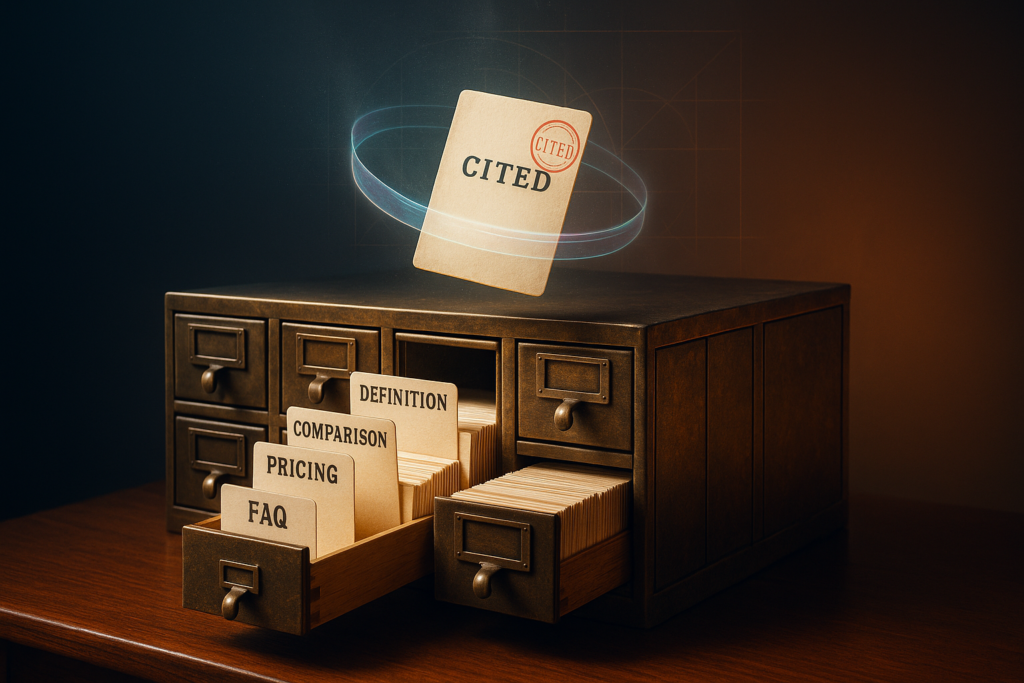
Neither short nor long content wins automatically in Google AI Overviews. What gets cited is content that directly answers the query on the first line, with length set by intent, not word count. With roughly 60% of Google searches reportedly ending without a click and AI Overviews accelerating that curve, the structure of your bio pages, landing pages, and FAQ blocks now decides whether your brand is quoted or skipped.
Why It Matters
AI Overviews are no longer a niche experiment. Google rolled them out broadly in May 2024 and they now appear on a majority of informational queries in the U.S. Independent analytics tracking through 2025 has suggested organic click-through rates dropping on queries where an Overview shows, because users get the answer without clicking through to any site.
For brands that built their funnel on social-to-website traffic, the choke point has moved upstream. If the AI doesn’t quote you, the user never sees you at all. That makes the content sitting behind every social link, bio destinations, landing pages, FAQs, blog posts, a new front line for visibility. Roughly 60% of Google searches are now estimated by some analysts to end without a click, and AI Overviews are accelerating that curve.
How AI Overviews Pick Sources
The central insight here is one worth taping to the wall: neither short nor long content wins automatically. What gets cited is content that directly and clearly answers the query. Length follows intent, not a word-count target.
That maps cleanly onto the assets you already own. A definition query (“what is [your service]?”) gets two clean sentences at the top of a page. A “Service X vs. Service Y” comparison query needs a structured page with sub-sections an AI can lift wholesale. A pricing question deserves a number, not a paragraph.
Four core principles apply to any page you want extracted:
- Lead with the answer. State your main point in the first sentence after each heading. Don’t bury it three paragraphs in.
- Keep paragraphs short. Aim for 40-60 words. Dense blocks are harder for AI to isolate as clean, quotable passages.
- Use specific headings. “What services does [Business] offer?” outperforms “Our Services.”
- Add structured data. Lists, tables, and FAQPage schema are parsed easily by AI systems and frequently surfaced.
AI Overviews don’t reward word count. They reward content that answers the question on the first line.
Short vs. Long: When Each Wins
Here’s how query intent breaks down:
Short content wins for:
- Definition queries (“What is [your service]?”), one or two sentences at the top of the page.
- Local searches (“Best [business type] near me”), concise service descriptions with clear location signals.
- Pricing queries, direct price ranges or structured pricing breakdowns.
- FAQ-style questions, one or two sentence answers that match how customers actually ask.
Long content wins for:
- Comparison queries (X vs. Y), structured breakdowns with comparison tables that give the AI multiple citation opportunities.
- How-it-works explanations, multi-step processes, and technical concepts.
- High-consideration B2B decisions rely on case studies, ROI data, and process detail to build credibility with AI and human readers.
The businesses getting cited in AI Overviews aren’t winning because they write the most content. They’re winning because their content is structured for extraction, with clear answers and logical formatting matched to the intent of real customer queries.
What Comes Next
Google’s AI Overviews are the loudest surface, but the shift is broader. TikTok, Pinterest, Meta, and a long tail of vertical search apps are stitching in-app AI answer experiences into discovery. The content you publish to support a single campaign, the bio link, the landing page, the FAQ block on a product page, can end up cited across surfaces you didn’t plan for.
Google’s own structured data guidance continues to expand, and competitors are quietly adopting the same extraction patterns. The teams that win the next 12 months will be the ones who audit every social-adjacent URL and rewrite it answer-first, not the ones chasing another 1,800-word listicle.
What This Means for You
Practical moves to make this week:
- Audit your bio destinations. Each link should pair with a one-sentence description that names the service and (where relevant) the location. That’s the structure AI extractors prefer, and it’s exactly what a link-in-bio page should be doing.
- Rewrite top-performing campaign landing pages with an answer-first lead. Move the long context, social proof, and ROI tables below the lead, not above it. Treat your landing pages as citation targets, not just conversion forms.
- Add an FAQ block to every product or service page you drive social traffic to. Questions as H3 subheadings, answers in one to two sentences.
- Watch your short-link analytics carefully. If a campaign’s impressions hold but its short-link click-through drops, you may be getting cited in an AI surface (zero-click) instead of clicked through. That’s a signal worth tracking, not a failure to fix.
- Don’t sleep on Google Business Profile Posts. They get pulled into Overviews more than people realize, we covered the playbook in Google Posts: The Free Local Search Channel You’re Not Using Yet.
- Use AI assistants to rewrite for extraction, then keep a human pass for tone. Our walkthrough of Claude Opus 4.7 workflows covers prompts that turn long brand copy into answer-first paragraphs without bleeding voice.
The Bigger Picture
AI Overviews didn’t kill social-to-web traffic, they raised the floor on what your destination content has to do. The brands that come out ahead will be the ones who treat bio links, landing pages, and FAQ blocks as serious citation targets, not afterthoughts. If you want a baseline on where your brand shows up in AI and search today, BizScoreAI visibility scan is one option to consider. Length follows intent. Structure follows extraction. Get both right and AI search becomes a distribution channel instead of a tax on the traffic you used to own.
Related coverage
- Google Gemini 3.5 Pro Delayed as Coding Performance Falls Short
- Google’s Generative AI Search Guide Signals What Content Will Survive