Why Your Business Is Invisible in AI Search (And How to Fix It)
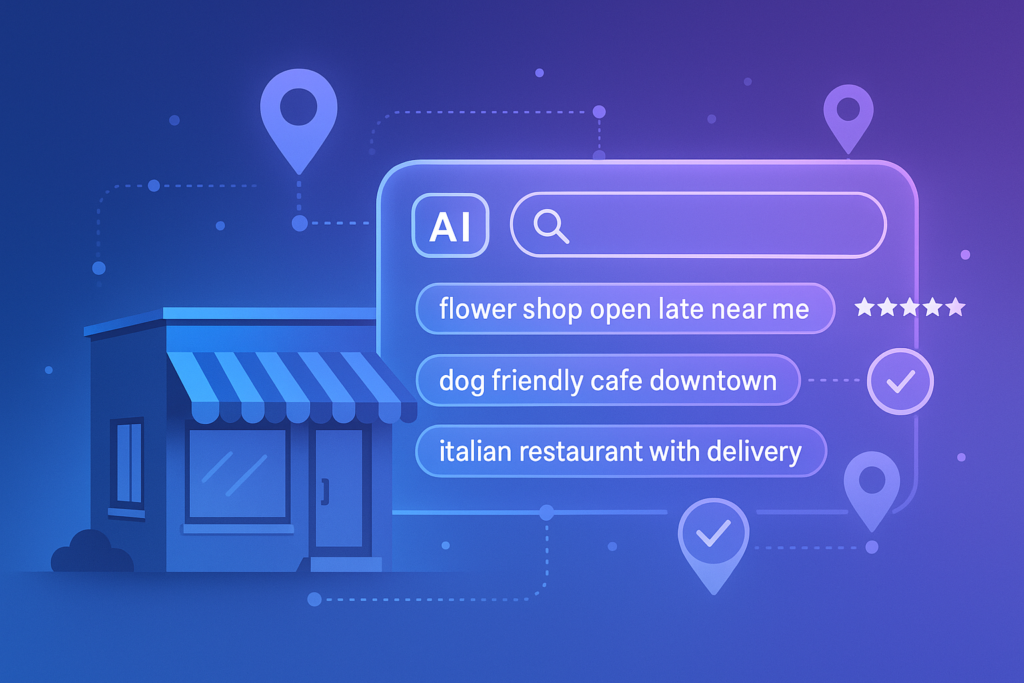
Long-tail queries triggering Google AI Overviews have grown 7x since the feature launched in 2024, and the customers typing full questions into ChatGPT, Perplexity, or Google are being routed to competitors whose bios match how real humans phrase real problems. Most business profiles are still optimized for short generic keywords like "plumber" or "skincare," which means AI assistants skip them when generating answers. The fix is rewriting social profiles, bios, captions, and About pages in specific, intent-driven language that mirrors how customers actually ask questions.
Why It Matters
The way people search has changed faster than most businesses have updated their profiles. A potential customer no longer types "plumber" or "skincare." They type "emergency pipe burst repair in [city]" or "fragrance-free moisturizer for rosacea-prone combination skin." The shift is partly behavioral and partly driven by AI assistants trained on conversational input.
The cost is blunt: businesses optimized around short, generic keywords are losing high-intent customers to competitors who built around specific, intent-driven language. Long-tail phrases, roughly four to ten words, already account for about 70% of all search traffic, and they convert at higher rates because the person searching already knows what they want.
This is not a tangential SEO story. AI search systems crawl social profiles the same way they crawl websites. Your Instagram bio, your TikTok account description, your YouTube channel About page, your LinkedIn company headline, all of these are citation candidates. If they read like everyone else’s, they do not get cited.
What’s New / How It Works
AI assistants don’t just match keywords. They match intent, the specific problem behind the query. When ChatGPT or Google’s AI Overview drafts an answer to a multi-word question, it pulls from sources whose language closely mirrors that intent. The clearer your profile copy communicates who you serve, what problem you solve, and where, the higher the odds of being the cited source.
This is why generic captions, bios, and category tags get skipped. The logic is direct: a plumber who optimized for "plumber" will lose to a plumber who optimized for "emergency pipe burst repair in [city]." A consultant who lists "business services" will lose to one who has content on "revenue growth strategy for SaaS companies under $5M ARR."
In 2026, the brands cited by AI search are the ones whose bios match how customers type real questions, not the ones with catchy taglines.
Translate that to your platforms. A skincare brand whose Instagram bio reads "clean beauty, glowing skin" loses to one whose bio reads "fragrance-free moisturizers for rosacea-prone skin, shipped from Austin." A creator whose YouTube About says "lifestyle content" loses to one whose About reads "weekly van-life cooking tutorials for full-time travelers." Specificity is the new authority signal.
The Numbers
Pull the headline stats and the parallel research behind them:
- 7x growth in queries with eight or more words triggering Google AI Overviews since the feature’s 2024 launch.
- ~70% of all search traffic now comes from long-tail phrases of four to ten words.
- 400% increase in AI citations from pages ranked 21-30, per BrightEdge data, meaning you no longer need page-one rankings to be cited in an AI answer.
- Long-tail search terms often lead to higher conversion rates.
- Citation candidates now include Instagram bios, TikTok descriptions, YouTube About pages, LinkedIn headlines, and Pinterest profile copy, not just websites.
Companies that describe their target customers, the problems they solve, and the regions they serve may be favored by AI systems.
What Comes Next
The platforms are evolving in the same direction. Google AI Overviews now embed inline citations to source pages again. Conversational search keeps eating share from short-form keyword search. Over the next 12-18 months, expect search engines and AI assistants to weight profile-level signals, bios, descriptions, pinned posts, Q&A sections, more heavily as citation sources.
Platform-level features will follow. TikTok’s keyword search now surfaces caption text aggressively. Pinterest’s AI-driven discovery weighs board descriptions and pin alt text. YouTube’s chapter markers and description copy are increasingly used by AI summarizers building answer cards. Generic copy gets skipped everywhere.
Expect more emphasis on cross-platform consistency too. AI systems cross-reference your profile data across the web. If your bio language, NAP (name, address, phone), and category descriptors don’t line up across Instagram, Facebook, LinkedIn, YouTube, and your Google Business Profile, you send a trust signal that works against you.
What This Means for You
If you run multiple brands across multiple platforms, this is a quarterly audit, not a one-time project. Three actions to put on the calendar:
1. Rewrite bios in customer language. Audit every Instagram, TikTok, YouTube, LinkedIn, and Pinterest bio. Replace generic descriptors ("digital marketing agency") with specific, problem-solving language ("Shopify SEO audits for DTC apparel brands under $5M revenue"). If you manage multiple brands, batch this across accounts in a single workflow rather than logging into each platform separately.
2. Use long-tail captions and pinned Q&A. Every caption is a potential AI citation. Phrase your hook the way a customer would type the question, then answer it in the body. Add FAQ-style pinned story highlights or pinned posts that mirror real long-tail queries. For more on caption structure, see our earlier piece on how conversational search is reshaping search behavior.
3. Standardize NAP and link-in-bio across platforms. Inconsistent name, address, phone, or URL across profiles is a trust signal that works against you. Your link-in-bio and shortened URL setup should follow the same naming and category conventions everywhere. This dovetails with what we covered in why your profiles count as local SEO citations, the consistency audit applies to AI search the same way.
Not sure how your business currently reads to AI search? A free BizScoreAI visibility scan checks your listings, NAP consistency, and citation signals in one pass, so you know which profiles to rewrite first.
The Bigger Picture
The era of broad keyword stuffing is over for online profiles. The brands that get cited in 2026 are the brands whose copy reads like a customer’s question, not a marketer’s tagline. Pull up your platform list. Find the bios, captions, and pinned content that still read like 2019. Rewrite them in the actual words your best customer would type. The audit takes an afternoon. The visibility may compound for months.
FAQ
What are long-tail keywords on social media?
Long-tail keywords are specific phrases of four to ten words that mirror how a real customer describes their problem. On social, they live in your Instagram bio, TikTok account description, YouTube About page, LinkedIn headline, and pinned captions. Instead of "fitness coach," a long-tail bio might read "postpartum strength coaching for runners returning after C-section." These phrases convert at higher rates because the searcher already knows what they want, and AI search systems cite them because they closely match the conversational queries users type into ChatGPT, Perplexity, and Google.
Why is AI search ignoring my Instagram bio?
AI search systems prioritize sources whose language matches the specific intent behind a user’s question. A generic bio like "lifestyle brand, good vibes" gives them nothing to match against. Bios that explicitly state who you serve, what problem you solve, and where you operate get cited because they map cleanly to the multi-word, intent-driven queries users now type. Rewrite your bio to read like the answer to a customer’s full-sentence question, not a marketing slogan, and your odds of being cited rise immediately.
How do I optimize my social profiles for ChatGPT and AI Overviews?
Three steps. First, rewrite bios in customer language, replace generic descriptors with specific problem-solving phrases that mirror long-tail queries. Second, add Q&A-style captions, pinned posts, or story highlights that phrase questions the way customers would type them, then answer them clearly. Third, standardize NAP (name, address, phone) and link-in-bio across every platform so AI systems get a consistent trust signal when cross-referencing your profiles. Run all three on a quarterly cadence so drift doesn’t undo the work.