Top 2026 SEO Moves Every Small Business Should Own
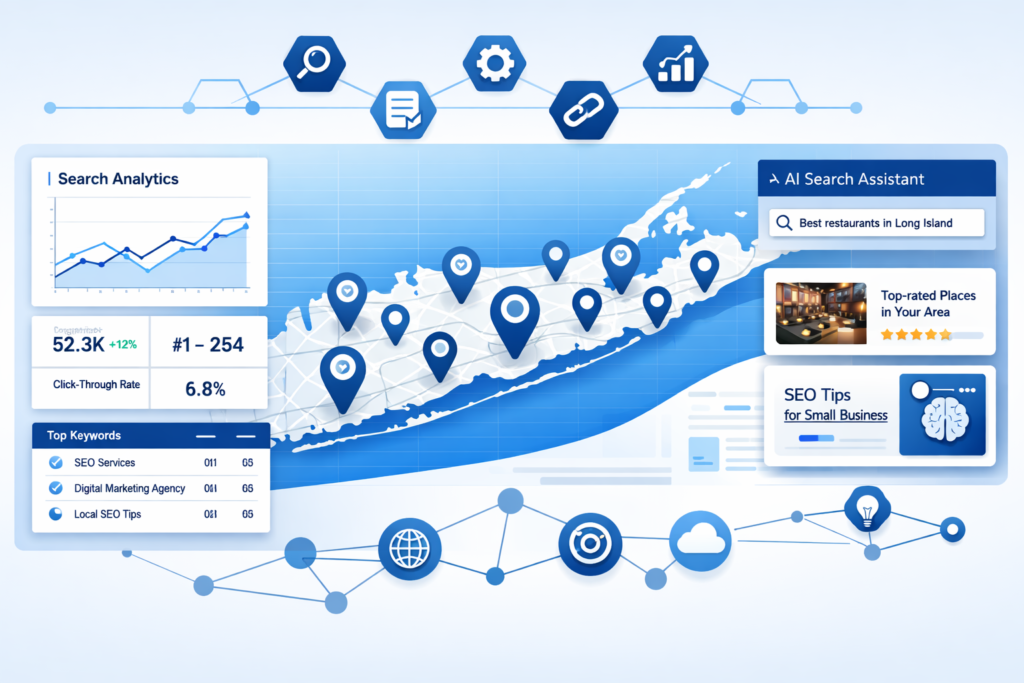
Google’s AI Overviews now answer a growing share of local queries before users click, and in 2026 the small businesses holding ground in competitive markets are the ones whose whole online presence reinforces every signal Google’s AI weighs. Brand mention frequency, NAP consistency, video watch time, review velocity, and Core Web Vitals all feed the same ranking decision. If your marketing still treats search and social as separate worlds, you’re leaving rankings on the table.
Why It Matters for Small Businesses in 2026
Google’s AI Overviews, the AI-generated summaries that sit above the traditional ten blue links, have expanded dramatically through 2026. Google’s own official rollout announcement and ongoing updates to Search Central documentation show these AI summaries now surface for a wide majority of informational queries, especially the local "how much," "near me," and "best for" searches that drive small-business traffic.
A significant percentage of searches now resolve without a click, which limits direct traffic to regional brands. If a brand isn’t the source Google’s AI quotes, it can be effectively invisible even when it technically ranks.
Local competition makes this harder. Competitive metro markets hold some of the densest small-business directories in the country. Customers searching for plumbers, roofers, restaurants, and accountants expect fast answers and relevant results across platforms, and Google rewards the brands delivering all three.
What’s New: How AI Overviews Read Your Online Footprint
The biggest 2026 shift isn’t that AI Overviews exist, it’s that Google’s systems now evaluate your brand’s overall online presence when deciding what content to surface and cite. YouTube videos, Instagram Reels, LinkedIn posts, X threads, and Pinterest boards aren’t just engagement channels anymore. They’re brand-authority signals feeding the AI’s ranking model.
Google’s emphasis on E-E-A-T, Experience, Expertise, Authoritativeness, and Trustworthiness has intensified. With AI-generated text flooding the internet, Google’s algorithms place a premium on content that demonstrates real human expertise. For a hands-on local business, that’s an unfair advantage: every behind-the-scenes Reel, every founder interview, every customer-shot video is exactly the kind of provable, on-the-ground proof that content farms cannot fake.
The mechanism works in three layers:
- Brand mention frequency, Google weighs how often your business name appears across reputable platforms, even without a direct link back.
- Citation consistency, Your NAP (name, address, phone) plus your service descriptions need to be identical across every profile, directory, and listing.
- Content depth proof, Platform-native long-form videos that show actual work earn more E-E-A-T credit than recycled blog snippets.
The Numbers Social Managers Need to Track
- Local-pack share, Google’s local pack now incorporates AI-enhanced recommendations and gives more weight to active, complete profiles.
- Review velocity, Steady review flow beats one-off bursts; aim for a recurring weekly cadence.
- NAP consistency, Audit citations quarterly across directories, social profiles, and review platforms.
- Video watch time, YouTube watch time and Reels completion rates correlate with broader brand-search visibility.
- Core Web Vitals, Interaction to Next Paint (INP) replaced First Input Delay in 2024 and remains a confirmed ranking factor in 2026, per Google’s Core Web Vitals documentation.
Local SEO is the most important channel for companies that serve a geographic area. For a local brand, that’s not just a website problem, it’s a presence problem, because platforms you neglect weaken the signal Google’s AI uses to decide who shows up.
In 2026 your publishing calendar isn’t separate from your SEO, it drives it, because every platform you post on feeds the brand signal AI Overviews now cite.
What Comes Next for Local SEO
Search Generative Experience is just the first wave. Google has signaled aggressive expansion of AI Overviews into commercial queries, and Bing, Perplexity, and ChatGPT Search are running parallel tracks. Each engine ingests your online presence slightly differently, but the underlying logic is the same: brands with active, consistent, multi-platform footprints earn more citations.
Expect three trends to accelerate through the second half of 2026:
- Schema markup for social profiles becomes table stakes; structured data helps every AI engine identify your brand entity.
- Short-form video earns larger weight in local-pack decisions as Google integrates more YouTube Shorts and Reels excerpts into Overviews.
- Review-response language gets parsed by AI for sentiment and expertise, generic "thanks!" replies weaken your authority signal compared to detailed, knowledgeable responses.
What This Means for Your Business
If you run a local brand, or any geographically anchored business, your 2026 to-do list looks different from 2024’s. Stop treating each platform as a silo. Start treating your publishing calendar as the upstream source of search authority.
Feedsta, an AI-powered social media platform, exists precisely for this moment, aiming to offer one place to publish, schedule, and analyze across TikTok, Meta, Pinterest, X, LinkedIn, and YouTube, with the cross-platform consistency Google’s AI now demands. Pair that with the built-in link-in-bio, URL shortener, and QR tools and every touchpoint feeds the same brand signal, not a fragmented one.
A few specific moves to put on next week’s calendar:
- Audit your NAP across every platform before you publish another post. One outdated phone number on Yelp can quietly drag your local pack ranking.
- Build a recurring video cadence, even one YouTube Short per week, that demonstrates real expertise. Local case studies, behind-the-scenes work, regional regulatory commentary.
- Set up a review-request flow tied to your inbox so satisfied customers are nudged within 48 hours of a positive interaction.
For deeper playbooks, see our breakdown of how social media drives local SEO discovery for SMBs in 2026 and our guide to the local search ranking signals that decide which brands show up first.
The Bigger Picture for 2026 SEO
The SEO playbook hasn’t been killed by AI; it has changed to prioritize the signals active brands already send through their presence. Brand visibility, multi-platform consistency, visible expertise, and an active community footprint are now cited as ranking factors. Local brands ahead in category rankings generally aren’t spending the most on SEO. They’re the ones whose websites, social profiles, and listings all point to the same expertise and location cues.
FAQ
How does social media affect SEO in 2026?
Social media now directly influences SEO because Google’s AI Overviews and ranking systems evaluate your brand’s overall online presence, not just your website. Brand mentions, NAP consistency, video watch time, and review velocity all originate on platforms like TikTok, Instagram, LinkedIn, YouTube, X, and Pinterest, and now factor into whether AI Overviews cite your business.
What is an AI Overview and how do brands get cited in one?
An AI Overview is the AI-generated summary Google places above traditional search results, answering a user’s query directly using sources it deems authoritative. To get cited, your content needs clear, structured answers to specific customer questions, a logical heading hierarchy, schema markup, and a demonstrated track record of E-E-A-T, Experience, Expertise, Authoritativeness, and Trustworthiness.
Do social signals directly impact Google rankings?
A single like or share doesn’t directly boost rank, but your cumulative online footprint, including brand mentions, consistent NAP citations, video watch time, and review velocity, feeds the brand-authority signals AI Overviews use to decide who gets cited. Brands with strong, consistent multi-platform presences rank better and appear in AI summaries more often than brands relying on website SEO alone.