Zero-Click Searches Reach 68%: What It Means for Businesses
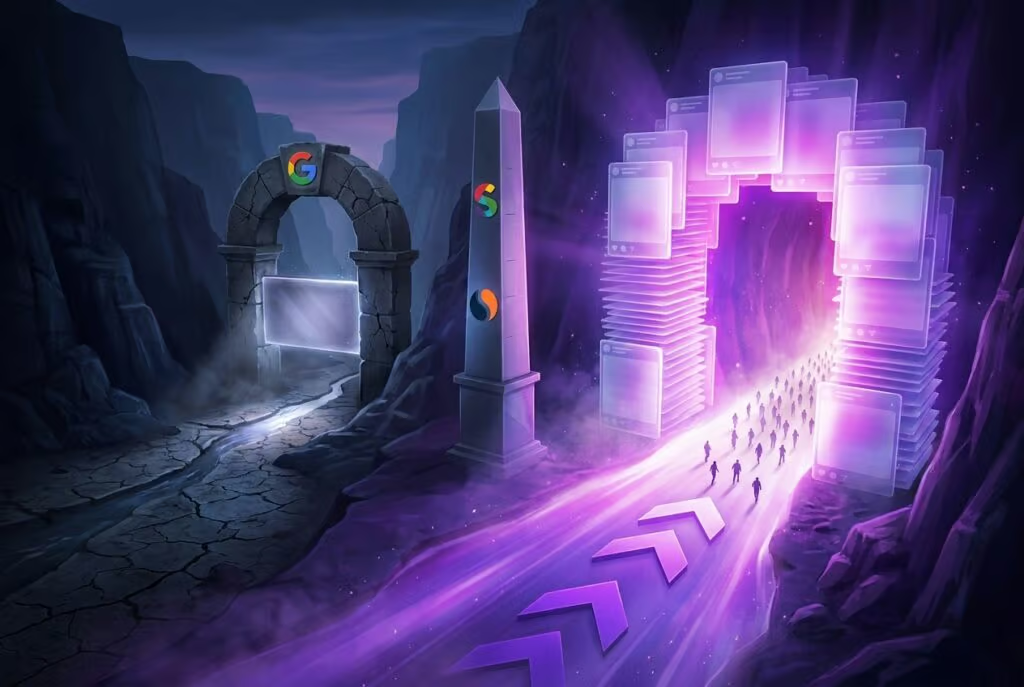
Google zero-click searches reached 68.01% in the U.S. during the first four months of 2026, up from 60.45% in 2024. A new SparkToro analysis of Similarweb clickstream data shows fewer than one in three Google searches now result in a click to an external website. For businesses, publishers, and creators, the shift is profound: visibility that once came from search traffic is increasingly captured by Google’s own AI interfaces, and the places where audiences already spend their time are becoming the front line for discovery.
Why does the zero-click rise matter for your business?
Google processes billions of searches daily, and for years brands, publishers, and creators have relied on that traffic engine to fill their funnels. But the ground is cracking beneath that model. The new SparkToro study shows the zero-click rate jumped 7.56 percentage points in just two years, meaning a significantly larger share of queries never leave the Google ecosystem. When searchers get their answer directly inside the search results page, from an AI Overview, a featured snippet, or a knowledge panel, the click that used to go to your website disappears. And the share of searches that lead to another Google query rose 7.2 percentage points over the same period, signaling that users are being trained to refine their searches on-platform rather than explore external pages.
For brands, this should be a warning: you cannot count on Google to deliver visitors the way it did even two years ago. The places where conversations, trends, and community already live are becoming the main way people discover content, instead of a secondary channel.
What’s driving the change and how does it work?
The zero-click surge is powered chiefly by Google’s AI Overviews, which now appear on more than 20% of searches. When an AI Overview is present, click-through rates to external websites drop by nearly 60%. These AI-generated summaries pull information from across the web and present a synthesised answer right at the top of the results page, often eliminating the incentive to click through to a source. Meanwhile, Google’s conversational search experience, AI Mode, is still in its early public footprint, only 0.34% of searches transitioned into AI Mode during the study period, but its velocity is staggering. Google disclosed at its 2026 I/O conference that AI Mode surpassed 1 billion monthly users, with query volume more than doubling each quarter. As AI Mode expands, the zero-click dynamic will likely accelerate further, because the interface is designed for dialogue, not for listing ten blue links.
In practice, this means the inbound playbook built on “write a blog post and wait for Google traffic” is losing effectiveness across broad, informational queries. The highest conversion-intent searches, local business queries, branded terms, and transactional lookups, still drive clicks. But the wide middle of the curve, where most content marketing lives, is being hollowed out.
What do the numbers look like?
- 68.01%, zero-click share of U.S. Google searches, January to April 2026.
- +7.56 points, increase in zero-click rate from 2024 (SparkToro 2026 study).
- 22.9% decline in the share of searches that generated at least one organic click.
- +7.2 points, rise in searches that lead to another Google search instead of an external site.
- AI Overviews present on >20% of queries, triggering a ~60% reduction in click-through rate.
- AI Mode accounted for only 0.34% of search transitions in early 2026, but Google reports 1 billion monthly users and rapidly accelerating adoption (Google I/O 2026).
“SEO alone may be insufficient for many publishers seeking to regain historical levels of Google-referred traffic. Instead, invest in brand awareness and influence on the platforms where your audience already spends time, regardless of whether those efforts drive direct website visits.”
Rand Fishkin, co-founder of SparkToro
What comes next for zero-click search?
Google’s AI Mode is still ramping. As its interface matures and adoption among everyday users grows, expect the zero-click number to climb further. Mobile search, where the SparkToro study likely understates the zero-click share because it excludes the Google mobile app, already skews even more toward on-Google answers. Voice search and wearable AI assistants will layer on more friction-free answer experiences. The trend is not a blip; it is the new architecture of commercial search.
Waiting for Google to send a click is becoming a less effective strategy for businesses and creators. You need to show up where audiences already spend time and publish content in the formats each platform favors, prioritizing engagement over search crawler requirements.
What should you do about it?
The growing share of searches that end without a click does not make content marketing obsolete, but it does change which tactics matter most.
1. Double down on platform-native content. Short-form video, carousels, newsletter-first stories, and interactive threads are built for the discovery algorithms of TikTok, Instagram, LinkedIn, and YouTube, not for a traditional SERP. Repurpose your best blog insights into formats native to each platform and publish them where your audience opens the app, not only where they search.
2. Create once, publish everywhere. Keeping a consistent presence across multiple channels is hard without automation. An AI-powered content workflow lets you schedule, adapt, and cross-post in far less time, so you can keep a steady drumbeat across platforms while focusing on creative quality. Use it to queue up content, repurpose high-performing assets, and maintain a consistent brand voice across every account.
3. Re-measure what success looks like. If fewer visits come from Google, classic traffic metrics like sessions and pageviews become unreliable signals. Track engagement, saves, shares, and community growth instead. At the same time, you need visibility into how your business shows up across AI-powered search surfaces like Google, ChatGPT, Gemini, and Perplexity. You can run a BizScoreAI visibility scan (according to BizScoreAI, the tool shows how a business appears across AI assistants like ChatGPT, Gemini, and Perplexity) to see where you are appearing, or not, when a potential customer asks an AI assistant about your industry.
4. Ride the platforms people are moving toward. As users move away from Google’s AI-heavy results, some are migrating to alternatives like DuckDuckGo, whose installs jumped 30% earlier this year, read our breakdown of the DuckDuckGo surge. That is a signal that audience attention is fragmenting, and a steady presence across search engines, feeds, and AI chat is what keeps your brand connected.
When nearly 7 in 10 Google searches keep users inside the platform, building visibility beyond a single search engine becomes the main event.
What is the bigger picture?
Zero-click searches have changed how people find brands. Google’s AI Overviews and AI Mode are not temporary experiments; they are a new front door to the internet, and that door often opens inward. Brands that build visibility and trust across the places where people spend time, not only the ones where they search, may perform better in discovery over the next decade.
FAQ
What is a zero-click search?
A zero-click search is a Google query that ends without the user clicking on any external website link. The searcher gets the answer directly on Google’s results page via an AI Overview, featured snippet, knowledge panel, or People Also Ask box, and does not leave Google’s ecosystem. In early 2026, about 68% of U.S. searches ended without a click.
How do AI Overviews affect click-through rates?
When an AI Overview appears on a Google results page, it provides a synthesised answer drawn from multiple sources, so the need to click through to a specific article or site drops significantly. SparkToro research shows AI Overviews reduce external click-through rates by nearly 60%, making them the primary driver behind the recent surge in zero-click searches.
Does this zero-click trend mean SEO is dead?
No. SEO still plays an important role, particularly for local business queries, branded terms, and high-intent transactional searches where clicks remain more common. However, relying solely on SEO for broad informational traffic is becoming less reliable, and experts recommend balancing SEO with brand-building on the platforms where your audience already spends time.
Sources
- SparkToro 2026 Zero-Click Search Study
- Google AI Mode 1 billion monthly users announcement (I/O 2026)