How California’s Age Verification Law Hits Social Media in 2027
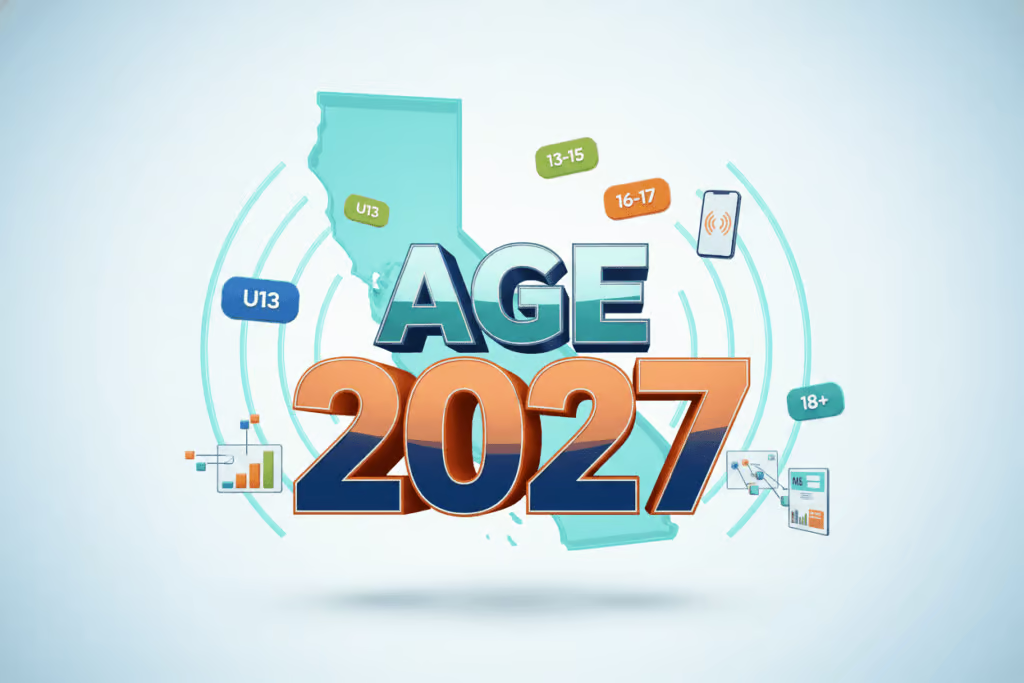
California’s Digital Age Assurance Act takes effect January 1, 2027, requiring operating systems to broadcast a standardized age-bracket signal to every app on the device. For any brand advertising on social platforms, that signal flows directly into ad targeting, content gating, and analytics. A fresh amendment exempts Linux distributions, but commercial platforms where audiences actually live are still covered.
Why It Matters
For two decades, age verification has been an app-level problem. TikTok asked. Instagram asked. The ad networks took what they were given and moved on. California is now pushing that responsibility one layer down, to the operating system itself. Every iPhone, every Pixel, every Windows laptop sold in California will ship age data to apps via a standardized signal organized into four brackets: under 13, 13 to 15, 16 to 17, and 18 plus.
That changes social marketing in ways most agencies are not yet pricing in. Paid social, creator briefs, link-in-bio pages, and QR-driven landing pages will all be downstream consumers of this signal. Platforms will use the bracket data to filter inventory. Ad networks will use it to throttle delivery. Content moderation teams will use it to gate features. And the analytics used to optimize cadence and creative will start partitioning audiences by age tier whether the cut was requested or not.
California’s age signal is about to flow into every ad you buy and every link you ship on social, whether you opt in or not.
How Does the California Age Verification Law Work?
The original law, Assembly Bill 1043, passed in late 2025 and was scheduled to apply to all operating systems, including community-maintained Linux distributions. That created a controversy almost immediately: nobody is going to make the volunteer maintainers of Debian or Arch Linux build a centralized age-collection pipeline on the side.
Assembly Member Buffy Wicks introduced Assembly Bill 1856 on February 11, 2026 to narrow the definition of "operating system provider." The relevant carve-out exempts anyone who distributes an OS under license terms that permit a recipient to "copy, redistribute, and modify the software." That phrasing maps cleanly to standard open-source licenses, which means Ubuntu, Fedora, Mint, and the rest of the mainstream Linux ecosystem are out.
Commercial platforms, iOS, Android, Windows, ChromeOS, are still in. Valve’s SteamOS sits in a gray zone because the base is open source but the Steam storefront on top is proprietary. The Electronic Frontier Foundation and other privacy groups continue to push back on the broader framework, even with the Linux exemption, because OS-level age collection creates infrastructure that could later be repurposed for other identity attributes.
For any brand publishing on social platforms, the takeaway is simpler than the legal nuance: if content is consumed inside a commercial app store on a California device starting January 1, 2027, that app will know which age bracket the viewer falls into before the post even loads.
The Numbers
The legislative timeline at a glance:
- AB 1043 (original law): passed late 2025, effective January 1, 2027
- Age brackets defined: under 13, 13 to 15, 16 to 17, and 18 plus
- AB 1856 (amendment): introduced February 11, 2026 by Assembly Member Buffy Wicks
- Latest revision date: May 18, 2026
- Status as of May 19, 2026: read a second time, ordered to third reading
- Effective date if AB 1856 passes: January 1, 2027, alongside the original law
The exemption rests on a single license-language test, taken verbatim from the proposed amendment text:
"Operating system provider" does not mean a person or entity that distributes an operating system or application under license terms that permit a recipient to copy, redistribute, and modify the software. , Assembly Bill 1856, California State Legislature
That sentence is the entire reason Linux maintainers are not being conscripted into age-verification work they were never built to handle.
What Comes Next
AB 1856 still has to clear committee reviews in June 2026 and pass a third reading before reaching the governor’s desk. Even if the amendment passes cleanly, the underlying age-assurance requirements still apply to Apple, Google, Microsoft, and any other commercial OS vendor serving California users.
Downstream, the signal will land in app stores first. Apple and Google will almost certainly require apps to acknowledge the age bracket and behave accordingly. The major ad networks, Meta Ads, Google Ads, TikTok Ads, will move next, filtering inventory and updating targeting interfaces. Social platforms will start gating features and content surfaces based on the signal, in some cases more aggressively than the law strictly requires, because no platform wants to be the test case for the first enforcement action.
Other states will copy the framework. Texas, New York, and Utah have already debated similar bills, and California’s market size means most platforms will ship a national age-signal posture rather than maintain a California-only product. The Linux carve-out is likely to travel with the original framework.
What This Means for You
This is a planning problem, not a panic problem. Brands have roughly seven months before the law takes effect, and the agencies that move first are already rebuilding their workflows around the assumption that age signals are coming whether or not their clients have noticed.
Three concrete moves for the next two quarters:
Re-segment every paid social campaign by age bracket now. The platforms will start filtering inventory by the OS signal automatically once it goes live. If your creative was built for an undifferentiated audience, expect delivery to drop in the 18+ bracket and to collapse entirely in the younger brackets where compliance pressure is highest. Build a creative library mapped to the four California brackets and stage it through your scheduling workflow so the right version reaches the right audience on the right platform without manual juggling.
Audit your link-in-bio and landing-page funnels. Your bio link, branded short links, and QR-driven landing pages are all "apps" in the eyes of the broader ecosystem, and downstream regulation will likely treat them that way. Centralize destination control so that when ad networks and platforms start throttling links based on age bracket, you have one place to update, not seventeen.
Get your multi-brand workflow ready for split compliance. Agencies running multiple brand accounts will be juggling different age-appropriate strategies per client, sometimes in the same calendar week. A dedicated multi-brand workspace is the right place to draw that line: keep age-bracket creative pools per brand, separate the approval flows, and avoid the cross-contamination risk that comes from running everything out of one shared content library.
The Bigger Picture
California rarely legislates alone, and the age-signal infrastructure is now baked into the consumer-OS roadmap whether AB 1856 narrows the original law or not. Open-source maintainers won a carve-out because their argument was clean: you cannot regulate something that is not centrally controlled. Commercial platforms did not win that carve-out, and every brand publishing through those platforms inherits the rules. Start building age-bracket awareness into your content, ad, and analytics workflows now, before the January 2027 deadline turns a planning exercise into a fire drill.
FAQ
When does California’s age verification law take effect?
The Digital Age Assurance Act (Assembly Bill 1043) takes effect January 1, 2027. The open-source amendment, AB 1856, would also take effect on January 1, 2027 if it passes.
Does the age verification law apply to Linux?
No, under AB 1856. The amendment exempts anyone who distributes an OS under license terms that permit a recipient to "copy, redistribute, and modify the software," which covers standard open-source licenses like those used by Ubuntu, Fedora, and Mint. Commercial platforms such as iOS, Android, Windows, and ChromeOS are still covered.
How will the age signal affect paid social campaigns?
Ad networks including Meta Ads, Google Ads, and TikTok Ads are expected to filter inventory by age bracket once the OS signal goes live. Delivery will likely throttle for campaigns not segmented by bracket, especially in the under-13 and 13-to-15 tiers. Building a creative library mapped to the four California brackets is the recommended preparation.