Outdated SEO Practices Small Businesses Need to Drop in 2026
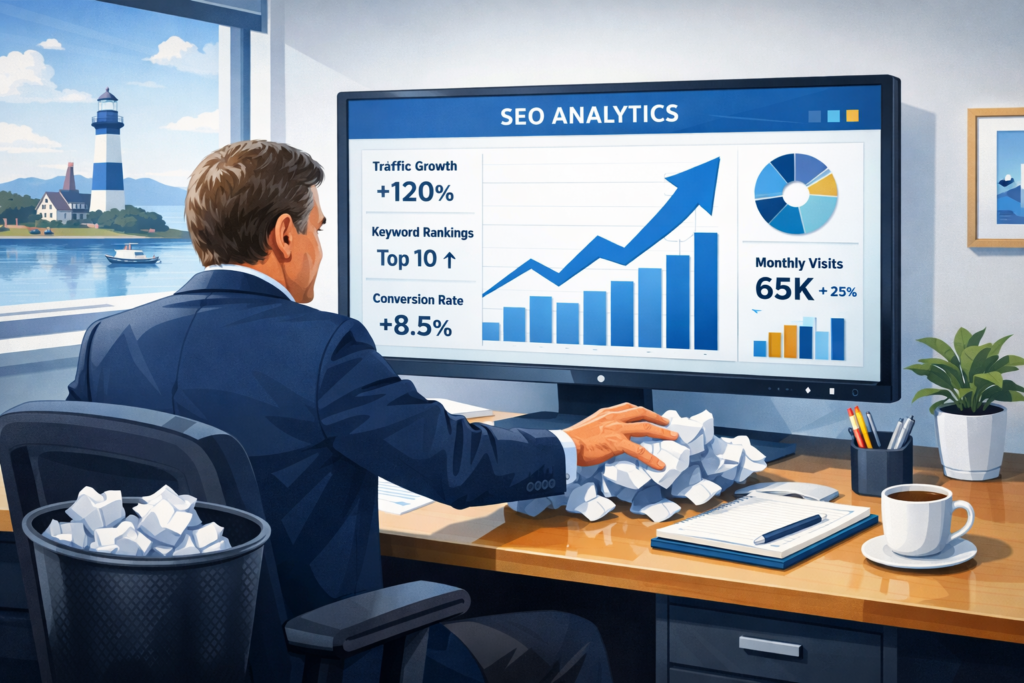
Google has retired the 2020 SEO playbook, and small businesses still running the old tactics are paying for it in lost visibility. Keyword stuffing, purchased backlinks, and dozens of duplicate town pages now actively drag rankings down, with the cost shifting onto social to fill the funnel.
Why It Matters
The majority of local searches now happen on mobile, and Google’s AI-driven ranking systems weigh user-experience signals, loading speed, visual stability, dwell time, directly against content quality. A slow, keyword-stuffed page doesn’t just rank lower; it bleeds traffic to faster competitors and trains the algorithm to suppress the whole domain. When SEO underperforms, the brand leans harder on paid and organic social to fill the funnel, and your channel gets credited, or blamed, for the gap.
Google has documented Core Web Vitals as direct ranking signals, and the bar keeps rising. Knowing what’s actively pulling a site down is now part of the job, because the link-in-bio and the landing page are the same revenue path.
What Outdated Practices Need to Go?
Five practices that small businesses should stop doing come to mind.
Keyword stuffing and exact-match obsession
Cramming the target phrase into every heading, meta tag, and paragraph was once standard SEO. In 2026 it actively triggers penalties. Consider absurd examples like “best plumber near me near me plumber services”, a string that signaled effort years ago and signals manipulation today. Write for the human reading the social caption and the landing page, not for a density checker.
Low-quality backlinks and link schemes
Purchased links from blog networks, directory farms, and irrelevant foreign sites are now liabilities. The 2026 standard is editorial legitimacy. One link from a respected local news outlet outweighs a hundred placements from generic directories, and social-driven mentions from local creators and partners are increasingly part of that earned-link pipeline.
Ignoring user experience and Core Web Vitals
Loading speed, visual stability, and interactivity are non-negotiable. If a phone takes more than two seconds to render your landing page, the bounce reads as a quality signal, and the algorithm responds by deprioritizing the whole domain. Your perfectly timed Reel does not save a four-second mobile load.
Thin content and duplicate location pages
Building a near-identical page for every town in your service area with only the place name swapped used to be a local-SEO staple. Google’s helpful-content systems now devalue these pages and can drag the entire site down with them.
Neglecting Google Business Profile and AI search
Static GBP listings lose to active ones. Without schema markup or factual content that AI systems can parse, the brand stays invisible in AI Overviews, ChatGPT, Gemini, and Perplexity, segments that handle a growing slice of search.
The Numbers
The trends worth tracking when SEO is failing:
- Mobile now drives the majority of local searches, and landing-page speed affects conversions.
- AI-powered overviews answer many queries directly in the SERP by pulling from content marked with schema.
- Google’s spam updates have rolled out manual penalties for purchased-link patterns that take months to recover from.
- Active Google Business Profiles, fresh photos, posts, prompt review responses, consistently outrank stagnant listings in the local pack.
- Search engines use helpful-content systems to reduce the visibility of posts written mainly to rank well, such as frequent blog posts with little substance.
“Google’s AI-driven ranking systems evaluate content based on topical depth, user satisfaction signals, and how well a page answers the searcher’s actual question.” The implication for social is direct: every click you send to the site has to land somewhere the algorithm actually respects.
What Comes Next
The biggest shift on the horizon is AI search integration. Google’s generative search features now pull from well-structured, authoritative content to answer queries inside the results page, which means the brands that win in 2026 are the ones whose social content, blog posts, and product pages share clean schema and consistent factual claims. Expect more pressure on cross-channel consistency: NAP data (name, address, phone) across the GBP, link-in-bio destinations, and landing pages all need to match exactly, because AI systems triangulate trust from agreement.
Expect more weight on review velocity and recency, because GBP signals are feeding the AI summaries. And expect the gap between SEO and social to keep collapsing, the person who can flag a 404, a slow page, or a stale listing is now doing half the SEO job by default.
If your SEO partner is still optimizing for 2020 Google, social is paying the algorithm tax in 2026.
What This Means for You
The takeaway isn’t that you suddenly own technical SEO. It’s that you can’t pretend the site is someone else’s problem. Every Reel, Story, and LinkedIn carousel you publish drives traffic somewhere, and if “somewhere” is a slow page wrapped in stuffed keywords and duplicate town content, you’re spending creative energy on conversions that will never land. Audit the destinations behind your link-in-bio and shortened campaign URLs first, those are the pages your audience actually touches. A free BizScoreAI visibility scan surfaces which listings and pages are dragging the brand down before you spend another dollar on either channel.
This is also a content-strategy moment. If the brand’s blog is publishing thin, keyword-padded posts, your content calendar can pick up the slack with platform-native content that AI Overviews increasingly cite, but only if the foundational pages support the claims you’re making in social. Our AI search visibility playbook for 2026 walks through how to format posts so they get surfaced by ChatGPT and Perplexity, and the 2026 Google Business Profile guide shows how to wire GBP posts into your publishing cadence so the listing stays alive between site updates. Pair both with a scheduling and analytics workflow that surfaces underperforming destinations, and the SEO drag stops showing up in your reports.
The Bigger Picture
The brands that will rank highly in search in 2026 won’t be the ones that hire a new SEO vendor every two years, they’ll be the ones whose social, SEO, and listings work look like one strategy instead of three. Step two is making sure the channel you run isn’t still using tactics that stopped working years ago.
FAQ
What is the most damaging outdated SEO practice in 2026?
Keyword stuffing combined with duplicated location pages. Google’s natural-language and helpful-content systems now actively suppress sites that repeat target phrases unnaturally or publish near-identical pages for every town in a service area, and the penalty can drag the entire domain’s authority down.
Why should marketers care about Core Web Vitals?
Every click from social lands on a page Google is silently grading. If the destination is slow, visually unstable, or unresponsive on mobile, users bounce and the algorithm treats that as a quality signal that lowers organic rank, forcing social to work harder to fill the gap.
How does AI search change what a brand should publish?
AI Overviews, ChatGPT, Gemini, and Perplexity pull from clear, factual, well-structured content. Brands cited in AI search share consistent claims and clean schema across social, blog, and product pages, with identical NAP data, services, and hours everywhere.
Related coverage