AI Search in 2026: How to Get Found by ChatGPT, Gemini, and Perplexity
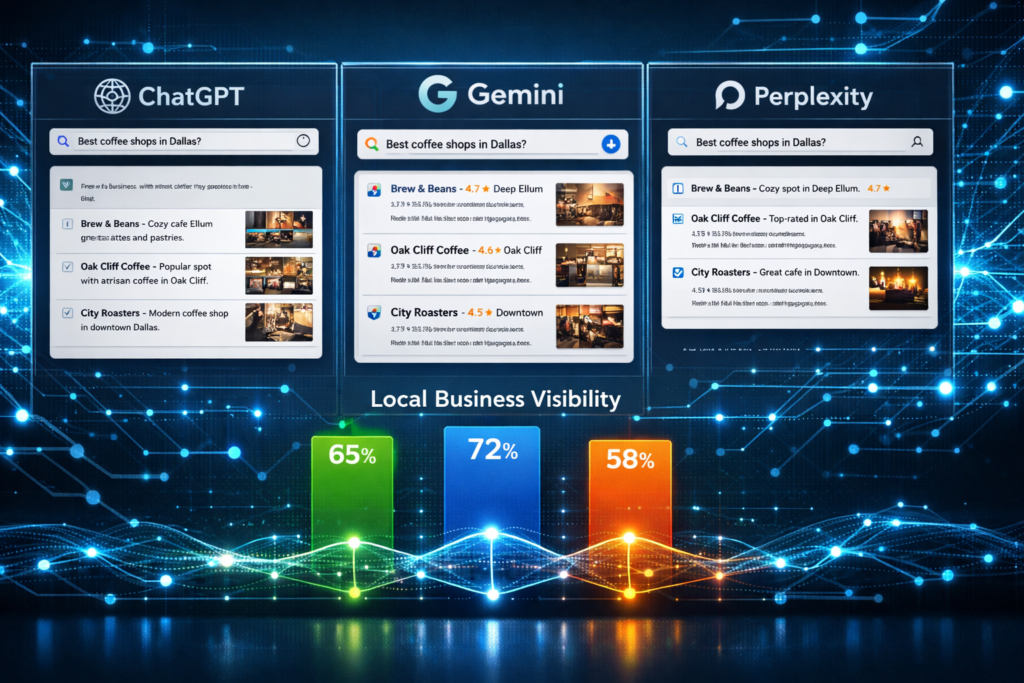
AI search may now handle a combined volume equal to roughly 12% of Google’s total, and 45% of consumers may use ChatGPT, Gemini, or Perplexity to research local businesses, up from about 6% a year ago. The same brands that win Google’s local pack are often invisible in AI answers, because AI search reads different signals, and social media is one of the loudest ones. The businesses that adapt now decide who gets cited in the next two years of conversational search.
Why It Matters
For a decade, the brief was simple: post consistently, run paid, and let traditional SEO carry discovery. That brief is now incomplete. Roughly 60% of Google searches end without a click to any website, and Google’s AI Overviews appear in 40% of local queries. The user gets answered inside the result and never leaves.
For anyone managing one brand or many, the pressure is twofold. First, organic social still drives awareness, but the path from awareness to consideration increasingly runs through an AI assistant the brand never directly authored. Second, the surface area of “discovery” now includes platforms that don’t appear in any traditional social reporting tool: ChatGPT (542 million monthly users), Gemini (Google’s default assistant for Cloud customers), and Perplexity (the fastest-growing answer engine).
The competitive math has tightened. Google’s traditional local 3-pack may surface about 35.9% of qualifying businesses in a given area. AI recommendations surface only a small share of qualifying businesses, depending on the platform.
How Do ChatGPT, Gemini, and Perplexity Pick Local Businesses?
Each major AI platform pulls from a different data source, and that drives wildly different visibility outcomes for the brands you manage.
Google Gemini grounds its local answers in Google Business Profile data, the same database that fuels Google Maps. The result, according to Google, is 100% location data accuracy and 11% local business visibility. A brand with a complete, well-maintained GBP is far more likely to surface here than on any other AI platform.
ChatGPT relies on open-web crawls and structured data, not Maps. Only about 1.2% of local businesses surface in its recommendations. The bigger issue for traffic: ChatGPT sends 190 times less traffic to websites than Google does at the same query volume. Visibility there is closer to brand citation than to lead flow, valuable, but not a click engine.
Perplexity is said to recommend about 7.4% of qualifying businesses, with what is reported as 68% location-data accuracy, lower than Gemini because it aggregates from multiple sources rather than one authoritative database.
The unifying theme: AI doesn’t pick the closest business, it picks the most trustworthy one. “Trust” is reconstructed from review consensus, entity consistency across the open web, and topical authority. Most of those signals are reinforced or undermined on social media each day.
The Numbers
The headline figures worth keeping on a sticky note:
- 12%, AI search volume as a share of Google’s total
- 45% of consumers are using AI tools to research local businesses, up from 6% a year ago.
- 1.2%, share of local businesses ChatGPT recommends
- 7.4%, share Perplexity recommends
- 11%, share Gemini recommends
- 100%, Gemini’s local data accuracy (vs. 68% for Perplexity)
- 60%, Google searches ending without a click
- 40%, local queries now triggering an AI Overview
Most brands ask customers to write generic feedback, but AI systems scan reviews for language that signals a recommendation.
“Needed same-day service for a burst pipe in my basement in Smithtown, they arrived in 90 minutes and had it fixed in 2 hours.”, sample review language
That review has location, service, urgency, and outcome embedded in plain language. It is exactly the kind of signal an AI system reuses when it generates “for HVAC service in Huntington, customers frequently recommend…” style answers. A generic five-star comment gives the model nothing to repeat.
AI search doesn’t reward the closest business; it rewards the one most consistently described across every touchpoint.
What Comes Next
The trajectory is clear. AI Overviews already cover 40% of local queries, and that share keeps climbing. Gemini will continue to lean on Google Business Profile. ChatGPT is expanding its commerce and local-business features through 2026, which should lift visibility for brands that show up in structured data and well-cited content. Perplexity is investing in shopping and answer-engine surfaces.
Three shifts are worth tracking through the rest of the year:
- Reporting tools will start adding “AI citation” metrics alongside reach and impressions
- Brand monitoring will expand to include AI-answer surveillance, “does my brand show up when I ask ChatGPT for X?”
- Content briefs will start specifying citation-friendly structure: clear claims, dated statistics, named experts, and verifiable sources
What Should You Actually Do This Quarter?
Whether you run one brand or fifty, the tasks are clear.
Treat Google Business Profile as a social channel, not a directory listing. Photos, posts, services, hours, Q&A, they all feed Gemini’s answers. Schedule GBP posts inside your normal social cadence so they never get orphaned during a busy launch week.
Rewrite how you ask for reviews. Move from “leave us a 5-star review” to a specific prompt: which service, which location, which outcome. AI systems mine the language, specific reviews get reused in answers, generic ones get ignored. This is closer to a local SEO workflow than a one-off ask to a happy customer.
Audit your entity consistency. NAP (name, address, phone) and brand description should match across every social bio, listing, and link-in-bio destination you maintain. A free BizScoreAI visibility scan shows how consistently your business currently surfaces across AI answers and local listings, and exactly where the NAP gaps are.
Write content that earns citation. Specific, dated, expert-authored posts get surfaced in AI answers. Generic re-treads don’t. If you’re unsure where to start, we mapped the signals in our AI search visibility breakdown.
The Bigger Picture
Search isn’t dying; it’s splitting into multiple channels. Search results still drive most click-through traffic, but a larger share of the buyer journey happens inside AI conversations that the brand never directly authored. Businesses that succeed over the next two years are those that treat social output, review language, and entity consistency as a single feed into the systems that increasingly answer on the brand’s behalf.
FAQ
Which AI search platform should a local business prioritize first?
Google Gemini, by a wide margin. Gemini is grounded in Google Business Profile data, giving it 100% location accuracy and 11% local business visibility, the highest of any major AI platform. ChatGPT recommends only 1.2% of local businesses, and Perplexity recommends 7.4% with 68% location data accuracy. Optimize GBP photos, posts, categories, and Q&A first, then expand outward.
How do customer reviews influence AI search recommendations?
AI systems parse review language to decide what a business does, who it serves, and where. Reviews that name specific services, locations, urgency, and outcomes are reused in AI-generated answers. Generic comments like “great company, highly recommend” give the model nothing to repeat. Restructure review-request prompts to ask what the customer needed, where they were, and what the result was.
What practical steps improve AI search visibility this quarter?
Four steps. First, audit and complete every Google Business Profile field, then add GBP posts to your scheduled cadence. Second, rewrite review-request templates to ask for specific service, location, and outcome details. Third, audit name, address, phone, and brand description for consistency across every social bio, link-in-bio, and directory listing. Fourth, publish at least one citation-grade blog post per month, specific, dated, and expert-authored.
Related coverage