SEO Trends 2026: From Rankings to AI Citations
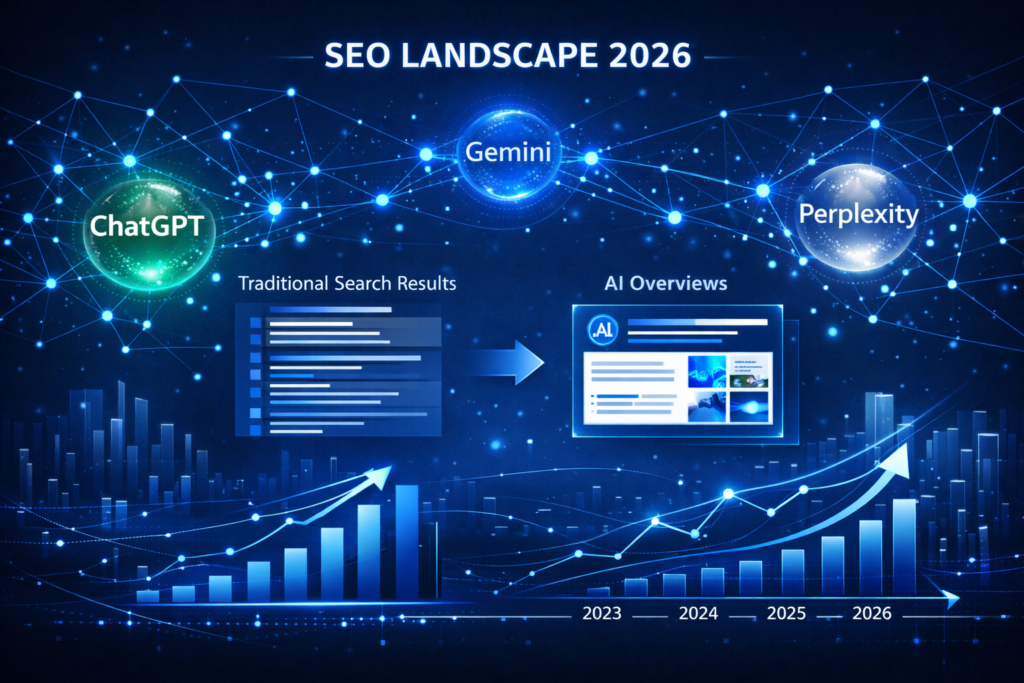
Zero-click searches now account for roughly 60% of all Google queries, AI Overviews appear in 4.5% to 12.5% of searches, and AI referral traffic may be up 357% year-over-year. Search has split between traditional rankings and AI citations, and the March 2026 Google Core Update tightened scrutiny on thin content while rewarding brands that publish with genuine experience. Businesses running content across TikTok, Instagram, LinkedIn, and X can no longer rely on the old SEO playbook.
Why does this shift matter for brands?
Social content has always lived adjacent to SEO. Pinterest pins index in Google. YouTube Shorts surface in video carousels. LinkedIn articles rank for branded terms. But 2026 raised the stakes because the search ecosystem itself has changed shape. AI Overviews now appear in 4.5% to 12.5% of all queries, with the rate climbing higher on informational and local searches. When an AI Overview appears, the click that used to land on a website increasingly lands inside the generative answer instead.
If an AI answer cites your brand by name, it borrows the platform’s credibility and reaches the user before they scroll. If it doesn’t, you aren’t surfaced for that query. Social content that is structured, attributed, and distributed is one of the most underused inputs into that citation engine. Most businesses still treat social as a separate channel, disconnected from search visibility.
What’s new: from rankings to citations
The structural shift is that search is no longer just about rankings, it’s about citations. AI Overviews, ChatGPT search, Perplexity, and Gemini synthesize content and attribute it to sources. Getting your brand mentioned by name inside one of those answers is, in many cases, more valuable than ranking fourth in organic results. The signals that earn AI citations diverge from the signals that earned traditional rankings. Content quality and demonstrable expertise matter more. Structured data matters more. Entity consistency, your business showing up the same way across many sources, including social platforms, matters more. Exact-match keywords and anchor-text gymnastics matter less.
Google’s E-E-A-T framework also grew teeth in 2026. The “Experience” pillar is the hardest to fake: it means first-hand involvement. What Google now rewards is content like “a plumber writing about plumbing from years on job sites, not a writer summarizing what plumbers do.” For social content, that translates almost word for word. A founder posting from the warehouse floor outperforms a brand account posting stock copy. A trainer recording a real session beats a faceless studio reel. Authenticity isn’t a vibe anymore, it’s a measurable signal. You can read more about Google’s helpful-content and E-E-A-T guidance in their own docs.
Core Web Vitals also evolved. INP (Interaction to Next Paint) fully replaced FID, measuring responsiveness across the whole session, not just at page load. The relevance is direct: the landing pages and link-in-bio destinations your posts drive traffic to are now graded on responsiveness throughout the visit, not just first paint. A sluggish landing page below an Instagram bio link is a measurable drag on both conversions and the search visibility of that page.
What are the key 2026 SEO numbers?
The headline data points worth holding on to:
- Zero-click searches: roughly 60% of all Google queries
- AI Overviews may appear in 4.5%, 12.5% of searches (higher for informational queries)
- Organic click-through rate can drop 34.5% on average when an AI Overview is present
- According to 8% of users, click below an AI Overview, vs. 15% without one
- Reported AI referral traffic: +357% year-over-year as of mid-2025, still climbing in 2026
- Core Web Vitals targets: LCP under 2.5s, INP under 200ms, CLS under 0.1
Consider the new “Experience” bar by looking at a specific service-page line that supports E-E-A-T.
“we fixed a persistent drain issue for a Huntington homeowner, reducing their repeat service calls by eliminating the root cause”
That sentence does work a generic “we offer drain cleaning services” page never could. The same pattern applies on social: specific outcomes, named projects, real before-and-after, not categories of services described in the abstract.
Search is no longer about ranking; it’s about being cited, and your own feed influences those citations.
What comes next for search and social?
The trajectory is clear. AI referral traffic is still small in absolute terms compared to traditional search, but the growth curve isn’t slowing. Generative Engine Optimization (GEO), structuring content specifically to earn AI citations, has moved from experimental to baseline. Expect 2026 to bring tighter integration between social platforms and AI search: short-form video deals surfacing TikTok in Google’s results, Meta’s AI search features inside Instagram and Facebook, and LinkedIn carrying increasing weight in AI answers for B2B queries.
Brands that build a consistent entity profile across all of these channels, same name, same description, same primary URL, same visual identity, same authoritative voice, will accumulate citation weight over time. Brands that don’t will look fragmented to both classical algorithms and AI synthesizers. YMYL (Your Money Your Life) verticals get the tightest scrutiny going forward. Legal, healthcare, and financial brands need verifiable author credentials attached to every piece of content, not just blog posts. Platform-level creator verification will expand to meet that demand.
What should you actually do this quarter?
You don’t need to become an SEO specialist to benefit from this. Writing posts with the idea that they may be cited by other sources can help. You don’t need to become an SEO specialist, but making three practical moves this quarter can help.
1. Tie every post to verifiable experience. Each piece of content should answer the question, “what specifically did our brand do, see, or learn?” Generic tips lose. Specific case studies win, even short ones. A 30-second Reel showing a real fix performs differently than a polished motion-graphics tip card. Our companion piece on how to get cited by ChatGPT, Perplexity, and Google AI Overviews walks through the LLMO and GEO tactics you can run without a developer.
2. Standardize your entity profile across every platform. Same business name, same bio language, same primary URL, same featured-image style. AI search engines synthesize across sources; inconsistency dilutes your citation footprint. A free BizScoreAI visibility scan shows how consistently your business currently surfaces across the web and where the gaps are.
3. Audit your link-in-bio and landing-page performance. Slow pages now actively suppress ranking, and they kill conversion at the same time. Run PageSpeed Insights on every link-in-bio destination and treat anything under 70 on mobile as an active problem. Fix the slow destination before you push more traffic to it. And if you’re still wondering whether classical search matters in 2026 at all, we answered that question here.
The bigger picture
The 2026 shift may be best understood as a layering, not a replacement. Quality content, credible links, technical fundamentals, and local presence all still work. AI citation is a new layer that rewards the same fundamentals, with less tolerance for thin work. Across the next twelve months, the brands that win won’t be the ones chasing every algorithm tweak. Publish genuine expertise on every platform where customers and AI engines both search.