Shopify SEO in 2026: The Strategy That Drives Sales
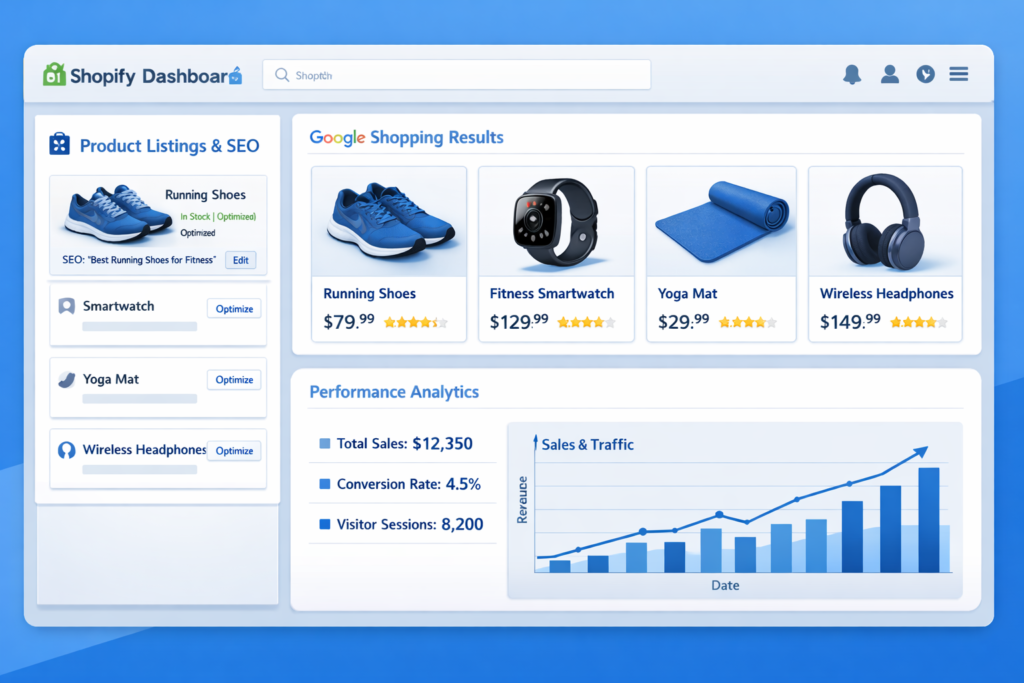
Most Shopify SEO playbooks still treat search and social as separate funnels. They aren’t anymore. The Shopify stores winning organic traffic in 2026 are the ones whose social presence is doing half the discovery work, surfacing product names into branded search, feeding AI shopping assistants, and routing link-in-bio clicks straight into optimized product pages.
Why It Matters
Shopify powers a sizable slice of independent e-commerce globally, and product discovery has moved upstream of Google. Shopify’s commerce research shows short-form video and social-first product discovery now drive a meaningful share of session starts for SMB stores. Translation: if your store ranks for branded search but nobody’s searching the brand, ranking solves nothing. Social is the demand layer that makes SEO pay off.
That’s especially true for the catalogs that struggle against national retailers, boutiques, specialty food, artisan goods, niche outdoor gear. They can’t outspend Amazon on paid ads or out-link big-box sites on backlinks. They can out-post them.
What’s New / How It Works
The 2026 playbook stops treating Shopify SEO and social as separate jobs. They share assets, content cycles, and analytics. Here’s the integrated stack social media managers should be running:
Product pages built for share-ability. A unique, detailed product description that explains who the item is for and why it’s different doesn’t just rank, it gives your content writer something to clip. Manufacturer copy pasted to 50 stores ranks nowhere and can’t be repurposed. Specific copy can be sliced into reels, carousels, and TikTok hooks all month.
Collection pages as content hubs. Most Shopify stores invest zero effort in collection page content, a 200-400-word category-level intro is the difference between ranking and disappearing. That same intro doubles as the script for a category explainer post on Instagram or TikTok.
Local positioning that travels across channels. A line like “Our handmade leather goods are crafted in small batches by artisans based right here in our hometown” earns geographic relevance on the product page and works as a caption hook on every social post. Same words, two algorithms.
Product schema markup. Google’s product structured data spec still drives shopping rich results, price, availability, ratings rendered directly in search and increasingly cited by AI shopping assistants. Shopify generates baseline schema; apps or theme edits complete it.
The Numbers
What actually moves traffic for an SMB Shopify store in 2026:
- Product page entry rate. Individual product pages remain the highest-traffic landing surface for most Shopify stores, meaning a single optimized product page outearns a polished homepage every time.
- CTR from rich results. Completed product schema (with reviews and availability) measurably increases click-through rate from Google shopping results.
- Branded search lift from social. Stores running consistent multi-platform social content see branded-search volume climb within 60-90 days, which Google reads as a positive ranking signal.
- Link-in-bio conversion. Direct social-to-product-page routing converts substantially higher than dumping every click on the homepage.
“Artisan Gift Shop in [Your City], [Store Name]” is searchable. “[Store Name]” is not.
Your Shopify store’s SEO is only as strong as the social presence driving people to search for it.
What Comes Next
Three shifts are about to compound. First, AI shopping search, ChatGPT, Gemini, and Perplexity are surfacing product recommendations more often, and they pull from a mix of Schema.org Product markup, reviews, and brand mentions across the social web. Second, native social commerce: TikTok Shop, Instagram Shopping, and Pinterest’s buyable pins are turning the “visit our store” step into an in-app purchase. Third, the merging of local SEO and social signals, Google Business Profile reviews, geo-tagged posts, and recent activity are increasingly weighted together for “near me” queries.
None of that work happens once. It happens weekly, across six to ten platforms, for every brand you manage. That’s the workflow problem, and it’s why the social media manager’s toolchain is now part of the SEO stack, not adjacent to it.
What This Means for You
If you’re running social for a Shopify store, yours or a client’s, the 2026 job isn’t to post more. It’s to wire your social calendar to your store’s SEO surfaces so the two feed each other.
Three concrete moves:
- Schedule product and collection content cross-platform from one calendar. The same hook adapted for TikTok, Reels, Pinterest, and Shorts, published consistently, is what builds the branded-search demand SEO needs. Feedsta is built to keep that cadence across multi-brand portfolios without manual reposting.
- Route every social CTA to the right product or collection URL, not a generic homepage. A tracked link-in-bio plus campaign-specific short links tell you which platform actually converts. The fsta.li shortener inside the Feedsta app gives you per-link analytics so the next post can lean on what worked.
- Treat reviews and user-generated content as ranking content, not vanity metrics. Reviews show up in schema; UGC shows up in your feed. Both signal trust to AI shopping assistants and to Google’s shopping panel.
For more on the social-to-search loop, our 2026 social media conversion rate optimization guide covers the link-in-bio and landing page stack in depth, and the social signals Google reads for local SEO walks through which posts actually move local rankings, both directly relevant if your Shopify store has a physical address you want to rank for.
The Bigger Picture
The Shopify stores that win search in 2026 aren’t the ones with the best meta descriptions. They’re the ones whose social presence is consistent enough that buyers already know the brand name by the time they type it. Search captures demand. Social creates it. If you’re only doing one, you’re leaving the other on the table, and the competitors who figured that out two algorithm updates ago aren’t waiting around for you to catch up.