Conversion Rate Optimization: A Practical Strategy for Small Businesses
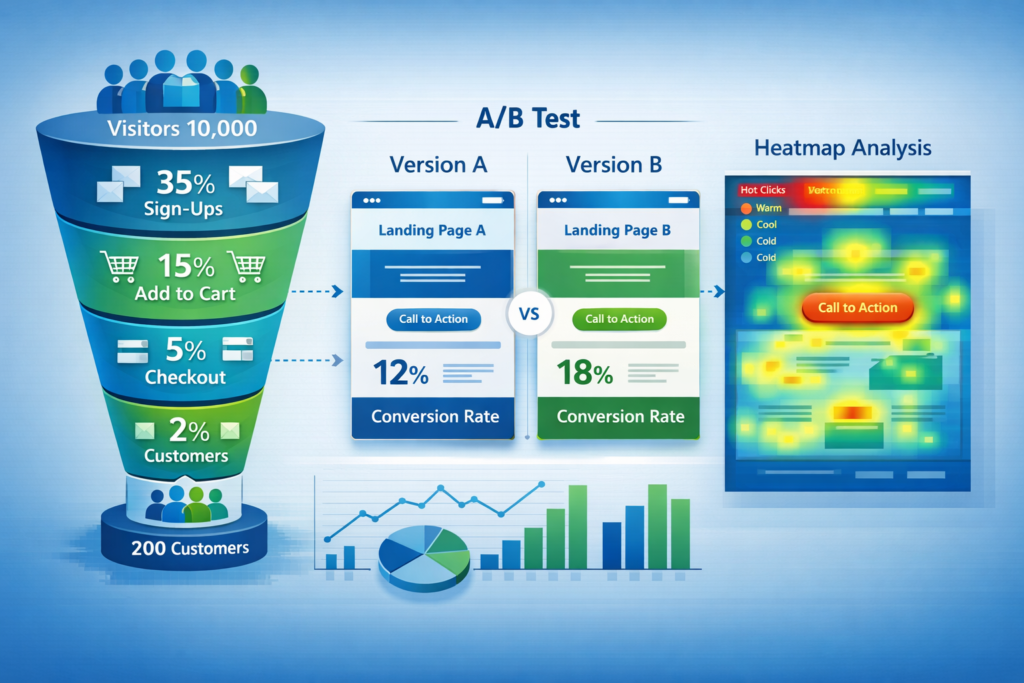
Conversion rate optimization is the discipline of turning the clicks social campaigns already produce into leads, calls, and customers. A business spending $3,000 a month on paid traffic at a 3% conversion rate gets 60 leads from 2,000 visitors, and lifting that rate to 6% doubles the output to 120 leads on the same budget. For small businesses, CRO is unglamorous, data-heavy, and compounding, and most teams have never run a single A/B test on their landing pages.
Why CRO Matters for Small Businesses
Social campaigns ship traffic. A TikTok bio tap, an Instagram Story sticker, a LinkedIn carousel CTA, a Pinterest pin to a landing page, the job ends with a click. But the campaign’s value is decided after the click. That’s where most teams lose the math.
Better creative earns you more clicks. Better conversion paths earn you more customers. That gap is where CRO lives, and it is usually wider than teams will say. Most social reports list impressions, reach, and engagement metrics.
The catch is mobile. 61% of local searches happen on mobile, and mobile conversion rates run 40 to 51% lower than desktop on average. Social traffic is almost entirely mobile, and DataReportal pegs mobile share of social usage above 99% on most platforms. If your landing pages were built for desktop, you’re hemorrhaging conversions on the exact channel that drives most of your clicks.
The campaign’s value isn’t decided at the click; it’s decided at the conversion.
How Conversion Rate Optimization Works
CRO isn’t a single fix. It’s a loop: measure, identify friction, test a change, measure again. Four data sources tell you where the leaks are.
Conversion tracking. Set up event tracking in Google Analytics 4 for the actions that matter: phone calls (via CallRail or similar), form submissions, demo bookings, link-in-bio taps, app installs. If you can’t see which post or landing page produced the conversion, you can’t prioritize what to fix.
Heatmaps and session recordings. Tools like Microsoft Clarity (free) and Hotjar show exactly where visitors click, how far they scroll, and where they drop off. This data reveals problems no dashboard will surface, including visitors clicking an image thinking it’s a button, mobile users abandoning before they reach the CTA, and phone numbers that aren’t tappable.
Exit-rate analysis. Sort your landing pages by exit rate. Pages where a high percentage of visitors leave without converting are your biggest opportunity pages. The traffic is showing up, and something on the page is breaking the journey.
Ad-to-page match. If your TikTok caption promises “free trial” and the landing page leads with “Welcome to Acme Inc.,” visitors feel misled and bounce. The offer in the post and the offer on the page should match word-for-word. This is the most common cause of high bounce rates on paid traffic.
The Conversion Benchmarks Worth Tracking
The benchmark stats worth holding in your head:
- 20%: average form completion rate. Longer forms (5+ fields) perform measurably worse.
- 40-51%: how much lower mobile conversion rates run compared to desktop.
- 61%: share of local searches that happen on mobile.
- 80%: share of visitors who read only the headline before deciding whether to stay.
- 3 seconds: the load-time ceiling on cellular; slower pages bleed conversions linearly.
- 33%: the compounded lift from three sequential 10% improvements.
“CRO without data is guessing with a better name.”
What to Test First on Social Landing Pages
The independent A/B testing tool landscape has consolidated. Google Optimize was discontinued in 2023. The current options are Optimizely, VWO, and AB Tasty for enterprise testing; for WordPress-based landing pages, Nelio A/B Testing integrates cleanly without engineering work.
The tests with the most impact aren’t exotic.
- Headline, 80% of visitors read only this. Test against your current control for 2-4 weeks.
- CTA button copy, “Get a Free Quote” vs. “Request Your Free Estimate” can swing conversion 10-15%.
- Form length, cut fields one at a time and measure what each removal does to completion rate.
- Testimonial placement, above the fold vs. below, near the CTA vs. in the footer.
- Page speed, image compression and lazy loading produce measurable mobile lifts.
The compounding math matters more than any single test. Three modest 10% improvements stack to a 33% overall lift, which on a paid social budget of $5,000 a month means meaningfully more leads at the same spend.
What CRO Means for Your Marketing
If you run marketing for a brand, conversion rate optimization differs from other contexts in three ways:
Treat your link-in-bio like a landing page. Most teams treat it as a link list. It’s the highest-converting real estate in your entire social footprint, since every TikTok and Instagram tap routes through it. Run the same headline test, CTA test, and mobile audit you’d run on a paid landing page, and use a link-in-bio tool that reports per-destination taps so you can see where attention is leaking.
Match your post creative to your landing-page headline. The Instagram caption, the TikTok hook, and the landing-page hero should use the same words. This is covered in depth in Social Media Landing Pages: The Conversion Math You’re Missing: if you’re running paid social to a page that doesn’t restate the offer, fix that before testing anything else.
Audit conversion path on an actual phone, not a desktop emulator. Open your link-in-bio, your latest landing page, and your contact form on a real iPhone. Can you read the headline without zooming? Is the phone number tappable? Is the form usable with one thumb? Most teams have never done this audit. The ones who have find five fixable problems on every page.
And measure all of it. Engagement metrics tell you whether posts perform; conversion metrics tell you whether the business performs. Feedsta, an AI-powered social media platform, is designed to help tie posts to clicks to conversions so you stop optimizing in the dark. For the broader question of whether AI-generated posts actually drive the same conversion behavior as human-written ones, see AI Content vs. Human Content: Which One Actually Ranks in 2026?
The Bigger Picture
Social media has always rewarded reach. In 2026, the channels that win, and the teams that keep their budgets, are the ones who translate reach into action. CRO is the discipline that bridges the gap. It’s data-heavy and it compounds, and most teams have never run a single A/B test on their link-in-bio or landing pages. That’s not a problem. That’s an opportunity most teams have not yet noticed, and the math suggests the team that runs the first three tests this quarter may out-convert the team that ships ten more posts.
FAQ
What is conversion rate optimization for small businesses?
Conversion rate optimization (CRO) is the discipline of finding why visitors aren’t taking action and systematically removing the friction. It applies the same testing loop, measure, identify friction, test, measure again, to the destinations social traffic lands on: link-in-bio pages, campaign landing pages, mobile checkouts, and form flows.
Why is mobile so important for social media CRO?
61% of local searches happen on mobile, and social traffic is almost entirely mobile (mobile share of social usage is above 99% on most platforms, per DataReportal). Mobile conversion rates run 40 to 51% lower than desktop on average, which is why landing pages built only for desktop bleed conversions on the channel that drives most clicks.
What should I A/B test first on a landing page?
Test the headline. 80% of visitors read only the headline before deciding whether to stay, so it’s the single most influential element. Run a 2-4 week test against your current control, then move to CTA button copy, form length, and testimonial placement.