SEO for Law Firms: A 2026 Playbook
The legal market is crowded in most U.S. metros, and the law firms that get found online aren’t always the best practitioners, they’re the ones whose social media managers do the unglamorous infrastructure work. If you handle social for a local firm in 2026, the local SEO playbook that wins search translates almost directly into a social strategy that compounds. Same fundamentals: profile completeness, review velocity, practice-area depth, local specificity. Different surface.
Why It Matters
Legal marketing is a knife fight. According to the New York State Bar Association, more than 180,000 attorneys are licensed in New York alone, one of the densest concentrations in the country. Per Pew Research Center tracking of platform usage, the majority of U.S. adults use social media daily, and most potential clients now shortlist firms with two tabs open: Google and Instagram. If your client’s bio is half-finished and their last post is from 2024, you’ve lost the consideration race before the consult is even booked.
What’s New / How It Works
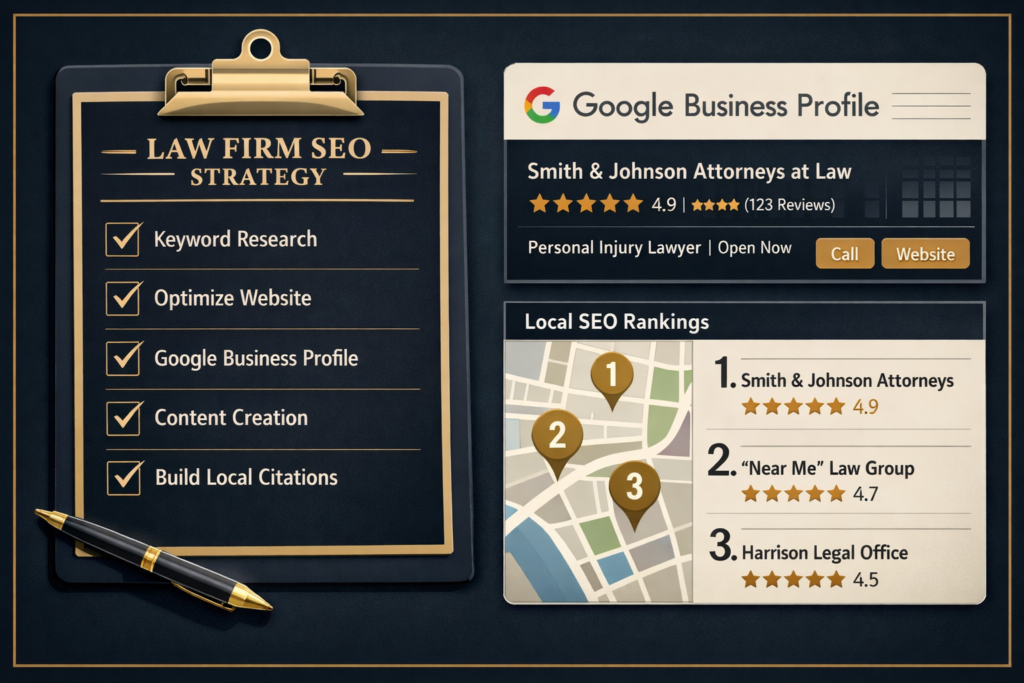
The local SEO playbook for law firms has five moves. Every one of them has a social media analog you can ship this week.
Profile parity is the new Google Business Profile. The same way a firm’s GBP primary category must be practice-area specific (“Personal Injury Attorney,” not “Lawyer”), each social profile bio needs the same practice-area precision. Use the full character budget. Name the counties served. List the practice areas. Match it across Instagram, LinkedIn, Facebook, TikTok, and YouTube, pixel-for-pixel parity matters for AI search systems that crawl multiple platforms to verify identity.
Review-driven content beats review-asking emails. Reviews remain the most controllable local ranking signal, but social media managers can amplify that signal. After a closed matter (with client permission), turn the testimonial into a graphic, a 30-second Reel, or a carousel. Pin it. Schedule it into the monthly rotation. Reviews live on Google; reusable proof lives on social.
Practice-area content pillars replace practice-area pages. A law firm site builds a dedicated landing page per practice area. Your social calendar should do the same, with a content pillar per area. If you handle personal injury, divorce, criminal defense, and estate planning, you need four recurring content tracks, each with the named handling attorney, anonymized case insights, and FAQ-format posts answering questions like “How long does a personal injury case take?” and “How much does a divorce cost in New York?”
Local content compounds on social the same way it does in search. Posts referencing New York law specifically, local court procedures, or regional statistics earn engagement that national legal pages never will. The county-to-county family court distinction is a carousel. The New York equitable distribution rule is a Short. Geographic specificity earns geographic authority.
Technical baseline still applies. NAP (name, address, phone) consistency across every social profile and link-in-bio destination. Schema-equivalent metadata in your bio links. Fast-loading link-in-bio pages. The mobile-speed threshold that breaks rankings breaks social conversion too.
The Numbers
The competitive thresholds that define local search map cleanly onto a social cadence:
- 50+ Google reviews in the past 12 months for competitive practice areas, translate this to 50+ social-proof assets per year (testimonial Reels, carousels, pinned posts).
- 30+ recent reviews establishes competitive standing in a competitive market.
- 2-4 substantive articles per month on the firm site, match it with one pillar post per article on every social platform.
- 5-8 FAQ questions per practice area on the website’s practice page, repurpose each into a standalone post, story highlight, or Short.
- 750-character business description on Google, apply the same fully-used bio to every social profile.
- Mobile PageSpeed score under 70 = active problem, your link-in-bio destination has the same threshold.
“What Happens After You File a Personal Injury Claim in New York?”, the kind of process-explainer query that earns ranking gold also makes the highest-converting carousel template a law firm social account can publish.
What Comes Next
The next wave isn’t another Google algorithm update, it’s AI search. ChatGPT, Gemini, Perplexity, and Claude are increasingly used by potential clients to triage legal questions before they ever open Google. Those systems pull from social signals as well as search results. That means your firm’s LinkedIn presence, the named attorney bios on each post, and even the comment-section engagement now influence whether an AI surfaces your firm for a “best personal injury attorney near me” query.
The other shift: short-form video is now where consideration happens. TikTok’s legal corner, LawTok, has crossed billions of views, and a single 45-second Short answering “Do I need a lawyer for a fender bender in New York?” can drive more qualified consults than a month of LinkedIn posts. Build a video pillar, name the attorney on camera, and caption everything for silent scrollers.
Social media for law firms isn’t about going viral, it’s about being consistently findable when a stressed potential client finally starts searching.
What This Means for You
If you’re managing social for a law firm, treat the SEO action plan as your content brief. Build four to six practice-area content pillars inside a single Feedsta scheduling calendar, with templated post types for testimonials, FAQ-answer carousels, attorney-led video explainers, and local-context posts. Use a single shortened link from your link-in-bio hub so analytics roll up across platforms, branded fsta.li URLs survive platform redirects and don’t burn click-tracking the way some social platforms quietly do.
Two neighbor topics worth bookmarking on the way out: the 2026 guide to 301 vs 302 redirects explains why your link-in-bio choices matter for analytics integrity, and the WordPress SEO plugin breakdown covers what the firm’s web team should be running in parallel to your social work.
For cadence, model the website article schedule: two to four substantive content pieces per month per practice area, each repurposed into 8-12 social posts. That gives you a 32-48-post monthly baseline before stories, replies, and reactive content. Schedule the entire month at once, leave room for newsroom-style legal updates as cases break, and review analytics weekly.
The Bigger Picture
The firms winning local search in 2026 aren’t the ones with the slickest websites, they’re the ones whose social, search, and review presences all tell the same story. As a social media manager, you’re not running a separate channel. You’re the consumer-facing layer of the firm’s entire findability stack. Treat every post, profile field, and link destination as a brick in that stack, and the firms you manage will start to compound, slowly, then suddenly.